
The people who wrote crypto off as a casino in 2022 are going to feel very silly very soon — if they don't already.
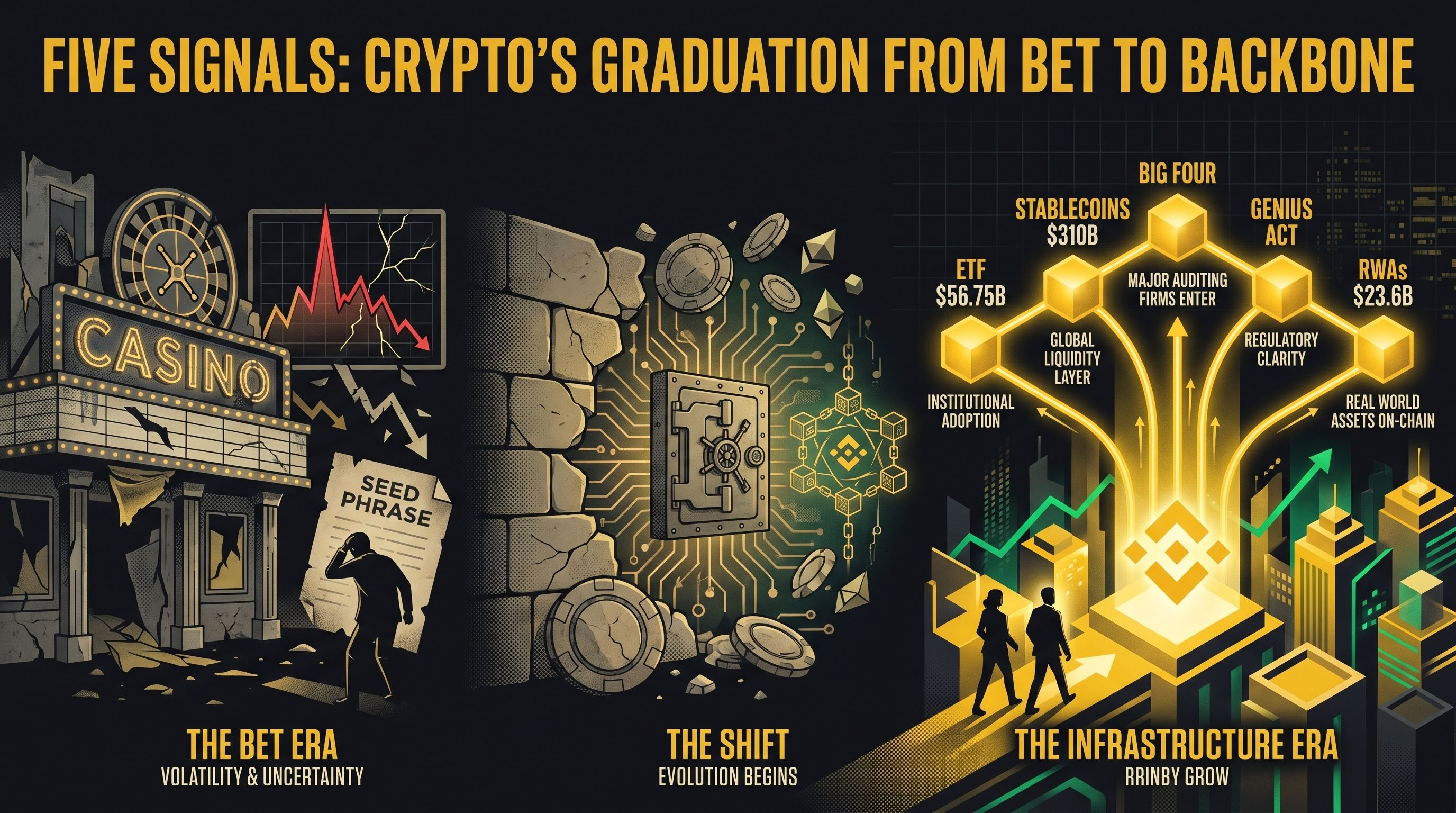
Because something has quietly shifted. Not in price, not in hype, but in the deep structure of how money, capital, and data move. The speculation hasn't gone away, but it's no longer the main story. The main story is that crypto has graduated from a bet to a backbone — and five very concrete signals prove it.
1. Spot Bitcoin ETFs Are Now Just… Finance
Let's start with the most visible shift.
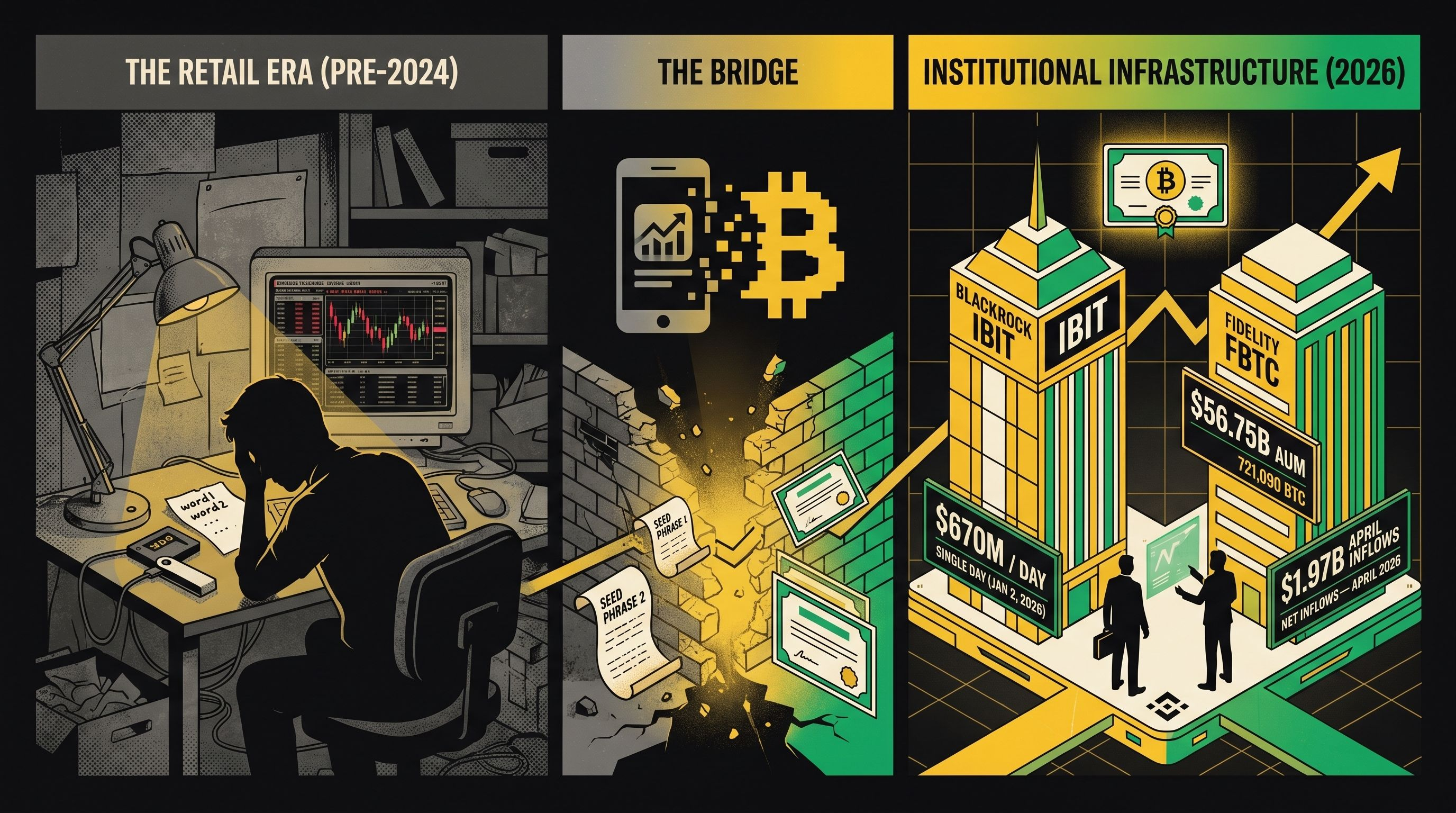
Not long ago, getting Bitcoin exposure meant navigating a foreign exchange, generating seed phrases, and explaining to your accountant why you held an asset that technically lived nowhere. Today, you can buy BTC through the same brokerage app where you hold your index funds — and the institutions doing exactly that are not messing around.
US spot Bitcoin ETFs drew nearly 670 million dollars in a single trading day on 2 January 2026 alone. Through April, the month closed as the strongest of the year, attracting 1.97 billion dollars in net new capital. By early April, total ETF holdings had climbed to 721,090 BTC — worth roughly 56.75 billion dollars at the time — accumulated through steady, methodical buying, not a hype spike. And the buyers aren't anonymous retail punters. BlackRock's IBIT has consistently led inflows, with Fidelity's FBTC and Ark's ARKB close behind. Goldman Sachs has filed for its own Bitcoin ETF product; Morgan Stanley has launched one.
Yes, there are volatile weeks — like mid-May 2026, when a six-week inflow streak of 3.4 billion dollars reversed into roughly 1 billion dollars in net outflows. But that's exactly how mature, liquid markets behave. Institutions buy, take profits, re-enter. The infrastructure underneath remains intact.
ETFs are the regulated wrapper, but they depend on deep, reliable spot-market liquidity underneath. Binance plays directly into that stack. Its VIP & Institutional platform offers low-latency APIs, portfolio margining, and dedicated OTC desks that market makers, hedge funds, and arbitrage desks use to price and hedge ETF exposure around the clock. The exchange is also actively narrating the shift: Binance Square's ongoing market updates have tracked the ETF inflow story in granular detail — from single-day records to cumulative AUM milestones — helping institutional readers build conviction on a market that's becoming structurally healthier by the month.
The takeaway: Bitcoin is no longer a fringe instrument. It's a line item next to your S&P ETF, and the infrastructure that prices it is now running at institutional grade.
2. Stablecoins at 310 Billion Dollars: The World's Programmable Cash Layer
Here's a number worth sitting with: the global stablecoin market has crossed 310 billion dollars in market cap and is still climbing. That makes it larger than the M2 money supply of many mid-size economies.
More remarkable is how it got there. The market hit a new all-time high of roughly 310.4 billion dollars in January 2026, then pushed beyond 311 billion dollars days later — all while broader crypto prices remained choppy. Capital wasn't flowing into stablecoins to ride a rally. It was flowing in because stablecoins had become useful — for cross-border B2B payments, on-chain treasury management, DeFi collateral, and as a savings instrument in countries where local currencies struggle.
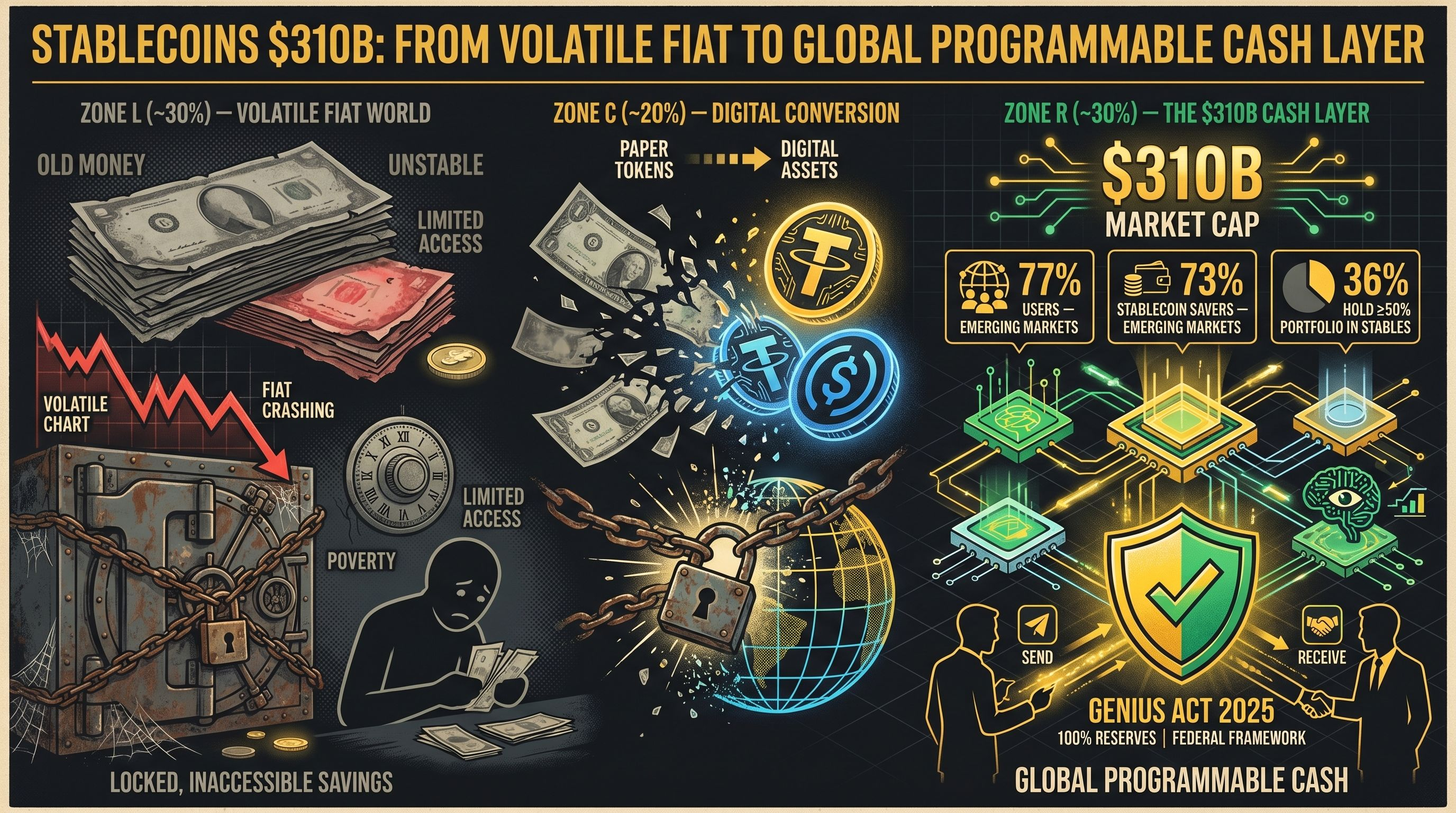
The regulatory picture has caught up, too. The US GENIUS Act, signed in 2025, created the first comprehensive federal stablecoin framework: 100% reserves in cash or short-term Treasuries, strict public disclosures, full Bank Secrecy Act obligations, and technical ability to freeze or burn tokens under lawful orders. That's not a constraint on stablecoins — it's a legitimization. Corporate treasurers and bank compliance teams can now model stablecoin exposure with the same rigor they apply to money-market funds.
Binance Research saw this inflection early. Its deep-dive report, The Stablecoin Business, published in late 2025, laid out how the market had shifted from a trading tool to a "global medium for digital savings and payments." Three forward-looking themes from that report stand out: multi-stablecoin liquidity solutions, the rise of Open Issuance platforms enabling white-label stablecoin creation, and stablecoins as native financial rails for AI agents.
That last theme is more relevant than it sounds. Binance Research's 2026 outlook specifically highlights autonomous AI agents using stablecoins and decentralized storage as their native financial layer — not as a future possibility, but as a near-term convergence happening now.
And on the user side, the data is striking: 77% of Binance's users are now based in emerging markets, up from 49% in 2020. Around 36% of those users with meaningful balances hold at least half their portfolio in stablecoins — a pattern Binance Research describes as savings behavior, not trading. Of all stablecoin savers on Binance globally, 73% are from emerging markets. That's not speculation. That's people using dollar-pegged stablecoins the way their grandparents used a savings account.
Stablecoins in 2026 aren't a crypto side product. They're a global cash layer — 310 billion dollars deep, growing, and now legally governed.
3. Deloitte Buys a Mempool Team — and That Changes Everything
In May 2026, Deloitte — one of the global Big Four accounting and consulting firms — acquired the team behind Blocknative, a crypto infrastructure company known for real-time mempool monitoring, gas-fee prediction, and transaction management.
If you don't live and breathe blockchain, "mempool monitoring" might sound like plumbing. It is plumbing. And that's precisely the point.
Blocknative's services are being wound down by 19 June 2026 as the team moves inside Deloitte's blockchain practice, focused on enterprise Web3 infrastructure and AI-driven digital-asset solutions. This isn't a marketing partnership or a pilot program. It's an acqui-hire — Deloitte is absorbing engineers who spent years in the guts of Ethereum's transaction ordering and MEV dynamics, because it needs that skill set internally to serve clients building on public blockchains.

This deal reflects a broader pattern: venture-backed crypto middleware companies are either shutting down or getting absorbed as traditional enterprises shift from "partnering with crypto" to "owning the crypto stack." It's the same thing that happened with cloud computing. For years, banks dabbled at the edges. Then they realized they needed engineers who could build on AWS natively — not just vendors they could call.
Binance has been building its own version of this strategy from the platform side. Its Crypto-as-a-Service (CaaS) offering is a white-label infrastructure stack that lets licensed banks, fintechs, and brokerages embed trading, custody, fiat on/off ramps, and compliance tooling into their own applications — with Binance powering the backend. Clients can match trades internally between their own users while tapping Binance's global order book for liquidity when needed.
For institutions that don't want to go the Deloitte route — building in-house capability through acquisitions — CaaS is the alternative: rent the rails from someone already running them at scale for hundreds of millions of users. That's not a retail product. It's an enterprise infrastructure decision.
When Big Four firms and global platforms are both racing to own and distribute crypto infrastructure, the "infrastructure era" label isn't hype. It's a description of competitive strategy at the highest level.
4. US Policy Has Finally Picked Up a Pen
For most of the last decade, US crypto regulation could be summarized in five words: wait and see who sues. Enforcement actions substituted for policy. Interpretive letters substituted for statutes. And serious institutions — banks, broker-dealers, asset managers — stayed at the edges because the legal risk was too unquantifiable.
That is visibly changing.
The GENIUS Act, signed in 2025, created the first US federal framework specifically designed for payment stablecoins. Not adapted from securities law, not borrowed from banking regulation — designed. It sets 100% reserve requirements, mandates monthly disclosures, brings issuers under the Bank Secrecy Act, and explicitly governs what happens if a stablecoin issuer fails — with stablecoin holders given priority in insolvency proceedings.

Congressional hearings in 2026 are actively debating legislation around tokenized capital markets, with executives arguing that existing securities and AML rules should be explicitly mapped to tokenized assets rather than applied through case-by-case enforcement. Legal trackers show the SEC, CFTC, Treasury, and OCC moving — slowly, but noticeably — toward coordinated frameworks rather than parallel, sometimes conflicting, enforcement postures.
Internationally, the picture is similarly constructive: the EU's DLT Pilot Regime and MiCA framework, the UK FCA's tokenized-fund blueprint, and Hong Kong's Project Ensemble sandbox are all building permanent regulatory infrastructure around tokenized assets and on-chain settlement.
Binance's Co-CEO Richard Teng has repeatedly emphasized that the next phase of industry expansion runs through regulatory legitimacy, not around it. Binance is one of the most licensed crypto exchanges globally, and its institutional product suite — compliance infrastructure, KYC/AML tooling, custody options via Ceffu, detailed audit-grade reporting — is built to operate comfortably inside these evolving frameworks, not despite them.
For a corporate risk team, a bank compliance officer, or a fund administrator, regulatory clarity isn't a nice-to-have — it's the prerequisite. As that clarity arrives, so does the capex.
5. Tokenized Real-World Assets: The Experiment Is Over. This Is Production.
Tokenized real-world assets (RWAs) have been "the next big thing" for so long that some people started treating the phrase as filler. That era ended sometime in 2025.
By early 2026, Binance Square reported that tokenized RWAs had grown 66% year-to-date in 2026 alone, rising from roughly 14 billion dollars to 23.6 billion dollars in total on-chain market value. Tokenized funds led the sector at 10.5 billion dollars, with Treasury bills and bonds transitioning onto blockchain rails. Tokenized commodities — primarily gold-backed assets — reached 6.5 billion dollars, while tokenized equities climbed to nearly 4 billion dollars. Tokenized US Treasuries, tracked separately by platforms like RWA.xyz, sit around 8.7 billion dollars, representing roughly 45% of the broader RWA stack.
These aren't pilot deployments. They're live issuances with real institutional buyers:
Franklin Templeton's blockchain-native Benji platform has MAS approval for a retail tokenized fund in Singapore.
BlackRock prioritized tokenized ETFs in its strategic outlook, with its BUIDL money-market token crossing the 1-billion-dollar mark.
HSBC's Orion platform is being used for on-chain Treasury certificates in Luxembourg. The ECB is running shared-ledger experiments for DLT-based securities settlement.
Hong Kong's Project Ensemble is enabling tokenized deposit and money-market fund transactions between major banks.
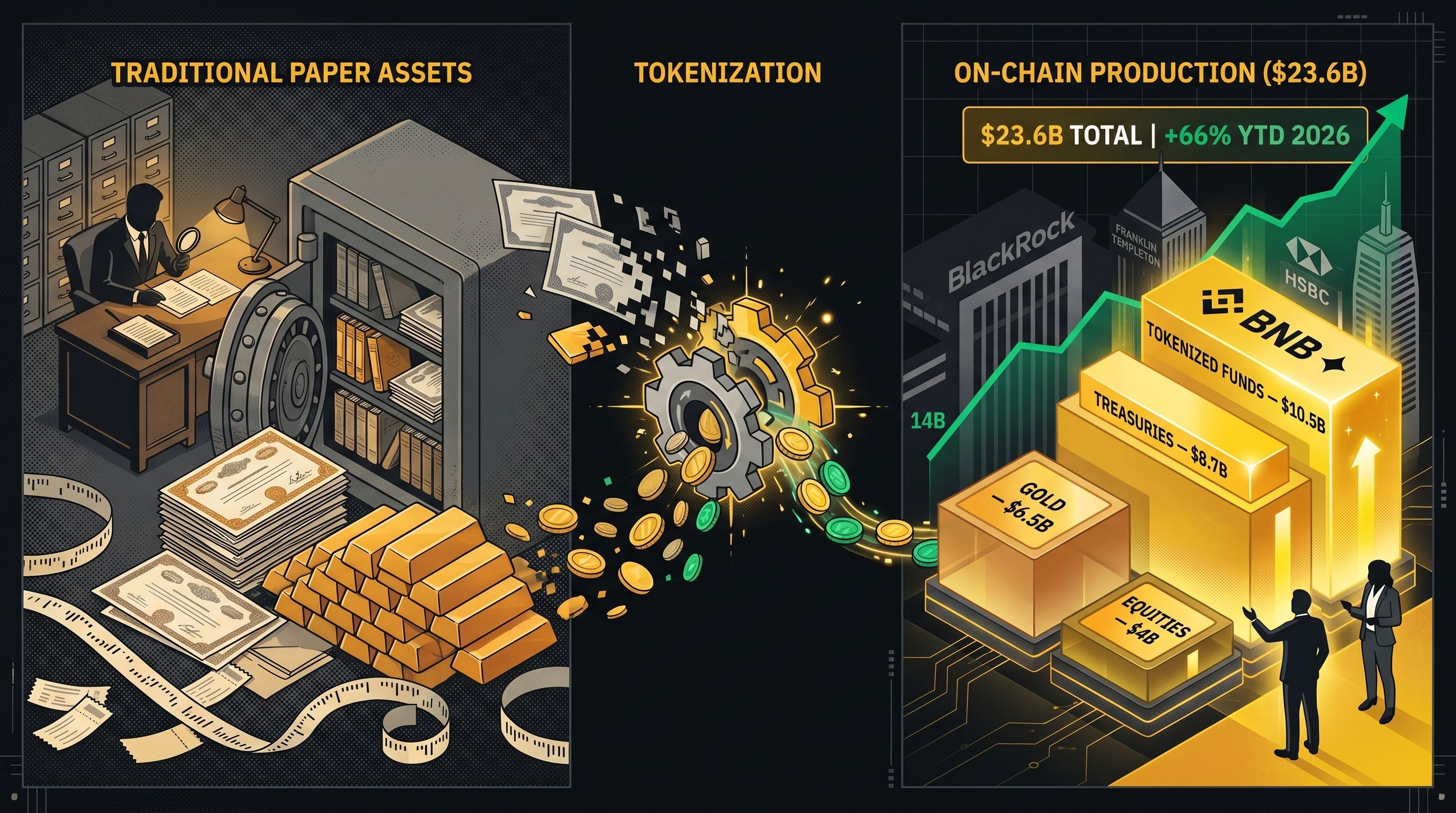
The use cases are also getting more sophisticated. Tokenized Treasuries aren't just a yield product — they're becoming on-chain collateral in repo-like structures and as settlement assets in prime brokerage. That's how you know something has moved from "interesting experiment" to embedded infrastructure: when risk desks start using it as collateral.
Binance's research arm published a report, Tokenization's Trillion-Dollar Runway, outlining the path from billions to trillions — and what infrastructure gaps need to close to get there. On the platform side, Binance already supports tokenized RWAs as off-exchange collateral inside its institutional settlement stack, allowing funds to hold tokenized assets while still accessing Binance's deep trading liquidity. It's a telling detail: when tokenized Treasuries are usable as collateral at the world's largest exchange, they've stopped being exotic and started being functional.
The Bigger Picture: Infrastructure, Not a Bet
Step back and look at all five signals together:
Bitcoin is accessible via ETF from any brokerage, held by institutions managing trillions.
Stablecoins are a 310-billion-dollar cash layer with federal reserve requirements and a 73%-emerging-market savings base.
Big Four firms are acqui-hiring mempool engineers to build blockchain capability in-house.
The US government is writing actual statutes, not just enforcement press releases.
Tokenized Treasuries are being used as institutional collateral in live, production settlement stacks.
None of this looks like a niche bet. It looks like infrastructure — the kind of thing other people build on, depend on, and eventually stop noticing because it's just how the system works.
That's the quiet revolution of 2026. Not a new all-time high. Not a new narrative. A shift in the underlying question from "Will crypto survive?" to "What gets built on top of it next?"
Platforms like Binance sit at the center of that question — bridging the world's unbanked savers in emerging markets and Wall Street's largest asset managers in the same system, covering the stablecoin layer, the institutional infrastructure layer, the research layer, and increasingly the tokenized-asset layer, all under one roof.
The era of betting on crypto is not over. But it's being joined — quietly, structurally, irreversibly — by the era of building on it.