
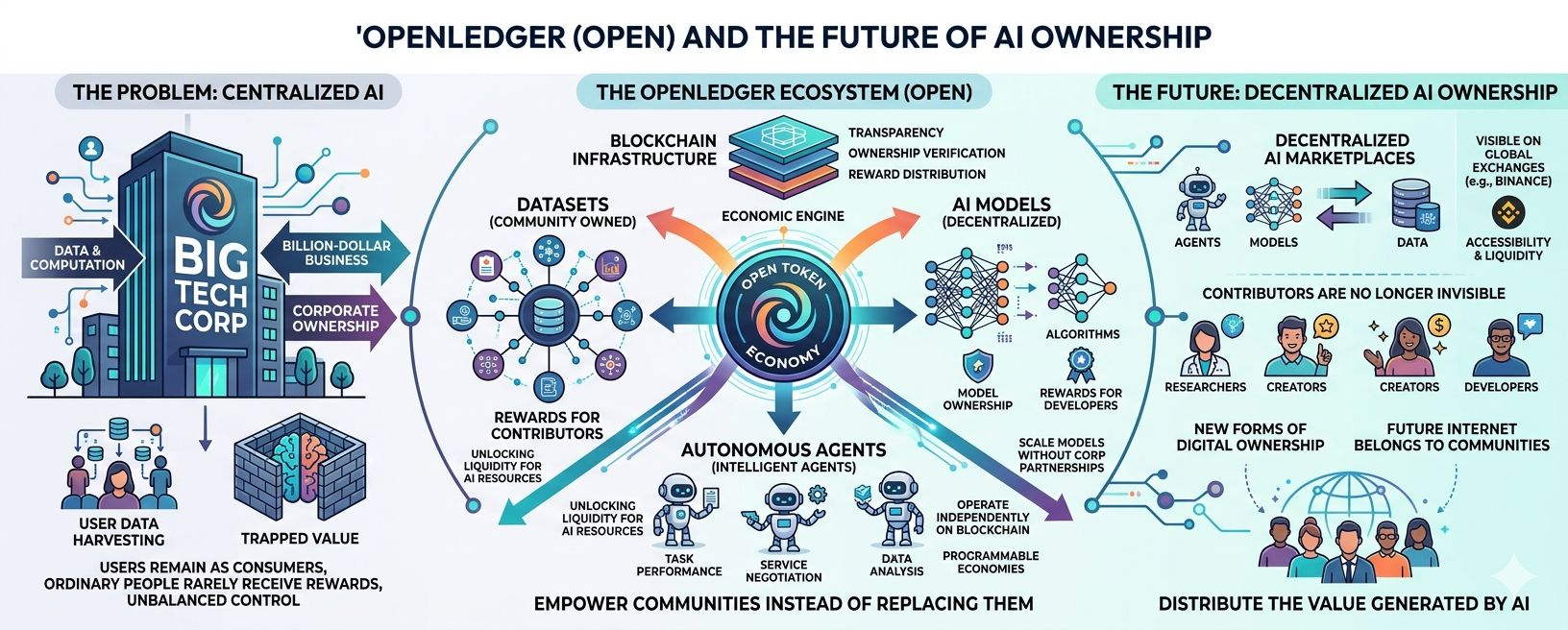
Artificial intelligence is rapidly changing the digital world, but one major question is becoming impossible to ignore. Who truly owns the value created by AI systems? For years, large technology companies collected user data, trained massive AI models, and built billion-dollar businesses while ordinary users remained only consumers in the system. OpenLedger (OPEN) enters this conversation with a very different vision, combining blockchain and artificial intelligence to create an ecosystem where data, AI models, and autonomous agents can become valuable assets owned and monetized by communities rather than controlled entirely by centralized corporations.
What makes OpenLedger interesting to me is that it is not simply trying to become another blockchain project competing for attention in the crypto market. The project focuses on something much deeper, which is the economic layer behind artificial intelligence itself. In simple terms, OpenLedger wants to unlock liquidity for AI resources, allowing datasets, machine learning models, and intelligent agents to move inside decentralized markets where contributors can actually benefit from the value they help create.
The word liquidity is extremely important here because most AI-related assets today remain trapped inside closed systems. A researcher may build a powerful AI model, but scaling it financially often requires partnerships with major corporations. Valuable datasets exist across the internet, yet ordinary people rarely receive rewards for contributing information that helps train intelligent systems. OpenLedger attempts to change that dynamic by building blockchain infrastructure where these assets can become part of an open economy.
The OPEN token functions as the economic engine of the ecosystem. Contributors who provide useful data or computational resources can participate in the network economy while developers building AI applications interact through decentralized incentives. Blockchain technology adds transparency, ownership verification, and reward distribution, which creates a more open framework compared to traditional AI systems controlled by centralized platforms.
What I find especially fascinating is the project’s focus on autonomous AI agents. We’re seeing artificial intelligence evolve far beyond simple chatbots because future AI systems may operate independently, performing tasks, negotiating services, analyzing information, and interacting with digital economies without constant human control. Blockchain infrastructure becomes essential in such a future because autonomous systems need transparent and programmable economic frameworks to operate securely.
If It becomes successful on a large scale, OpenLedger could help create decentralized AI marketplaces where intelligent agents and models interact economically across open networks. That possibility sounds futuristic today, but the foundations are already appearing. AI is becoming more powerful every year, and blockchain technology is evolving into infrastructure capable of supporting entirely new forms of digital ownership.
The connection with Binance is also important because visibility on a globally recognized exchange helps projects gain accessibility and liquidity. In the crypto industry, strong technology alone is not enough because adoption depends heavily on active communities, market participation, and ecosystem growth.
From my perspective, OpenLedger represents more than technology because it reflects a larger shift in how people think about ownership in the digital age. For too long, users contributed data and creativity to online systems without receiving meaningful control over the value generated from their participation. Artificial intelligence intensified that imbalance because AI models are trained using enormous amounts of public information, conversations, and human-generated content.
Now a different vision is emerging where contributors are no longer invisible. Blockchain creates the possibility of transparent ownership while AI creates entirely new forms of productivity. When combined correctly, these technologies can create economies where participation itself becomes rewarding. That idea feels powerful because the future internet should not belong only to giant corporations controlling every layer of digital life.
Of course, challenges remain because the AI blockchain sector is still young and highly competitive. Scalability, security, regulation, and real-world adoption will determine which projects survive long term. Many crypto projects launch with ambitious ideas but struggle to achieve practical utility. Still, I believe OpenLedger is exploring one of the most important questions of the coming decade, which is how humanity distributes the value generated by artificial intelligence.
I’m personally drawn to projects like this because They’re not only focused on speculation or hype. They are trying to rethink how digital economies work at a time when AI may soon influence almost every industry on Earth. The future may be shaped by intelligent systems, autonomous software agents, and decentralized economies operating together in ways people can barely imagine today.
Whether OpenLedger ultimately becomes a dominant force or simply contributes ideas that inspire future systems, the vision itself matters. We’re entering an era where intelligence may become one of the world’s most valuable assets, and the fight for ownership of that intelligence is only beginning. I believe people want a future where technology empowers communities instead of replacing them completely, and that is why projects like OpenLedger continue attracting attention. In a world increasingly controlled by algorithms, the most meaningful innovation may be the one that reminds ordinary people they still have a place in the future they helped create.
