
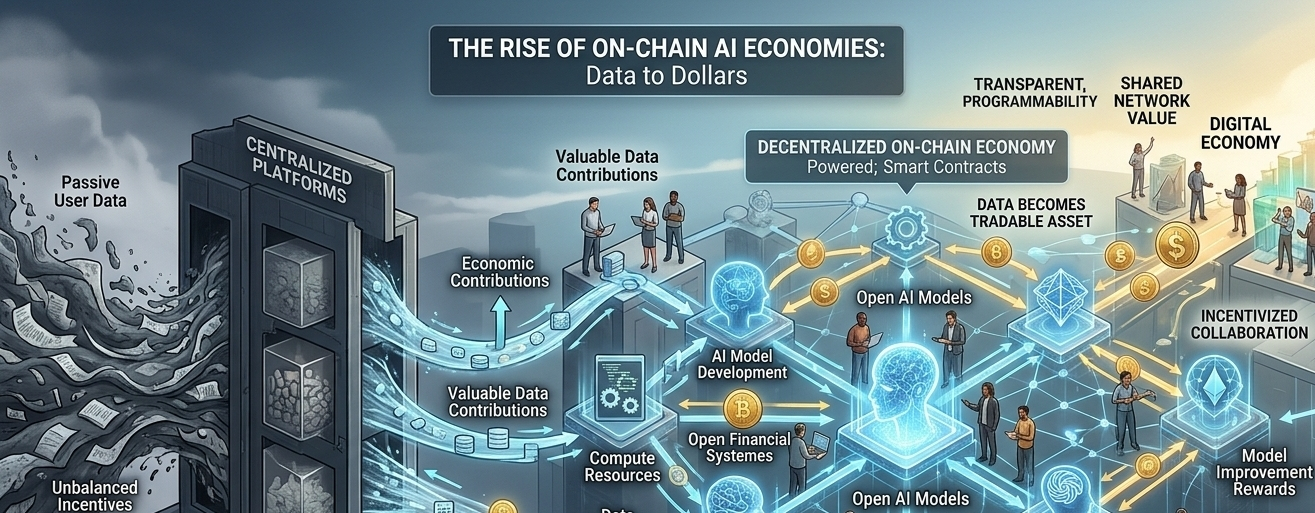
There’s a shift unfolding beneath the surface of both artificial intelligence and blockchain, and it’s not getting the attention it deserves. Most conversations still orbit around AI outputs, faster models, sharper images, more human-like responses. On the other side, crypto discussions often circle price action, speculation, and short-term gains. But something more foundational is taking shape where these two worlds intersect. It’s the emergence of on-chain AI economies, where data is no longer passive fuel but an active, monetizable asset, and where intelligence itself becomes part of an open financial system.
At the core of this transformation is a simple but powerful idea. Data has always been valuable, but until now, its ownership and monetization have been tightly controlled by centralized platforms. Tech giants built massive empires by collecting, refining, and leveraging user data, while the individuals who generated that data remained largely disconnected from its economic value. AI models were trained on oceans of information sourced from the public, often without clear attribution or compensation. The system worked, but it wasn’t balanced.
On-chain AI economies begin to challenge that imbalance by introducing transparency, ownership, and programmability into the equation. Blockchain technology allows data to be tracked, verified, and exchanged in a way that is open and tamper-resistant. When AI systems are layered on top of this infrastructure, something new emerges. Data contributors, model developers, and users can all participate in a shared economic loop where value flows more directly and more fairly.
This changes the role of data entirely. Instead of being an invisible input, it becomes a tradable asset. Individuals and organizations can choose to contribute datasets, label information, or provide compute resources, and in return, they can be compensated through tokens or other on-chain incentives. The process becomes traceable. You can see where the data comes from, how it’s used, and how value is distributed. That level of visibility doesn’t just build trust, it reshapes incentives.
AI models themselves are also evolving within this framework. Rather than being locked behind APIs owned by a single company, models can exist in more open environments where they are collectively trained, improved, and even governed. Contributors who help refine a model, whether through data, feedback, or technical improvements, can earn a share of the value it generates. This turns AI development into something closer to an open market rather than a closed lab.
What makes this particularly powerful is the programmability of blockchain systems. Smart contracts can automate how value is distributed. If a dataset contributes to improving a model’s performance, the contributors to that dataset can receive ongoing rewards whenever the model is used. This introduces the concept of continuous earning tied to real usage, not just one-time payments. It aligns incentives in a way that traditional systems haven’t been able to achieve.
The economic layer is where things start to scale. Tokens act as both incentives and coordination mechanisms. They can reward early contributors, encourage high-quality data, and help govern how systems evolve over time. When designed well, these token economies can bootstrap entire ecosystems around AI, attracting developers, researchers, and users into a shared network. The value generated by AI doesn’t just accumulate at the top, it circulates within the network.
There’s also a deeper implication around accessibility. On-chain AI economies can lower the barrier to entry for both building and using AI systems. Instead of needing massive infrastructure or access to proprietary datasets, individuals can plug into existing networks, contribute in smaller ways, and still capture value. This opens the door for more diverse participation, which in turn can lead to more robust and less biased models.
However, this transition is not without its challenges. Data quality remains a critical issue. Open systems can attract both valuable contributions and low-quality or even malicious inputs. Designing mechanisms that reward quality while filtering out noise is complex. Reputation systems, staking models, and decentralized validation processes are all being explored, but there is no perfect solution yet.
Scalability is another factor. AI workloads are resource-intensive, and running them on or alongside blockchain infrastructure introduces technical constraints. Hybrid models are emerging, where heavy computation happens off-chain while verification and coordination happen on-chain. This balance is still being refined, but it’s a necessary step toward making these systems practical at scale.
There are also questions around regulation and ethics. As data becomes more explicitly monetized, issues of privacy, consent, and ownership become even more important. Just because something can be tokenized doesn’t mean it should be. Clear frameworks will be needed to ensure that these systems empower users without exploiting them in new ways.
Despite these challenges, the direction is clear. We are moving toward a world where intelligence is not just a tool but an economic layer. Data, models, and compute are becoming components of a decentralized marketplace where value is continuously created and distributed. This is not just an upgrade to existing systems, it’s a rethinking of how digital economies function.
In the short term, we’ll likely see more experimentation. New platforms will emerge, some will fail, others will find product-market fit and begin to scale. Early adopters, particularly developers and data contributors, will play a key role in shaping these ecosystems. The focus will be on building infrastructure, refining incentive models, and proving that decentralized approaches can compete with centralized ones in both performance and usability.
Over the longer term, the impact could be far more significant. If on-chain AI economies mature, they could redefine ownership in the digital age. Instead of a few entities controlling the majority of data and intelligence, value could be distributed across networks of contributors. This would not only change how wealth is generated but also how innovation happens. Open collaboration, backed by aligned incentives, has the potential to accelerate progress in ways that closed systems cannot.
What makes this moment particularly interesting is that it’s still early. The foundations are being laid, but the full shape of these economies is not yet defined. That creates both uncertainty and opportunity. Those who understand the shift, who see beyond the surface-level narratives, are in a position to participate in building what comes next.
From data to dollars is no longer just a metaphor. It’s becoming a literal pathway, where information flows into intelligent systems and emerges as economic value that can be tracked, shared, and sustained. The rise of on-chain AI economies signals a move toward a more open, transparent, and participatory digital future. The question is not whether this shift will happen, but how it will be shaped, and who will be part of it.


