
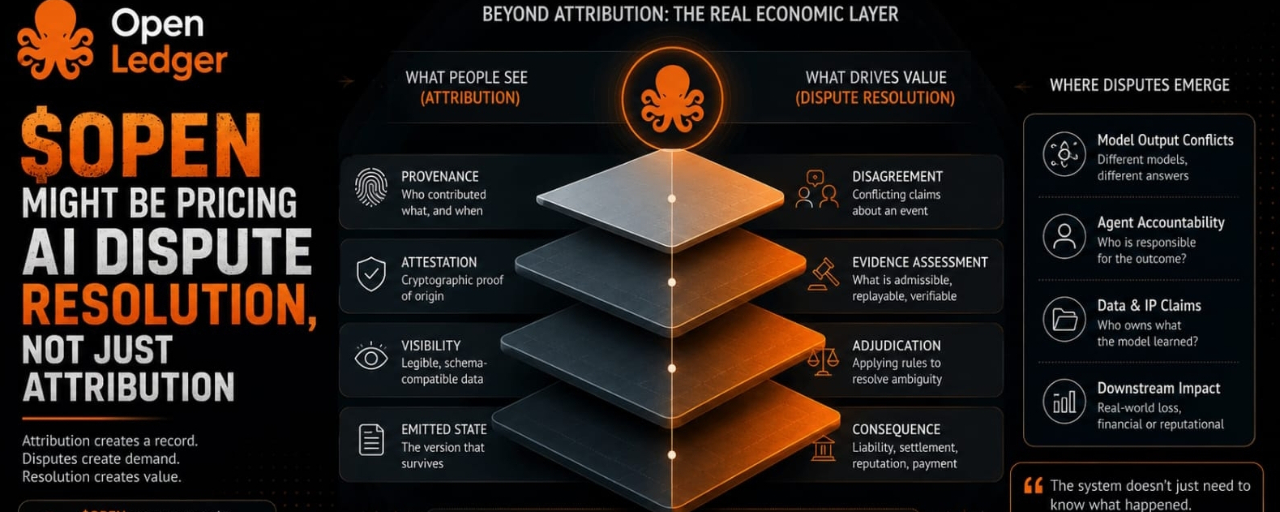
I used to assume attribution was the interesting part.
That sounds obvious now because AI infrastructure conversations keep circling ownership, provenance, contribution trails, who trained what, whose data got absorbed. The usual map. But I keep coming back to something narrower and honestly less comfortable. Maybe attribution is just the evidence layer people can see. Maybe the actual economic layer sits one step later, when two systems disagree about what happened and somebody needs a version of truth stable enough to act on.
That difference looks small when you say it fast.
But attribution answers one question. Dispute resolution answers a much heavier one.
Who wins?
I think crypto people sometimes flatten those into the same thing because a clean attestation feels like closure. Record the source, timestamp the event, emit a state, move on. But downstream systems rarely behave that cleanly. A model makes a recommendation. Another agent consumes it. A payment route triggers. A ranking engine boosts one output and suppresses another. A creator scoring system decides one interpretation looked credible enough to surface. Later, something breaks.
Then what?
That’s where attribution starts feeling incomplete to me.
Because a record is not a consequence. It is evidence that might become relevant if someone decides it matters.
And maybe that’s what infrastructure tokens like $OPEN are actually testing. Not whether AI contribution can be tracked. Whether disagreement itself becomes an economic event.
“Usage begins when certainty fails.”
That part sticks.
Most systems look elegant when everyone agrees. Provenance graphs feel useful when data ownership is uncontested. Reputation layers look coherent when agents behave predictably. But real demand often appears when coordination breaks. When an output causes loss. When two agents claim authority. When a fine-tuned model inherits a decision path nobody fully understands. When a downstream application says this model said X, and the model stack says no, context was different.
Now attribution is not metadata anymore. It becomes procedural.
And procedure costs money.
I think that is the hidden shift I missed.
We keep discussing AI infrastructure like the core product is transparency. But transparency by itself is strangely passive. A clean evidence trail matters only if some actor needs to resolve ambiguity under pressure. Otherwise it is archival comfort.
That sounds cynical. Maybe it is.
Still, infrastructure demand often emerges from conflict, not harmony.
Payments became essential because parties needed settlement. Courts exist because agreements fail. Identity systems matter because access gets contested. Even creator ranking environments work this way in a softer form. Visibility looks meritocratic from the surface, but underneath there is filtering logic, eligibility criteria, confidence scoring, freshness weighting, relevance compression. The visible ranking is already a dispute resolution artifact. Competing claims reduced into a usable state.
Not truth. Usable state.
That distinction keeps bothering me.
Because if OpenLedger or anything similar is building infrastructure where AI agents transact, collaborate, inherit data, fine-tune each other, consume outputs, and trigger real economic actions, then provenance is just the beginning. The expensive layer may be deciding whose version survives downstream.
“The system decides on what it was allowed to see.”
And what was missing before visibility?
That question gets uncomfortable fast.
A lot disappears before a final emitted state. Prompt context. Intermediate reasoning. Data weighting shifts. External API conditions. Human override moments. Temporary permissions. Hidden heuristics. Ranking filters. Partial failures that leave no clean residue.
By the time a dispute emerges, much of the original causal environment may already be gone.
So what exactly gets resolved?
A reconstructed version. A schema-compatible version. The part that survived legibility requirements.
Not necessarily the whole event.
And maybe that is enough. Maybe all infrastructure works this way. Legal systems do not recover reality either. Markets do not perfectly price information. Governance votes do not capture full intent. Systems need compression to function.
But now I am less interested in attribution as historical memory and more interested in attribution as admissible evidence.
That changes the token question.
If $OPEN demand depends on simply recording AI contribution, usage could feel episodic. One-time registrations. Incentive farming. Proof generation without repeated pressure. But if the real economic loop emerges when machine decisions require adjudication, validation, replay attempts, challenge resolution, liability tracing, then demand looks different.
Less like content storage.
More like procedural infrastructure.
And disputes repeat.
That is the important part.
AI systems do not get cleaner as they scale. They get denser. More composable. More layered. More dependent on outputs from systems that were themselves downstream of other uncertain systems. A single agent might consume three models, external retrieval, third-party tools, and delegated sub-agents before emitting something that affects money or access.
What happens when that stack produces harm?
Not in theory. In practice.
Who pays for replay? Who validates evidence? Which state boundary counts as authoritative? What if attribution exists but fails evidentiary standards for the consuming application? What if provenance is visible but consequence already propagated?
That is not a logging problem.
That is a governance and settlement problem.
And maybe tokenized infrastructure becomes economically relevant precisely there.
Not because attribution sounds intellectually appealing. Because unresolved disputes are expensive.
I keep thinking about how creator ecosystems accidentally teach this same lesson. Influence rankings look like pure visibility products, but they are really dispute minimization systems. They compress ambiguity into scores because platforms cannot manually adjudicate every credibility claim, originality dispute, freshness challenge, relevance conflict.
Compression creates order by discarding complexity.
AI infrastructure may be walking toward the same shape.
Not broken. Just incomplete.
If OpenLedger is only proving contribution, I am not sure recurring demand becomes structurally durable. But if it becomes part of how machine-origin disputes get economically resolved, that feels heavier.
Not cleaner. Heavier.
Because then the token is not pricing memory.
It might be pricing disagreement.
And I am still not sure whether that is a stronger thesis.
Or a much darker one.