
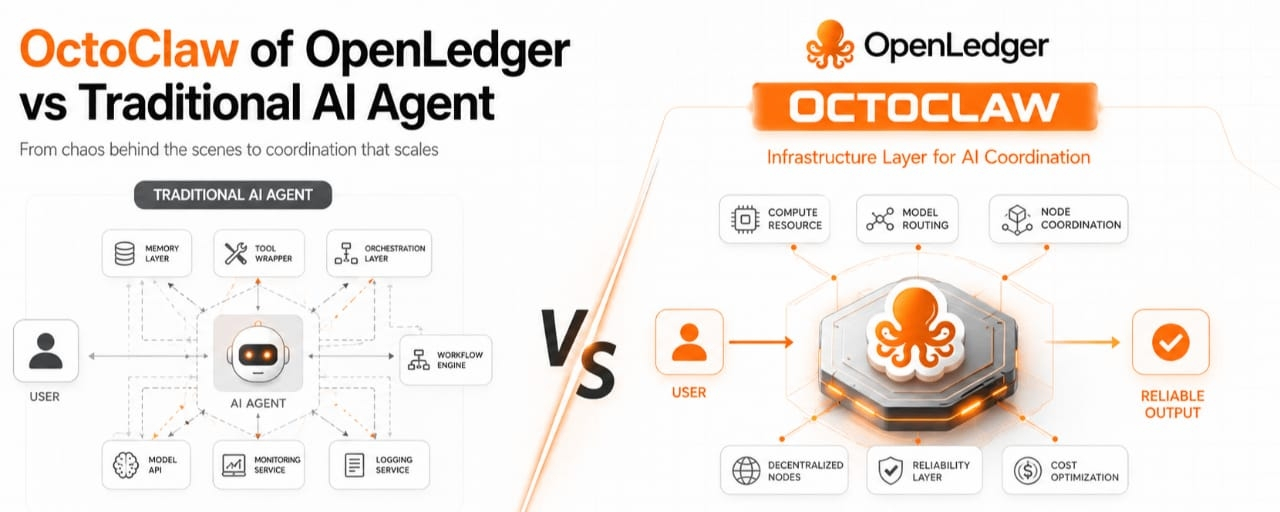
I’ve seen way too many things being labeled as “AI agents” lately. Too many dashboards, too many orchestration layers, and too many workflows that look intelligent on the surface but are ultimately just chains of API calls wrapped inside a cleaner interface.
The industry has a strange habit of rebranding old problems. The more abstraction layers appear, the harder it becomes for users to understand how the system actually works underneath.
That’s the feeling I get when looking at many current AI agent systems.
It’s not that they don’t work. A lot of them function quite well. But the longer you use them, the more you notice a kind of hidden friction emerging. The more “autonomous” the agent becomes, the more complicated the stack behind it gets — additional memory layers, tool wrappers, monitoring systems, logging services, synchronization pipelines.
Ironically, systems designed to reduce human workload often end up creating another layer of dependency instead.
Most agents today sit between the user and dozens of backend services. They process context, trigger models, execute workflows, cache memory, and route requests. From the outside, it feels seamless, but users rarely have visibility into what’s actually happening behind the scenes.
They only see outputs, while the operational layer becomes increasingly opaque.
That’s the part of the AI market I keep coming back to. Not which model scores highest on benchmarks, but who actually controls the operational infrastructure.
Because AI rarely fails during demos. It fails in reliability, latency, synchronization, node stability, API congestion, and resource coordination. Those are the less exciting problems, but they’re usually the ones that determine whether systems scale in the real world.
And from my perspective, a large part of the current AI ecosystem seems focused on solving “intelligence” before solving “coordination.”
That’s one reason I started paying closer attention to OpenLedger and OctoClaw.
Not because of the decentralized AI narrative — the market has already overused that phrase — but because OctoClaw appears to approach the problem from a slightly different angle.
Instead of trying to build a single AI entity that can do everything autonomously, it seems more focused on organizing the infrastructure behind AI itself: compute coordination, model routing, node orchestration, and system-level resource management.
Those are the layers users rarely notice, but they often define the actual experience.
That distinction is subtle but important.
Traditional AI agents are usually designed around behavior: making the agent more human-like, more autonomous, better at memory and decision-making.
OctoClaw, at least from what I’ve observed so far, appears more system-oriented. Less focused on creating another “smart personality,” and more focused on reducing chaos between multiple AI components operating together.
It’s not the kind of narrative that immediately captures attention like autonomous trading agents or AI systems booking flights on their own.
But infrastructure has always worked that way. The foundational layers are usually the least exciting early on.
Interestingly, the more market cycles I watch, the more I notice how often people undervalue those invisible backend systems. Markets tend to reward flashy interfaces over reliability, demos over operational stability, narratives over throughput.
But eventually everything returns to actual usage.
Whitepapers don’t retain users. Narratives don’t either.
At some point the questions become much simpler: Can the system remain stable under heavy load? Can it reduce operational costs? Can developers spend less time maintaining infrastructure manually?
That’s still where the real validation happens.
And honestly, I think a lot of the market is still pricing in future expectations long before products are truly battle-tested. AI already amplifies speculation, and when combined with crypto narratives, the noise becomes even louder.
So I’m not looking at OctoClaw as some confirmed “AI revolution” — at least not yet.
Right now, I see it more as an interesting infrastructure experiment in a market that remains heavily focused on the interface layer.
Maybe this direction works. Maybe it doesn’t.
But if there’s one area in AI worth watching closely right now, in my opinion it’s the teams trying to quietly solve backend coordination instead of only making the frontend appear smarter.
That’s where OctoClaw seems positioned for now.
The bigger question is whether the system will perform once real demand and real usage arrive.
That’s the part I’m still watching carefully.