
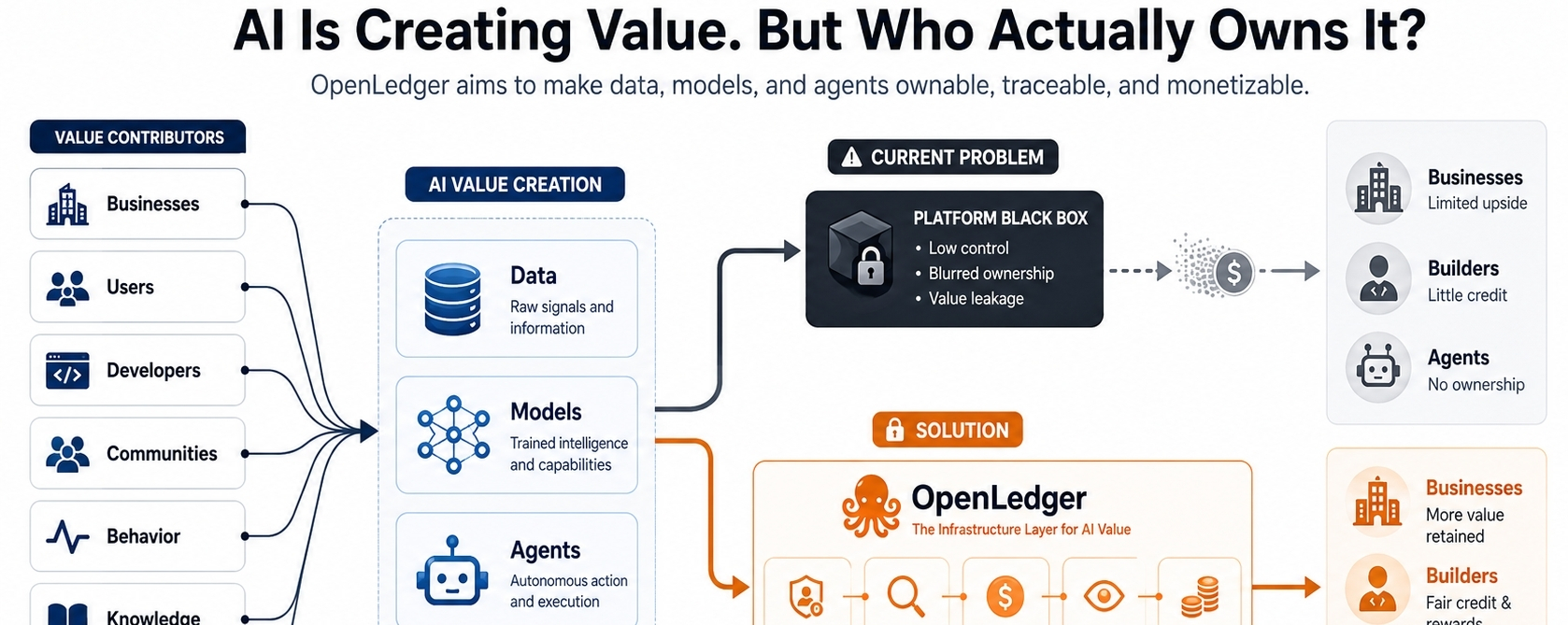
I’m watching AI become one of those things people speak about with too much confidence.
Everyone sounds so sure.
The future is agents. The future is models. The future is data. The future is automation. The future is intelligence moving faster than humans can keep up with.
Maybe.
But I keep looking at the part nobody wants to sit with for too long.
Where does the value go?
Because AI is not built from air. It feeds on data. It depends on models. It needs agents that can actually do something useful. It takes from businesses, users, developers, communities, behavior, knowledge, mistakes, patterns. All of it. And then somehow, after all that, the people closest to the value often get the least control over it.
That feels broken.
Not dramatically broken. Quietly broken. The kind of broken that becomes normal because everyone is too busy chasing the next big thing.
We call data valuable, but most data just sits there. Locked inside companies. Scattered across systems. Used badly, or not used at all. We call AI open, but a lot of the upside still belongs to whoever owns the biggest platform. We talk about agents like they are going to work for everyone, but we barely talk about who owns what they create.
That is why OpenLedger caught my attention.
Not because it has AI in the name. That means almost nothing now.
And not because blockchain magically fixes everything. It does not. A lot of crypto projects have spent years pretending complexity is the same as progress.
But OpenLedger is pointing at a real problem.
Data, models, and agents are becoming productive assets. Not ideas. Assets. They can create value. They can help businesses make money, save time, build better systems, and run smarter operations. But if those assets cannot be tracked, monetized, owned, or moved properly, then the whole thing stays trapped.
Value exists, but it has nowhere clean to go.
A business may have years of useful data sitting in its system, but no real way to turn it into liquid value. A developer may build a model that solves one specific problem better than anything else, but still struggle to capture the upside. An agent may perform real work, but the economics around that work are still blurry.
This is the gap.
And OpenLedger seems to be building around that gap.
Not the shiny part of AI. The useful part. The part where people actually need rails. Where ownership matters. Where contribution needs to be visible. Where value should not disappear into some platform’s black box.
I like that.
I am still skeptical, because I think skepticism is healthy here. Every project has to prove itself outside the announcement cycle. Real adoption. Real utility. Real businesses using it because it solves something painful.
But the idea makes sense.
AI is not just about intelligence anymore. It is about who gets to benefit from intelligence once it becomes infrastructure.
That is the question OpenLedger is trying to answer.
And honestly, that is why I am still watching. Not loudly. Not blindly.
Just seriously.
