
I’ve honestly become a little numb to AI and blockchain announcements lately. After a while, everything starts sounding recycled. One project says it’s building the future of AI infrastructure, another says it’s redefining decentralized intelligence, and somewhere in the middle there’s always a roadmap filled with big promises that may or may not ever become real products. I don’t even say that in a cynical way anymore. It’s just what happens when you spend enough time watching this space move in circles.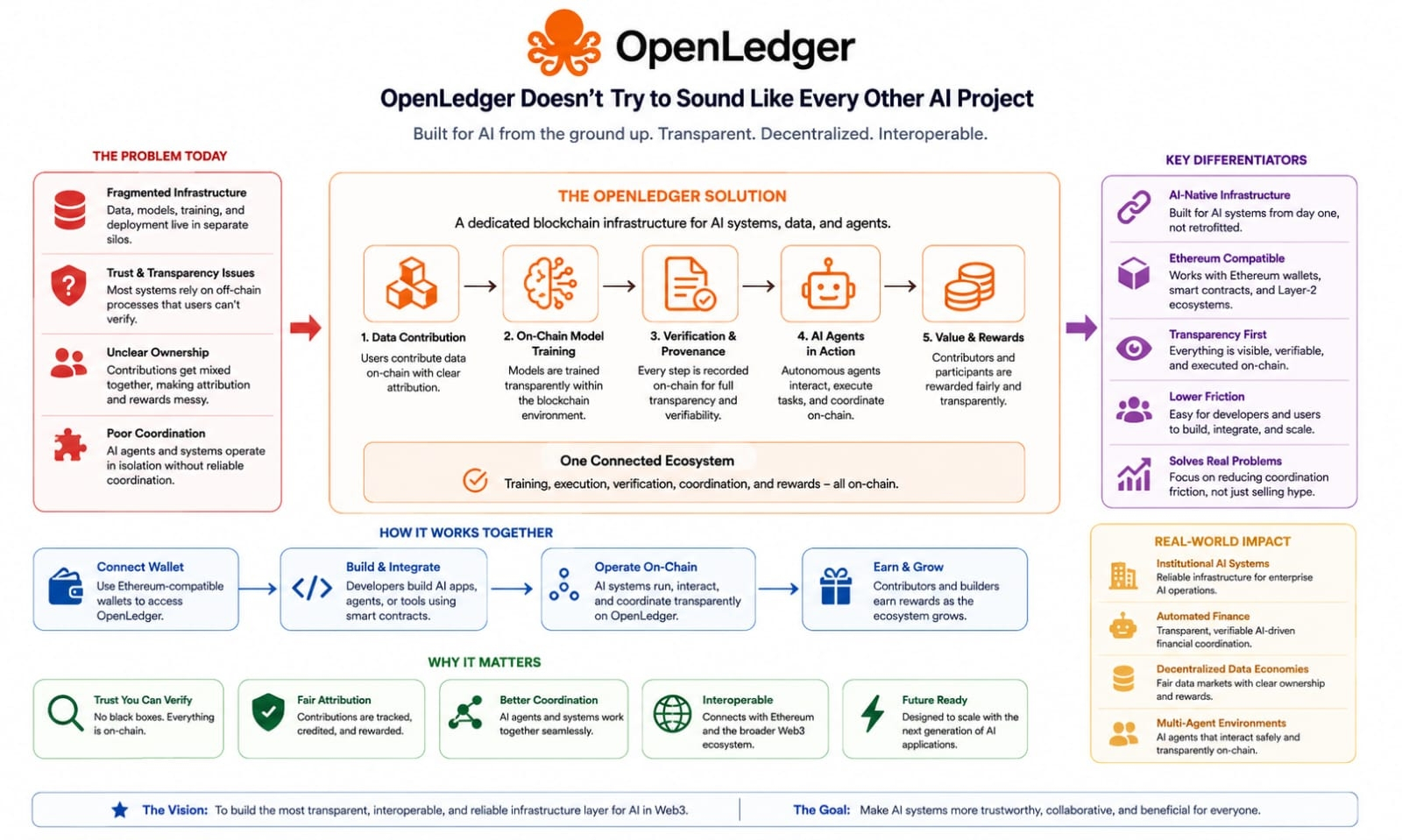
So when I first came across OpenLedger, I didn’t have some huge reaction to it. If anything, I expected the usual formula. Nice branding, a few technical phrases, maybe some talk about AI agents and decentralized systems, and then eventually you realize most of the important parts still happen off-chain anyway. That’s been the pattern with a lot of projects trying to mix AI and crypto together.
But the more I looked into OpenLedger, the more it felt like the team was at least trying to approach the problem differently. Not perfectly. Not magically. Just differently in a way that felt more grounded than I expected.
What caught my attention wasn’t flashy marketing or some dramatic vision about replacing everything overnight. It was the fact that the infrastructure itself seems designed around AI activity from the beginning. That sounds simple when written out, but it actually changes how you think about the system. Most blockchain projects still treat AI like an extra feature bolted onto existing architecture. OpenLedger feels more like it’s asking, “What would blockchain infrastructure look like if AI systems were meant to operate inside it from day one?”
That question stayed in my head longer than I expected.
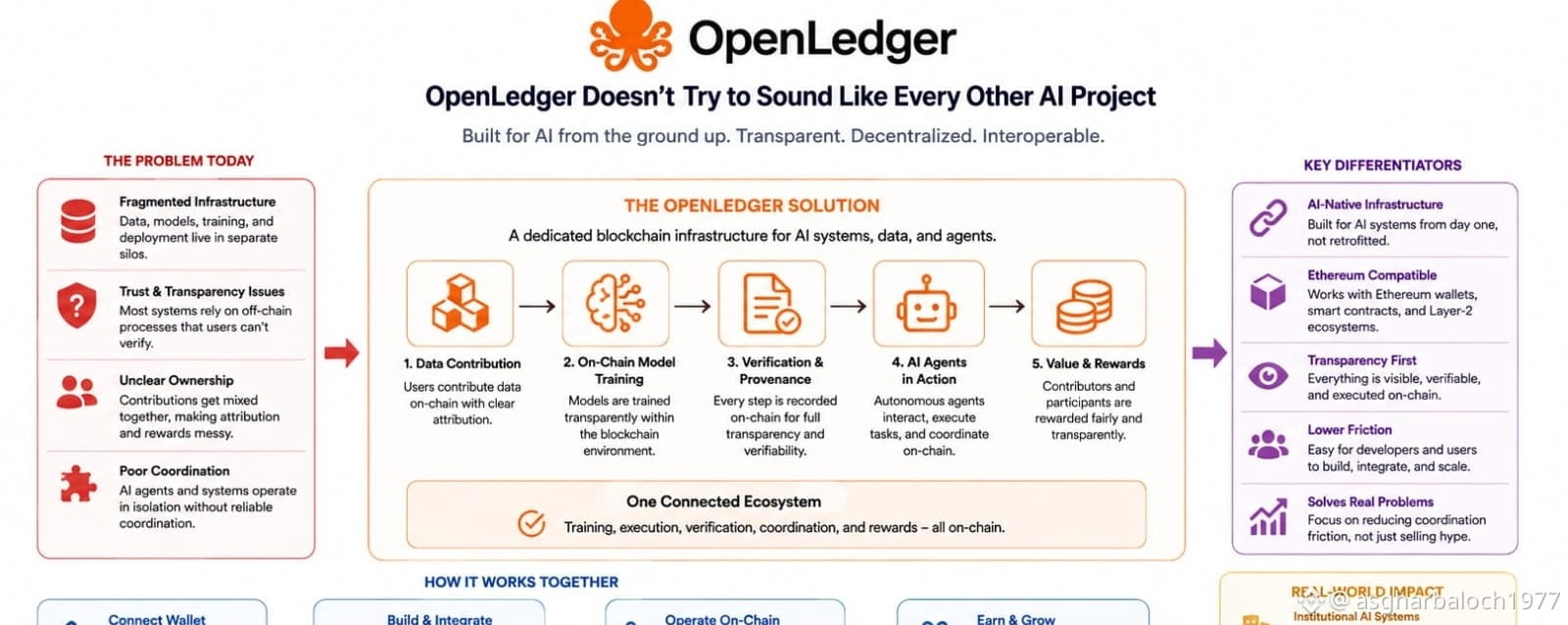
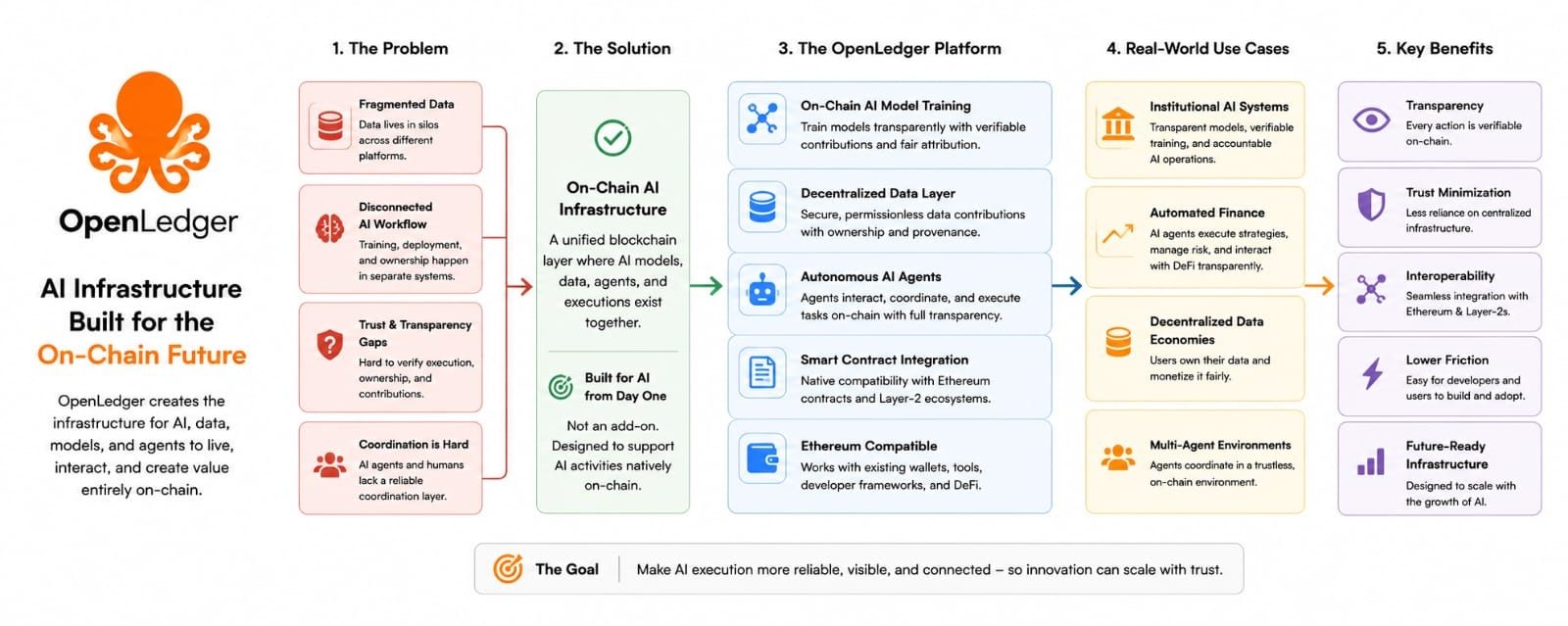
Because when you really look at how AI works today, the whole thing feels fragmented. Data exists in one place. Models are trained somewhere else. Deployment happens through separate services. Ownership gets blurry once multiple contributors get involved. Verification becomes difficult. Coordination becomes even worse. Everyone talks about decentralization, but in practice, a lot of these systems still rely heavily on trusting whoever controls the infrastructure behind the curtain.
And honestly, that’s the part I’ve grown tired of.
A lot of projects in Web3 still expect users to manually carry the burden of trust. You’re constantly expected to assume things are happening correctly without having real visibility into execution itself. OpenLedger became interesting to me because it seems more focused on reducing that gap. The platform is designed so AI models, data contributions, and autonomous agents can exist directly within the blockchain environment instead of floating around it externally.
That makes the idea of on chain AI model training feel more meaningful to me than most AI narratives I’ve read recently. Not because it sounds futuristic, but because it addresses a real coordination problem. If training, contribution, execution, and verification all connect through the same infrastructure layer, there’s at least a clearer system for understanding who did what and how value moves through the network.
The autonomous AI agent side also started making more sense once I stopped looking at it like a buzzword. Everybody talks about AI agents right now, but very few people talk about the infrastructure needed for those systems to coordinate reliably. If agents are interacting with contracts, data, users, and each other, then transparency and execution start mattering a lot more than flashy demos. OpenLedger seems aware of that. The project feels less focused on selling the image of AI agents and more focused on building an environment where those systems can actually function together on-chain without everything becoming chaotic.
I also think the Ethereum compatibility matters more than people give it credit for. One thing that kills a lot of infrastructure projects is isolation. Developers do not want to rebuild everything from scratch every time a new chain appears. Users don’t want complicated onboarding just to test a platform. OpenLedger integrating with Ethereum wallets, smart contracts, and Layer-2 ecosystems makes the whole thing feel more practical instead of theoretical. It lowers resistance. That’s important because adoption usually happens through convenience long before ideology.
And maybe that’s the biggest reason I kept thinking about the project afterward. It doesn’t feel obsessed with trying to sound bigger than it is. It feels more focused on reducing operational friction quietly in the background. The more time I spend around crypto, the more I realize the projects that actually last are usually solving boring but important coordination problems while everyone else is competing for attention.
That doesn’t mean OpenLedger is guaranteed to succeed. I don’t think any infrastructure project gets a free pass just because the ideas sound good on paper. There are still real problems ahead. Scalability pressure becomes serious once AI systems operate at larger scale. Regulation around AI ownership and automated systems is still evolving. And decentralized coordination in the real world is always messier than people expect during the early stages.
But at least the project seems pointed at a real issue instead of an imaginary one.
I can actually see where this kind of infrastructure would matter. Institutional AI systems. Automated financial coordination. Decentralized data economies. Multi-agent environments where transparency and interoperability matter more than marketing language. Those are the kinds of environments where execution quality becomes more important than narratives.
At this point, I’m mostly watching behavior instead of listening to promises. I want to see whether integrations work smoothly, whether developers can actually build useful workflows on top of the infrastructure, and whether AI coordination on-chain feels natural instead of forced. That’s the kind of thing you only learn over time by observing how people use the system when nobody is paying attention anymore.
And honestly, that’s probably why OpenLedger stayed with me longer than most AI projects do. Not because it shouted louder. Not because it tried to sound futuristic every five seconds. But because underneath everything, it seems like the project is trying to make execution itself more reliable, visible, and connected.
In this space, that already feels unusually realistic.