Honestly, most AI conversations right now feel weirdly shallow.
Every project keeps shouting the same things. Bigger models. Faster inference. More agents. More compute. More automation. Same cycle. Different branding.
And look, I get it. Capability matters. Of course it does.
But here’s the thing people don’t talk about enough: none of that answers the uncomfortable question sitting underneath the entire AI economy.
Who actually owns the value once AI starts producing economic activity on its own?
That’s the real problem.
Not who has the flashiest demo.
Not who raised the most money.
Not who can generate anime images 0.3 seconds faster.
I’m talking about ownership. Attribution. Accountability. The stuff that gets ignored because it’s harder to explain in a tweet.
That’s why OpenLedger caught my attention in the first place.
Because the project doesn’t seem obsessed with AI capability theater. It’s looking at the infrastructure problem underneath the infrastructure problem. And yeah, that sounds abstract at first. But stay with me.
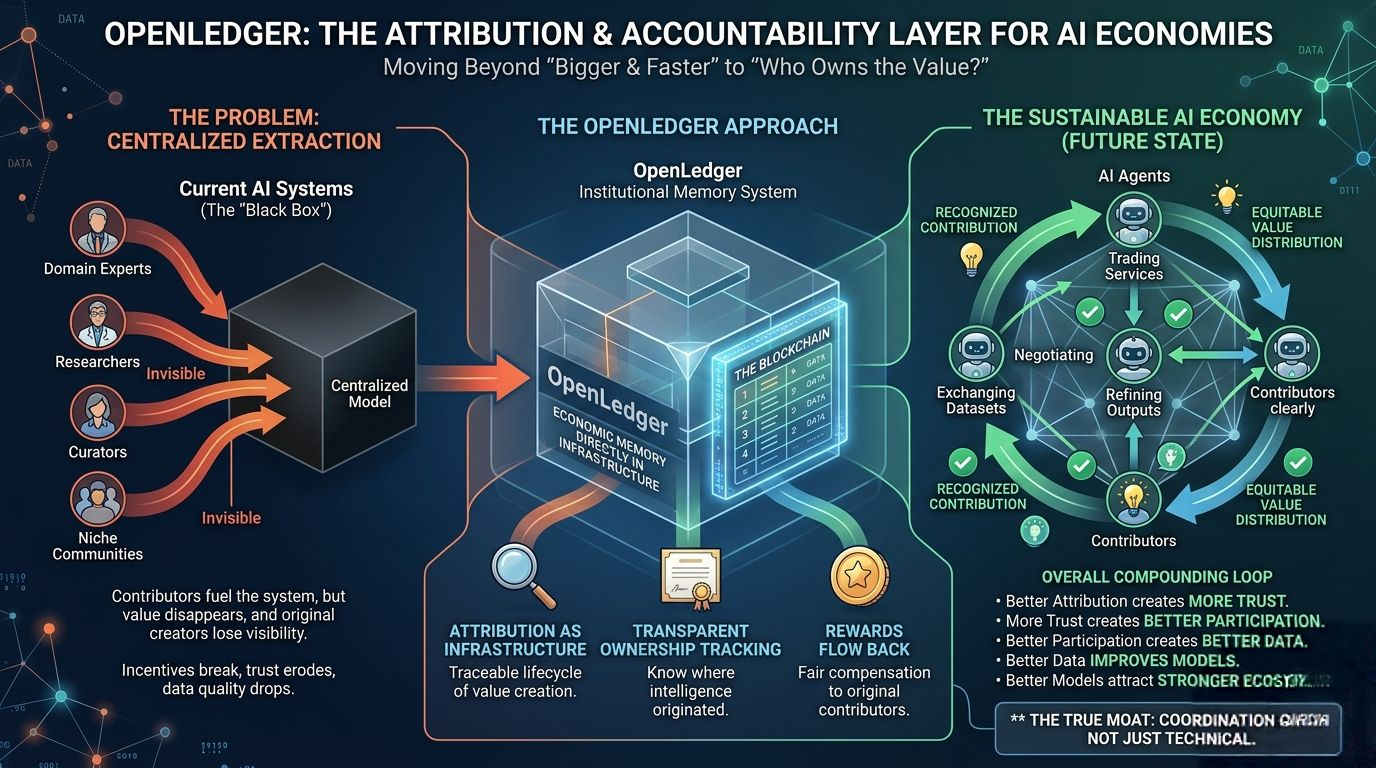
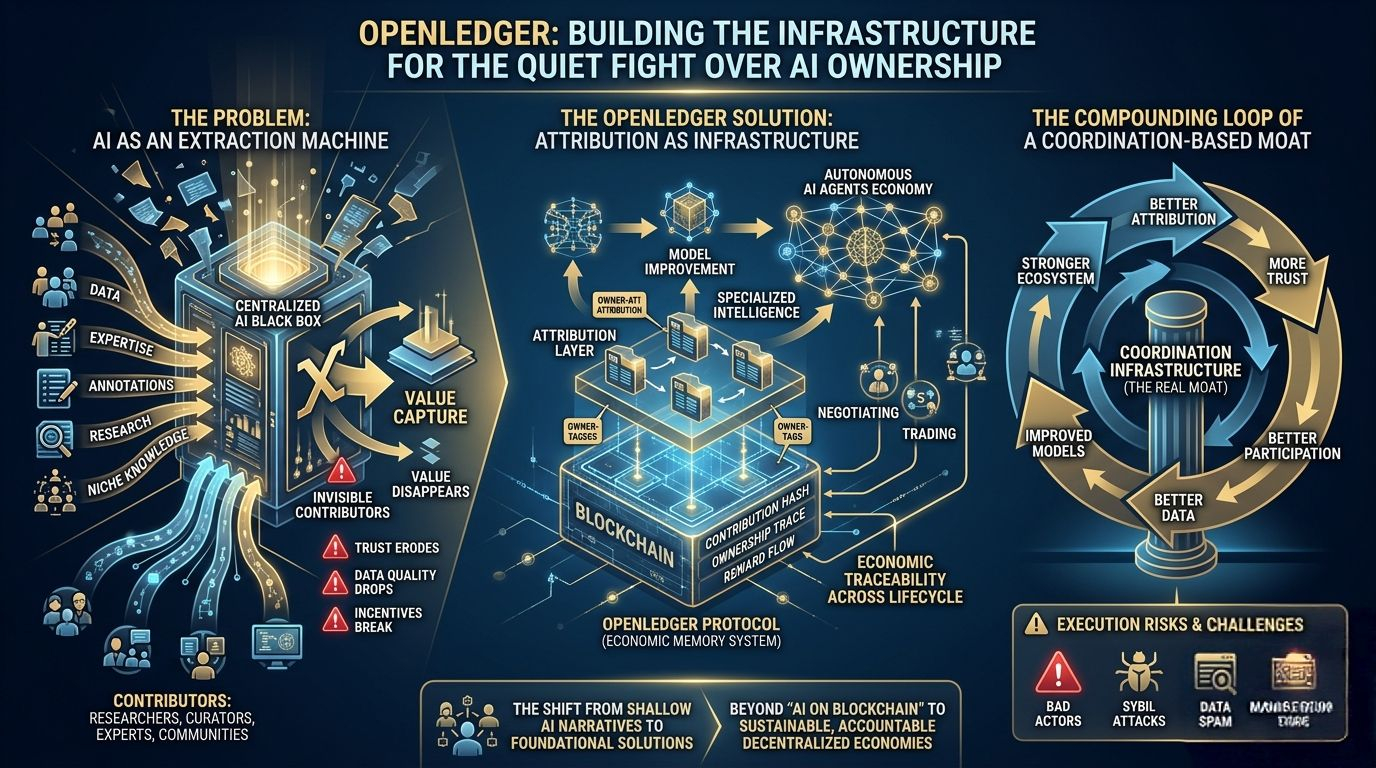
Most AI systems today operate like giant extraction machines. People feed them data, expertise, annotations, feedback loops, niche knowledge, research, specialized context… and then that value disappears into centralized black boxes.
The contributors? Mostly invisible afterward.
That’s been the dirty secret of the AI industry for a while now.
Researchers contribute. Curators contribute. Small niche communities contribute. Domain experts contribute. Then large systems absorb all of it, scale on top of it, monetize it, and the original value creators lose visibility almost immediately.
I’ve seen this before in tech cycles.
The platforms capture upside first. Contributors get thanked later. Maybe.
OpenLedger seems built around pushing against that exact dynamic.
And honestly, that’s where things get interesting.
The core idea behind the project isn’t just “AI on blockchain.” We’ve heard that pitch a thousand times already. Most of those projects blur together after five minutes.
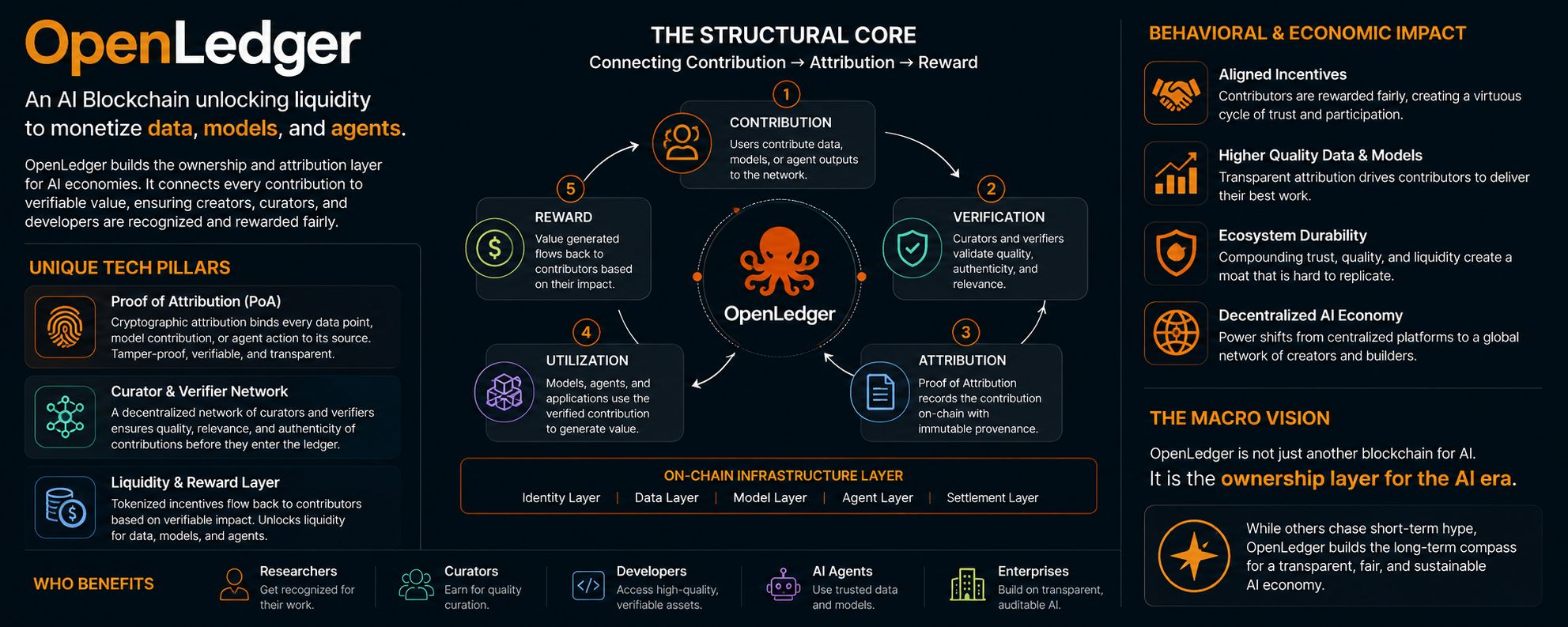
OpenLedger’s angle feels different because it focuses on attribution as infrastructure.
Meaning: if someone contributes data, model improvements, curation, or specialized intelligence, the system tries to keep that contribution economically traceable across the lifecycle of value creation.
That part matters a lot more than people realize.
Because once AI agents start interacting autonomously — and yes, that’s absolutely where this goes — attribution becomes a survival problem for the ecosystem itself.
Think about it for a second.
Future AI systems won’t just answer prompts. They’ll negotiate. Trade services. Refine outputs. Train derivative models. Exchange datasets. Make decisions. Coordinate with other agents.
Now imagine all of that happening at machine scale with zero transparent ownership tracking.
Sounds messy, right?
Because it is.
Without attribution systems, AI economies eventually drift toward pure extraction. The biggest actors absorb value faster than contributors can meaningfully participate. Trust erodes. Data quality drops. Incentives break.
And once incentives break, ecosystems rot from the inside.
That’s why OpenLedger’s structure actually makes sense to me.
The project seems to understand that AI economies aren’t just compute systems. They’re behavioral systems. That distinction changes everything.
If contributors believe their work disappears into a black hole, they stop caring. Or worse, they start optimizing for low-effort farming because quality no longer matters.
But if people trust the attribution layer?
Different story.
Researchers spend more time refining niche datasets. Curators filter higher-quality information. Experts contribute specialized knowledge because they know the system can still recognize where value came from later.
That creates a compounding loop.
Better attribution creates more trust.
More trust creates better participation.
Better participation creates better data.
Better data improves models.
Better models attract stronger ecosystems.
And suddenly the moat isn’t just technical anymore. It becomes coordination-based.
That’s a much harder thing to replicate.
Honestly, I think people underestimate how important coordination becomes once AI systems mature. Everyone focuses on model intelligence because it’s visible. Coordination infrastructure feels invisible until it breaks.
Then everybody notices at once.
We’re already seeing early versions of this problem across the AI industry. Massive debates around dataset ownership. Copyright fights. Provenance issues. Synthetic data contamination. Trust collapse around generated media.
And we’re still early.
Really early.
That’s why OpenLedger feels less like a short-term AI narrative play and more like an attempt to build economic memory directly into AI infrastructure.
I know that sounds dramatic. But I genuinely think that’s the direction this points toward.
The blockchain here isn’t just acting as a settlement layer for transactions. It’s functioning more like an institutional memory system for intelligence production itself.
Who contributed what.
Where value originated.
How rewards flow back.
Who refined outputs.
Who created downstream utility.
That’s powerful if it works.
And yeah, there’s the obvious catch.
Execution.
This stuff gets hard fast.
Attribution systems sound great until networks scale and bad actors show up. Then you run into sybil attacks, low-quality data spam, manipulation attempts, fake contribution farming… the usual problems decentralized systems always face.
People love talking about decentralization in theory. In practice? Coordination gets ugly.
Really ugly sometimes.
So OpenLedger still has a difficult road ahead. I don’t think anybody serious should pretend otherwise. Building attribution infrastructure for AI economies is probably one of the hardest coordination problems in crypto right now.
But honestly, I’d rather watch projects attack hard structural problems than launch another AI token wrapped around marketing buzzwords and recycled agent narratives.
We already have enough of those.
Way too many.
What makes OpenLedger interesting is that it’s trying to solve something foundational before the broader market fully realizes how important that problem becomes.
That usually matters.
The internet rewarded platforms that organized information better.
Crypto rewarded systems that coordinated value transfer better.
AI might reward systems that coordinate ownership and attribution better.
And if that thesis ends up being right, then OpenLedger isn’t really competing in the same category as most AI projects people casually compare it to.
It’s aiming at the layer underneath them.
The ownership layer.
The accountability layer.
The part that quietly determines whether decentralized AI economies actually stay sustainable once autonomous systems start producing real economic value at scale.
That’s the part most people still ignore.
For now.