There’s a certain kind of project that doesn’t fully make sense when you first encounter it. Not because it’s overly complicated, but because the industry around it has trained people to look in the wrong direction. Most crypto users have become conditioned to search for speed, hype, narratives, token velocity, and social momentum. Most AI conversations are trapped inside demos, chat interfaces, benchmark scores, or futuristic promises. OpenLedger sits in an unusual place because it quietly asks a different question altogether:
Who actually owns the intelligence being created?
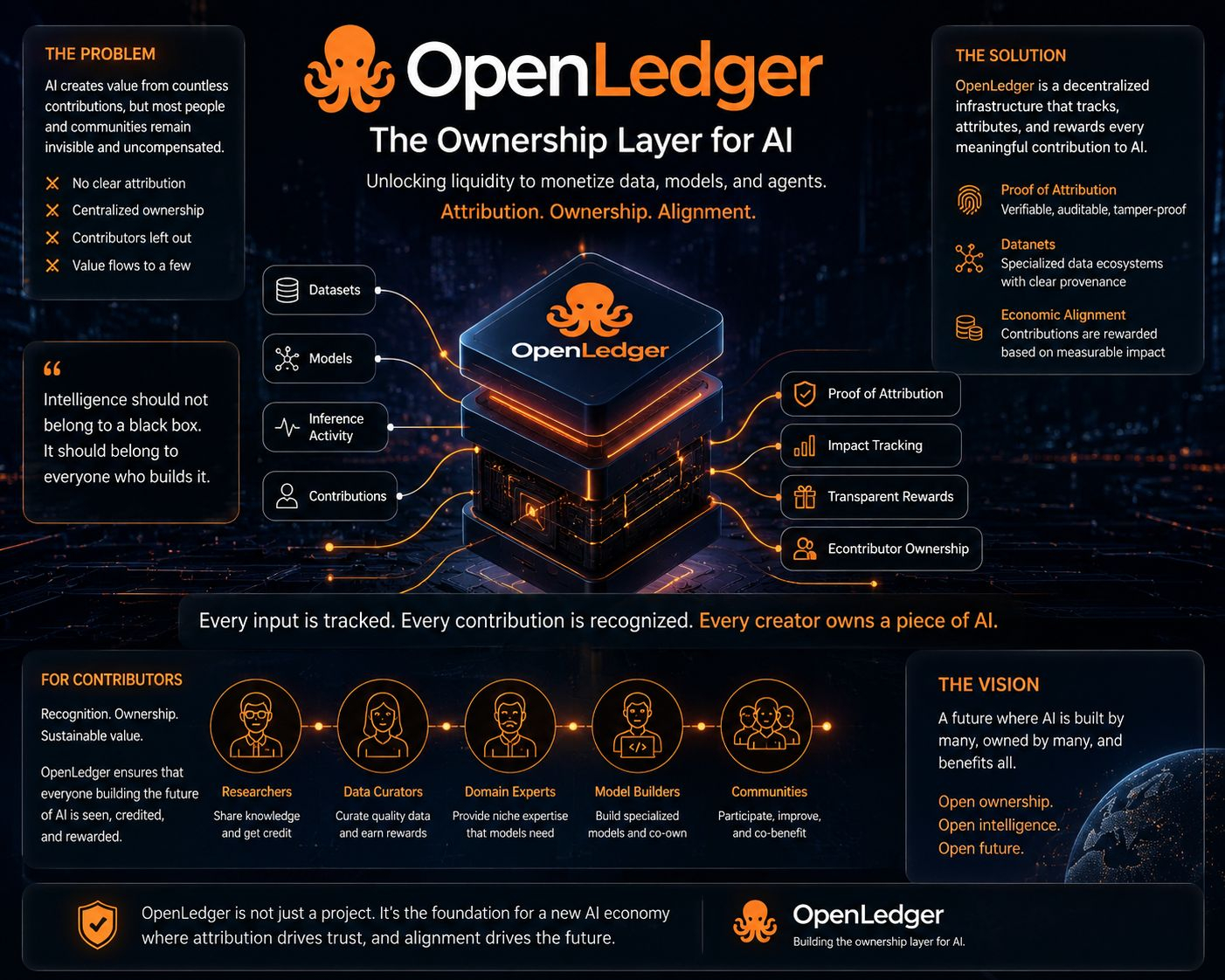
The more time I spent studying OpenLedger, the more I realized this question is larger than blockchain, larger than AI speculation, and probably larger than the current market cycle itself. It touches something structural that the modern AI economy still hasn’t solved properly. We are entering a world where enormous value is generated from datasets, human expertise, model training, inference activity, and continuous feedback loops, yet the people contributing to that value are often invisible once the machine starts working.
That invisibility is not accidental. It’s baked into how today’s AI systems operate.
A researcher refines a specialized dataset. A medical expert labels rare edge cases. A niche community contributes years of domain-specific knowledge. Thousands of users interact with models and improve them indirectly through behavior, correction, and usage patterns. But once intelligence becomes packaged into a polished AI product, the economic trail disappears. Ownership becomes concentrated at the top while contribution dissolves into abstraction.
This is the gap OpenLedger appears to be targeting.
Not through loud branding or theatrical promises, but through infrastructure.
And infrastructure projects are often misunderstood in their early stages because they don’t look exciting from the outside. They resemble plumbing before they resemble skyscrapers. Yet without plumbing, cities stop functioning. Without roads, supply chains collapse. Without accounting systems, economies lose trust. OpenLedger increasingly feels like one of those foundational layers that people may only fully appreciate after AI becomes too economically important to operate without transparent attribution.
The concept that kept pulling me deeper into the project was Proof of Attribution.
At first glance, the phrase sounds technical, maybe even dry. But after spending time unpacking it, I think it represents one of the most important ideas in the future of AI economics.
Artificial intelligence today creates value faster than existing systems can measure fairly. Models absorb data from countless sources, produce outputs at scale, and generate commercial value in real time. Yet most systems still operate like black boxes when it comes to tracing who contributed what. OpenLedger seems to recognize that attribution is not just an ethical concern. It is an economic infrastructure problem.
Proof of Attribution attempts to create measurable relationships between contributions and outcomes. Instead of intelligence appearing from nowhere like a magic trick, the system tries to track where value originates, who contributed to it, and how participation should be recognized over time.
That changes the psychology of participation entirely.
When contributors know their datasets, refinements, or specialized expertise can be measured and attributed transparently, behavior starts shifting. People become less disposable within the AI pipeline. Quality suddenly matters more because contributions are no longer swallowed invisibly into centralized systems.
This is where OpenLedger started feeling different from many AI-related crypto projects I’ve seen over the past year.
A large percentage of AI tokens currently orbit around attention. They build narratives around agents, entertainment layers, social virality, or speculative excitement. Many of them may survive temporarily because markets enjoy momentum, but few seem focused on the deeper coordination problems emerging beneath the surface of AI expansion.
OpenLedger feels more concerned with economic architecture than spectacle.
That distinction matters.
Because if artificial intelligence truly becomes embedded into healthcare, finance, education, logistics, governance, research, and digital labor, then attribution cannot remain optional forever. Ownership cannot remain vague forever. Incentive alignment cannot remain an afterthought forever.
The current AI economy resembles a city expanding faster than its property laws. Value is everywhere, but ownership remains blurry. Data flows continuously, models evolve constantly, contributors multiply daily, and yet the systems for tracking participation still feel primitive relative to the scale of creation happening underneath.
This is why Datanets stood out to me while researching OpenLedger.
The idea is subtle but powerful. Instead of treating data as a static commodity dumped into massive opaque training pools, Datanets organize specialized data ecosystems with traceable contribution structures. Different domains, industries, experts, or communities can participate in AI development while maintaining clearer visibility into how value flows through the system.
That may sound abstract initially, but the implications are enormous.
Most valuable intelligence is not generic. The future of AI likely depends heavily on specialized, high-context knowledge. Medical AI requires medical expertise. Legal AI requires legal precision. Scientific reasoning depends on carefully curated research environments. Financial systems need reliable contextual data. Agriculture, manufacturing, cybersecurity, language preservation, climate modeling — every serious vertical depends on niche expertise accumulated over long periods of time.
Traditional AI systems often flatten these contributors into anonymous inputs.
OpenLedger appears to be building systems where those contributors remain economically visible.
And visibility changes incentives.
A hidden contributor behaves differently than an acknowledged stakeholder. One gives labor into a void. The other participates in an economy where effort, quality, and specialization can potentially compound into ownership.
This may end up becoming one of the defining transitions in AI infrastructure over the next decade.
Not smarter chatbots.
Not prettier interfaces.
But accountable intelligence systems with transparent economic coordination.
The more I thought about it, the more OpenLedger reminded me less of a crypto application and more of an accounting framework for intelligence itself. Almost like the project is trying to build the missing ledger behind AI production. A system capable of answering difficult questions that most platforms currently avoid:
Where did this intelligence come from?
Who improved it?
Who contributed domain expertise?
Who should benefit economically from its success?
Those questions become unavoidable once AI stops being experimental and starts becoming foundational to global productivity.
And importantly, OpenLedger seems aware that attribution alone is meaningless without incentives attached to it. This is where many systems fail. Recognition without economic alignment eventually becomes symbolic rather than functional. OpenLedger’s broader structure appears designed around the idea that contribution tracking should connect directly to value distribution mechanisms.
That creates a much healthier long-term environment than systems built entirely around extraction.
One of the biggest risks in modern AI development is that contributors become increasingly detached from the upside generated by the systems they help improve. Over time, that disconnect weakens trust, reduces participation quality, and concentrates power into smaller groups controlling the infrastructure layers.
OpenLedger appears to move in the opposite direction by designing around shared participation economics.
And strangely, the project’s relatively quiet presence makes it feel more credible to me.
Infrastructure rarely announces itself dramatically. Most foundational systems look unremarkable during their construction phase because they prioritize durability over attention. Railroads were once boring compared to gold rushes. Internet protocols were less exciting than flashy dot-com branding. Yet eventually the infrastructure layers outlasted most of the noise built on top of them.
That same feeling kept returning while studying OpenLedger.
The project does not seem optimized for instant emotional excitement. It feels optimized for coordination. For traceability. For accountability. For sustainable participation inside increasingly complex AI ecosystems.
That may sound less glamorous in the short term, but structurally it feels far more important.
Especially because AI is moving toward an era where autonomous agents, specialized models, and decentralized computation will interact continuously across networks. Once machines begin generating economic activity at scale, attribution systems become essential. Otherwise value distribution collapses into opacity.
And opacity eventually destroys trust.
What OpenLedger seems to understand is that trust in AI will not come only from intelligence quality. It will also come from fairness, auditability, and economic transparency. People need confidence not only in what AI produces, but in how the systems behind it operate.
That is a deeper layer of infrastructure than most conversations currently acknowledge.
After weeks of reading through the architecture, the attribution mechanisms, the Datanet structures, and the broader economic philosophy behind the project, I stopped viewing OpenLedger as another AI narrative competing for market attention. It started feeling more like a response to a structural imbalance quietly growing underneath the entire AI industry.
An imbalance between creation and ownership.
Between contribution and compensation.
Between intelligence generation and economic accountability.
The projects that matter long term are often the ones solving invisible problems before the broader market fully notices them. OpenLedger gives me that impression. Not because it promises perfection, and not because infrastructure guarantees adoption, but because it is asking the right foundational questions at the right moment in technological history.
The future AI economy will likely produce unimaginable amounts of value. But unless ownership systems evolve alongside intelligence systems, much of that value will continue flowing through opaque channels that disconnect contributors from outcomes.
OpenLedger feels like an attempt to prevent that future before it hardens permanently.
And maybe that is why the project stays with you after researching it for a while. It does not feel like a sprint chasing trends. It feels more like a compass quietly pointing toward a more accountable architecture for intelligence itself.