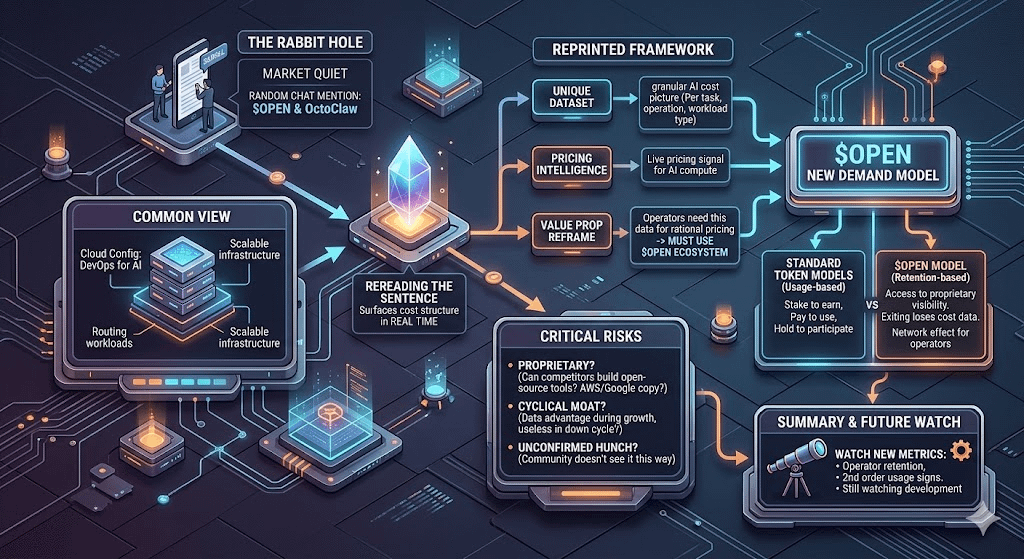
The Part of $OPEN Nobody's Actually Talking About
Market was doing that thing it does sometimes — not crashing, not pumping, just… sitting there. Uncomfortable. I had three tabs open and none of them were telling me anything useful.
So I closed the charts. Started reading instead.
I ended up on OctoClaw's documentation for about forty minutes longer than I intended. Not the tokenomics page. Not the roadmap. The Cloud Config layer. The part most people scroll past because it sounds like DevOps homework.
And somewhere in there, something started bothering me — in a good way.
Here's the thing I keep thinking about:
Everyone looking at Open is looking at it like an AI token. Which makes sense on the surface. AI narrative, scalable infrastructure, blah blah. The pitch is familiar enough that most people file it and move on.
But I think that framing is actually causing people to miss what's being built — and more importantly, what the real risk actually is.
OctoClaw's Cloud Config isn't a feature. It's the entire argument.
The way it's set up, the Cloud Config layer is essentially the coordination mechanism between AI workloads and the compute resources running them. It handles environment variables, resource allocation, deployment pipelines — the stuff that sounds boring until you realize that every AI operation running on this network has to route through it. Every single one.
I initially thought — okay, this is just infrastructure. Neutral. Table stakes.
But actually, it's not neutral at all.
What they've designed is a system where the config layer acts as the operational bottleneck in a deliberate way. Not bottleneck in the bad sense — more like a chokepoint that exists because centralized control of that layer is the only way to guarantee consistency at scale. You can't have fifty different AI deployments each managing their own resource configs and expect the network to behave predictably.
So the config layer has to be opinionated. It has to enforce things.
And here's where I started to get uncomfortable — not in a "this is a scam" way, but in a "I'm not sure this is as solved as they're implying" way.
The thing that doesn't fully sit right with me yet:
They're essentially saying that the Cloud Config layer will scale horizontally without degrading the quality of coordination. That as more AI operations come on, the config system keeps things coherent.
I believe that's the goal. I'm less convinced it holds under real enterprise load.
Not because the architecture is bad — it actually looks thoughtful. But because this specific problem, orchestrating heterogeneous AI workloads at scale through a single config interface, is genuinely hard. Companies with unlimited engineering budgets are still working on versions of this problem. The fact that OctoClaw has an approach doesn't mean the approach survives contact with production.
That's not a gotcha. That's just a real thing worth sitting with before you form a strong opinion in either direction.
Why does this matter for $OPEN specifically?
Because if the Cloud Config layer works — if it actually delivers consistent, low-friction deployment for AI operations at scale — then Open isn't just another AI narrative token. It becomes something closer to infrastructure rent. The value accrual story makes sense because usage of the layer generates demand for the token.
But if the config layer turns out to be fragile under load, or requires constant human intervention to maintain coherence, then the whole thing is just a good whitepaper.
The token thesis is entirely downstream of this one technical question.
Which means most of the retail conversation about Open is happening at the wrong level. People are debating entry points and chart patterns on something where the fundamental variable isn't price action — it's whether a DevOps problem got solved cleanly enough to run at scale.
I spent a while trying to find independent stress tests or third-party evaluations of the Cloud Config layer specifically. Didn't find much. A few developer comments, some anecdotal stuff. Not nothing, but not enough to feel confident either way.
That absence is information too.
There's a moment in trading — and I've had it too many times — where you look at something and you think you understand it because you understand the category. AI infrastructure. Okay. Got it. Seen this. And then you actually look at the mechanism and realize you were pattern-matching to the wrong thing the whole time.
I think that's what's happening with $OPEN in a lot of conversations right now.
People are evaluating it as "AI token, scalable, narrative play." When the actual question is: did a small team crack a genuinely difficult distributed systems problem, and can you tell from the outside if they did?
I don't have a clean answer. I'll probably keep watching the developer activity around the config layer, see if any larger deployments start showing up on-chain or in partnership announcements.
Anyway. Charts are still doing nothing. Maybe that's fine for now.
@OpenLedger