
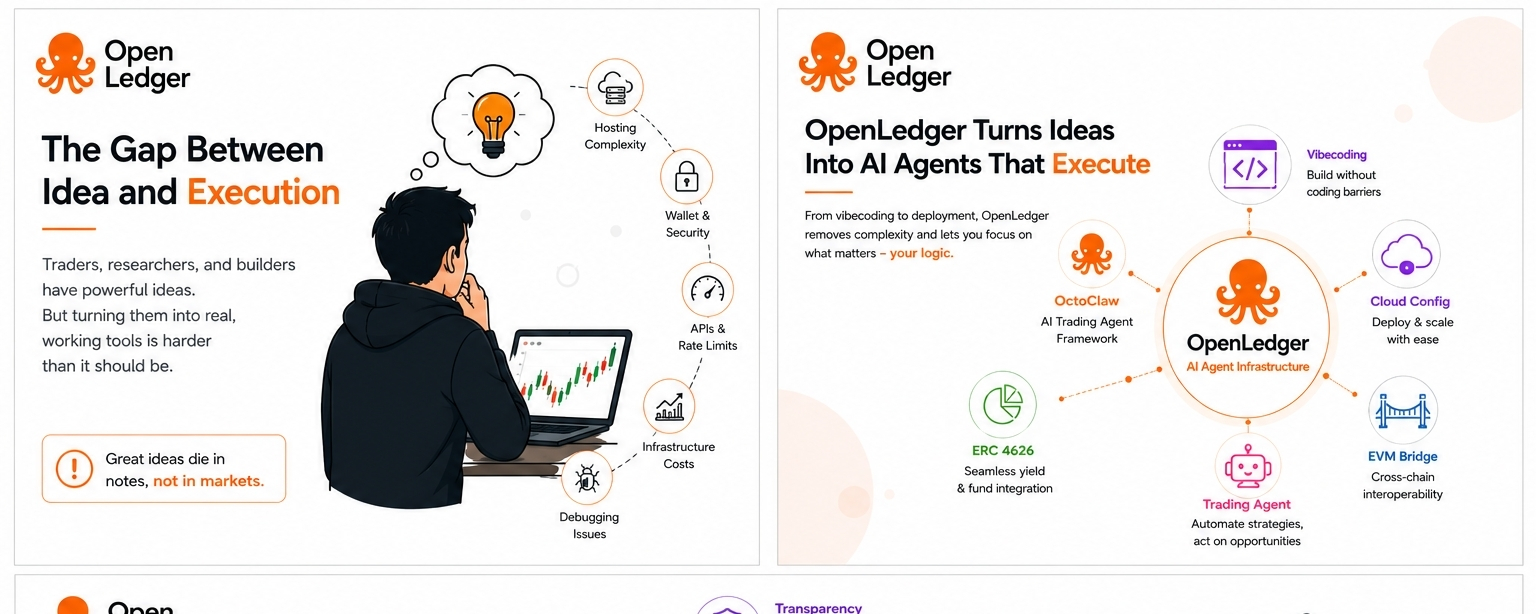
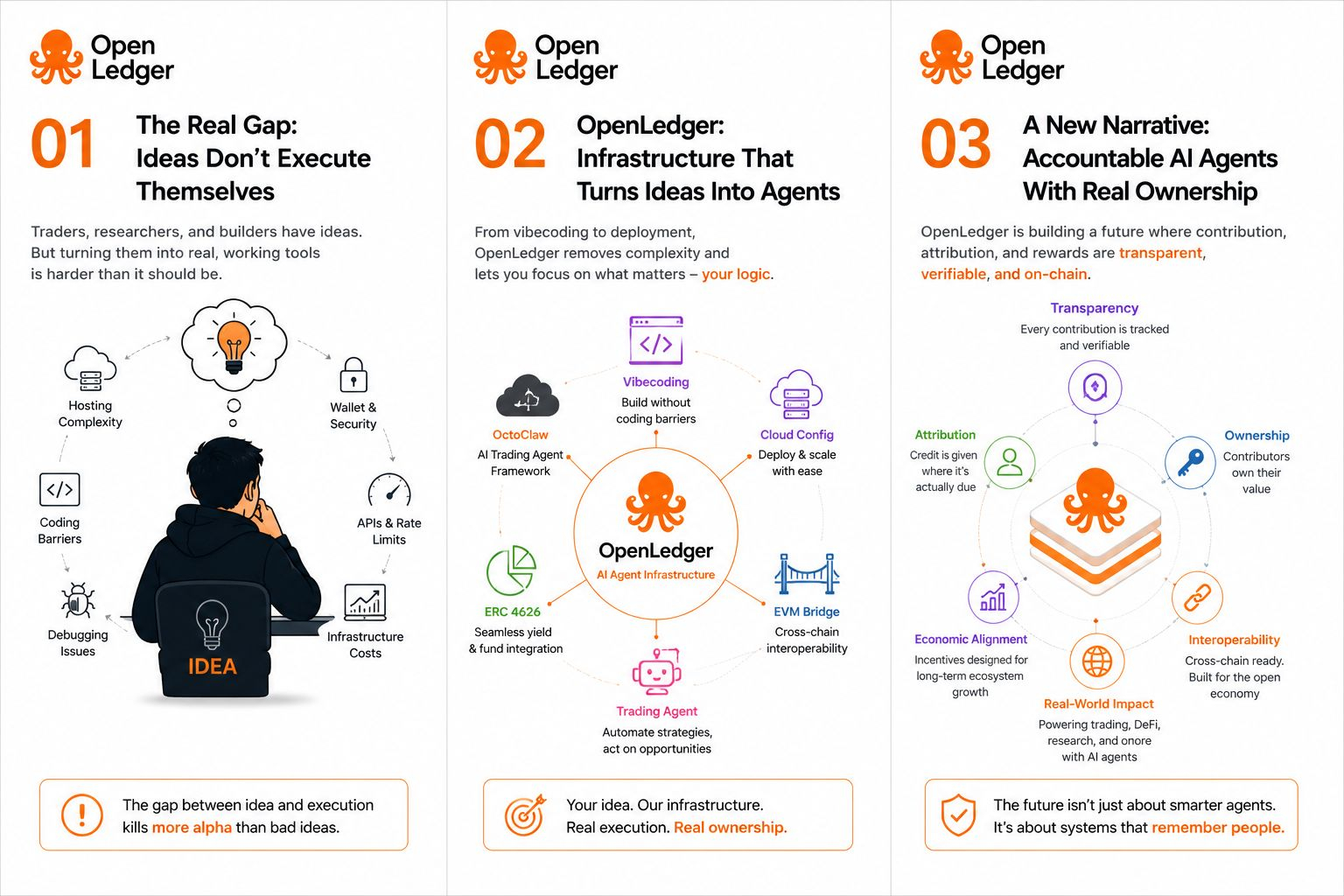
A few nights ago I was scrolling through different AI agent demos and trading dashboards while half-watching funding rates move across exchanges, and I realized something strange. Most of the conversation around crypto AI still feels trapped at surface level. Faster models. Bigger raises. More autonomous agents. Everyone keeps debating which system is smartest, but almost nobody talks about the invisible coordination layer underneath these tools. The part where infrastructure quietly decides who contributes, who gets rewarded, and who gets forgotten. That thought stayed in my head longer than I expected, especially after spending time looking deeper into OpenLedger and the recent OctoClaw launch. At first glance, it’s easy to categorize it as another AI-agent narrative entering crypto at the perfect moment. But the more I looked into things like vibecoding, trading agent infrastructure, ERC-4626 integrations, cloud configuration systems, and the EVM bridge layer, the less it felt like a simple product cycle and more like an attempt to reduce the friction between human intent and machine execution. And honestly, I think that gap may become one of the most important economic problems in AI over the next few years. Because most people don’t lack ideas anymore. They lack the infrastructure to operationalize them. A trader might understand market structure deeply but still cannot deploy an automated strategy. A researcher may identify patterns inside datasets but have no scalable way to monetize insight. A small developer may know exactly what kind of domain-specific AI tool should exist but gets buried under deployment complexity before anything ships. The execution layer remains inaccessible to most people even while AI keeps promising accessibility. That contradiction feels bigger than the market currently realizes.
What caught my attention with OpenLedger was not necessarily the promise of autonomous agents themselves, but the attempt to create a system where contribution, deployment, and attribution start becoming traceable economic actions instead of invisible background activity. Vibecoding especially stayed in my mind because it quietly addresses something many crypto-native users experience but rarely articulate. Half of the best trading ideas never become real tools. They die in notebooks, Telegram drafts, or random screenshots because turning logic into infrastructure requires crossing a technical wall most people were never trained to cross. APIs. Hosting. Wallet connectivity. Smart contract interaction. Maintenance. Debugging. Rate limits. Security assumptions. Suddenly an idea becomes a backend engineering problem. So when OpenLedger talks about AI agents that can move closer to production-level execution rather than just generating isolated snippets, I understand why people are paying attention. Not because it sounds futuristic, but because it touches a very real execution bottleneck. Still, this is also where skepticism matters. Infrastructure always sounds elegant before scale arrives. Once incentives become financial, systems attract manipulation. Low-quality datasets. Synthetic contribution farming. Agent spam. Attribution disputes. Model gaming. The system remembers activity. Markets optimize behavior around rewards. And those two forces do not always align cleanly. That’s partly why the accountability side of OpenLedger feels more important than the AI narrative itself. The deeper question is not whether agents become more autonomous. They probably will. The harder question is whether the economic systems surrounding those agents remain transparent enough for humans to trust them when real value starts flowing through them.
And maybe this is why the broader AI-agent narrative feels different from previous crypto cycles to me. Earlier narratives mostly focused on ownership of assets. But AI infrastructure forces a more uncomfortable discussion around ownership of contribution itself. Who owns intelligence once it becomes distributed across datasets, prompts, workflows, human corrections, model outputs, and autonomous execution layers? Who gets recognized when value emerges from systems that feel increasingly collective and blurry? OpenLedger seems aware of this tension at a structural level, especially through ideas around Payable AI, domain-specific Datanets, attribution systems, and legally traceable data infrastructure. Even integrations like Story Protocol start making more sense when viewed from that angle. Because eventually enterprises may care less about whether an AI system sounds impressive and more about whether its underlying intelligence can actually be verified, attributed, audited, and legally defended. That shift could quietly reshape the economics of AI itself. And honestly, I don’t know if the industry is fully prepared for how complicated that transition becomes once autonomous agents begin interacting directly with financial systems at scale. Maybe OctoClaw and similar systems become foundational pieces of that future. Maybe they don’t. But it does feel like something deeper is slowly changing beneath the visible surface of crypto right now. Not just smarter agents. Smarter coordination around human participation. And I keep wondering whether the next major AI narrative won’t be about replacing humans at all, but about finally building systems
 capable of remembering who actually helped create the value in the first place. $OPEN #openledger @OpenLedger