
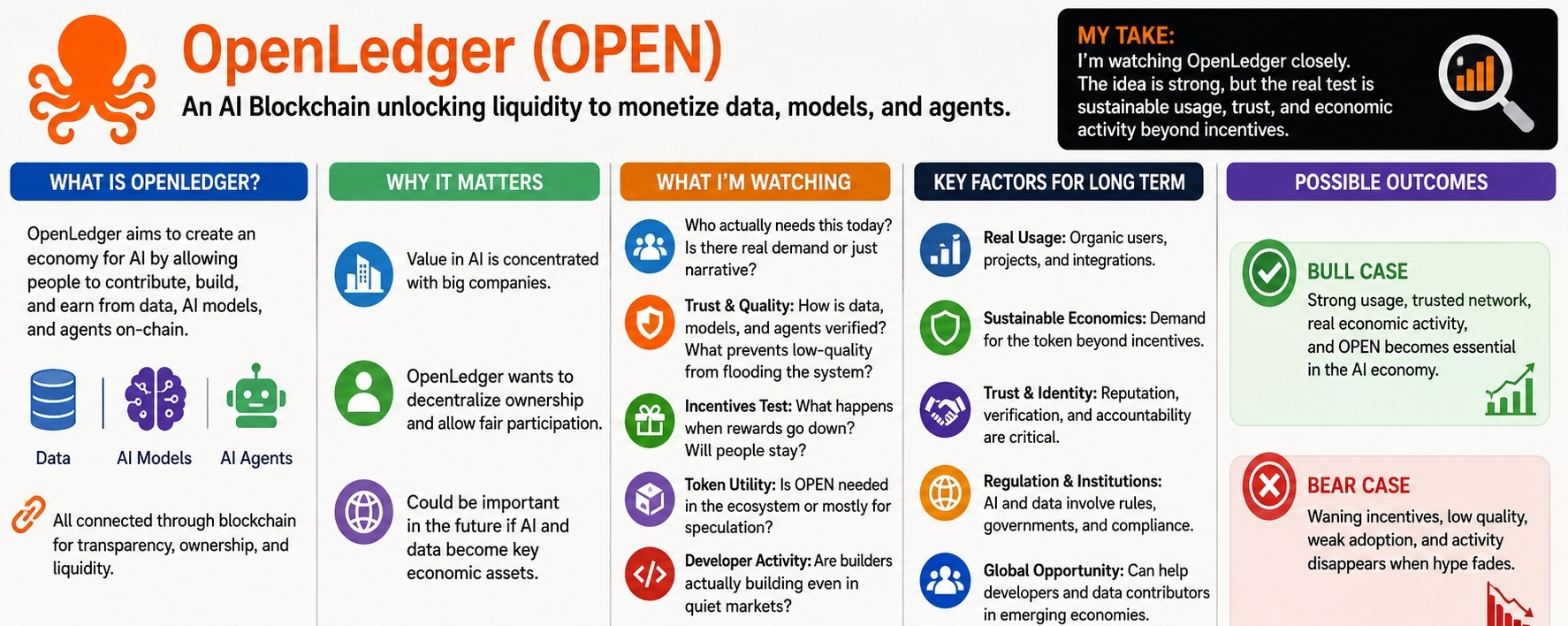
I’m watching OpenLedger more carefully these days because I’ve started paying less attention to loud narratives and more attention to whether a project is actually building something people might use in the real world. I remember when I used to get excited just hearing “AI” and “blockchain” together, but now I try to slow down and ask simpler questions. With OpenLedger, I’m not trying to rush into an opinion or chase excitement. I’m mostly trying to understand whether this is a system that can stay alive when attention moves somewhere else, because in crypto, surviving matters more than trending.
What keeps me interested in OpenLedger is the direction it is trying to take. The idea of creating an economy around data, AI models, and agents sounds important, especially at a time when AI is growing so quickly but ownership still feels concentrated. Most of the value today sits with large companies that control infrastructure, computing, and access. OpenLedger seems to be asking whether there is another way to coordinate this, where contributors, developers, and builders can actually participate in the value being created instead of sitting outside of it.
Still, I find myself asking who really needs this system right now. That question matters to me because crypto has a history of creating solutions before demand truly exists. It is easy to build something that sounds smart. It is much harder to build something people depend on. When I study OpenLedger, I try to understand whether developers genuinely need this infrastructure or whether the market is simply excited about the AI narrative and attaching value before usage arrives.
I’ve noticed that projects focused on infrastructure usually take longer to understand. They rarely look exciting in the beginning because real infrastructure often grows quietly. People usually notice it only after it becomes useful enough that removing it feels impossible. That makes OpenLedger difficult to judge too quickly. If the goal is to become an important layer for AI coordination, data sharing, or monetization, then this probably will not be proven overnight. The bigger question is whether activity slowly grows over time or stays dependent on speculation.
Trust feels like one of the most important things for OpenLedger to solve. AI systems only work when people trust the quality of what they are using. Data quality matters. Model quality matters. Reputation matters. If OpenLedger wants people to build around its ecosystem, then there has to be a reason for users to believe the information, models, or agents inside the network are reliable. I keep wondering how this works in practice because incentives alone do not always create quality. Sometimes they create noise.
That brings me to something I always think about when looking at projects like this: what happens when incentives become smaller? Crypto projects often grow quickly when rewards are strong, but real adoption only becomes visible when people stay after the rewards slow down. I think this is one of the biggest tests for OpenLedger. If developers keep building, contributors keep participating, and activity continues without needing constant incentives, then that says something meaningful. But if engagement disappears when rewards fade, then the system may be weaker than it looks.
I also pay attention to how the token fits into the bigger picture because token activity and ecosystem activity are not always the same thing. I try to understand whether the OpenLedger ecosystem actually needs the token to function or whether the token mostly exists for speculation. Is it helping coordinate activity? Is it creating useful incentives? Does it connect to real economic movement inside the network? These questions matter because long-term sustainability usually comes from utility, not excitement.
Developer activity is another thing I quietly watch. I trust builders more than headlines. If people continue experimenting, creating tools, and integrating with the ecosystem during slower market periods, I take that seriously. Healthy ecosystems usually grow when nobody is paying attention. OpenLedger feels like one of those projects where developer behavior may end up telling a bigger story than price action ever could.
I also think there is a broader economic angle here that people overlook. AI is becoming global infrastructure, and countries are starting to think more seriously about data ownership, digital identity, and technological independence. If OpenLedger wants to build an ecosystem around intelligence and data, it eventually enters conversations around regulation, trust, and institutions whether it wants to or not. Businesses and governments care about accountability, especially when valuable data or automated systems are involved. That makes adoption harder, but it also makes the opportunity bigger if trust can actually be built.
I’ve noticed that capital moves very quickly toward strong themes, and right now AI is one of the strongest themes in the market. That naturally brings attention to projects like OpenLedger. But I try not to confuse market attention with proof. A project can attract liquidity because people believe in the future, not because the present is already working. I think the real signal will come later, when excitement becomes quieter and only genuine activity remains.
So for now, I’m simply watching OpenLedger without rushing. I want to see whether real usage appears, whether developers continue showing up, whether the ecosystem creates actual economic activity, and whether people find reasons to stay beyond incentives. I’m less interested in promises and more interested in patterns. Sometimes the strongest projects are the ones that quietly keep building while everyone else looks somewhere else. I do not know yet where OpenLedger will end up, but I think it is one of those projects that makes more sense to study patiently than to judge too quickly.