
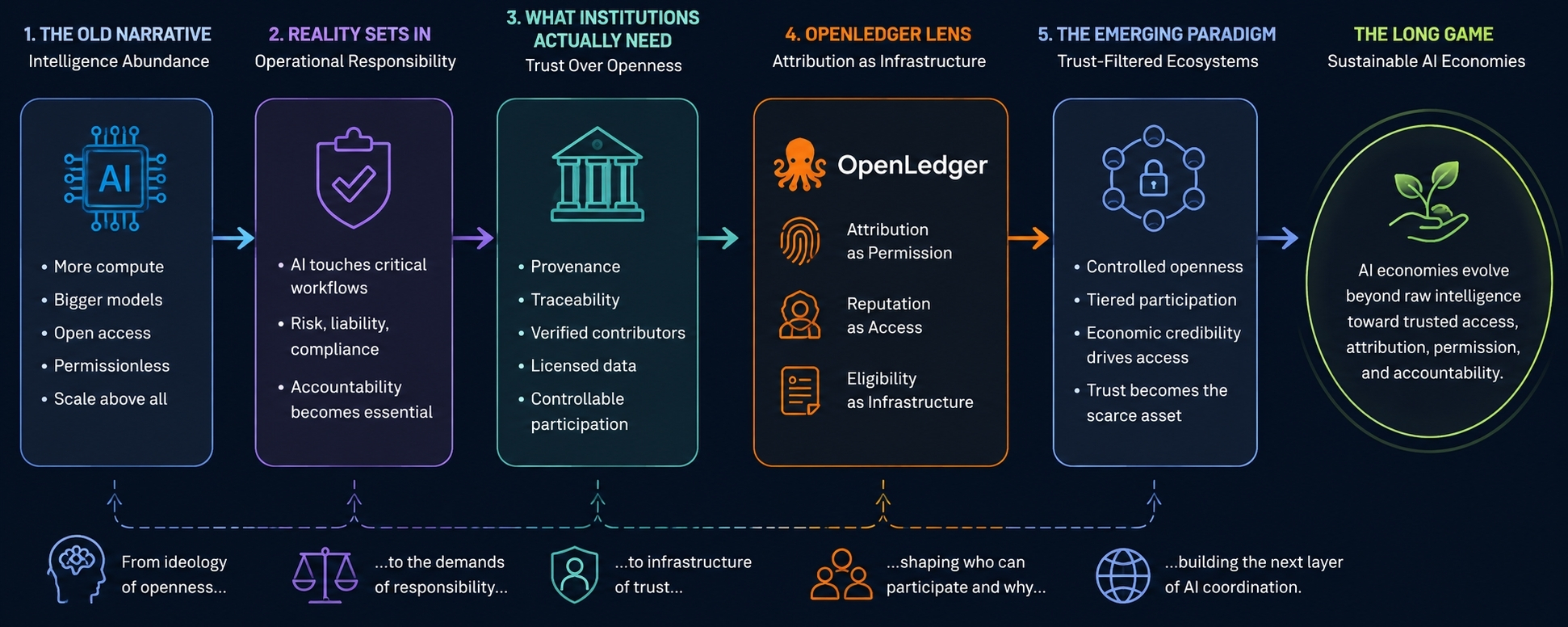
I keep thinking about how quickly the language around AI changed without most people noticing it happen. A few years ago, the conversation revolved around scale almost obsessively. Bigger models. Larger datasets. More compute clusters stacked across regions like industrial monuments to inevitability. The assumption underneath all of it felt strangely unquestioned: intelligence itself would become the scarce asset, and whoever produced the most capable systems would naturally control the future.
But the more I observe the way institutions actually behave, the less convincing that story feels.
When AI remains experimental, openness sounds noble. Markets reward accessibility because participation itself creates momentum. People celebrate permissionless systems because the risks still feel abstract. Yet something changes once AI moves closer to operational responsibility. The moment models begin touching insurance claims, financial approvals, legal interpretation, underwriting, enterprise records, procurement systems, or customer eligibility decisions, intelligence alone stops being the primary concern. Suddenly the questions become slower and more administrative. Who trained this model? Where did the data originate? Who approved the workflow? Can the outputs be audited later? Who carries liability if something breaks quietly rather than catastrophically?
It starts to feel less like software and more like infrastructure.
That shift is what keeps pulling my attention toward projects like OpenLedger, not because they promise another speculative AI marketplace, but because they accidentally reveal where institutional gravity may already be moving. Beneath the language about monetizing models, data, and agents, there is a deeper idea emerging almost indirectly: that future AI economies may revolve less around raw capability and more around trusted participation.
Not openness in the romantic early-internet sense. Controlled openness. Observable openness. Permissioned fluidity.
That distinction matters more than people admit.
Most enterprises do not actually want infinite intelligence flowing freely through their systems. They want bounded intelligence with provenance attached to it. They want attribution because attribution creates accountability. They want licensed data because ownership disputes become existential once AI outputs influence regulated decisions. They want verified contributors because anonymous participation introduces operational ambiguity. Even decentralization, when viewed through enterprise incentives, begins transforming into something narrower and more selective than the ideology that originally inspired it.
I think this is where many public conversations around decentralized AI become disconnected from institutional reality. There is still a tendency to imagine future AI ecosystems as vast open bazaars where models, agents, and datasets interact frictionlessly across tokenized markets. But large organizations rarely optimize for frictionless systems. They optimize for systems they can explain internally to compliance departments, regulators, legal teams, insurers, and shareholders.
The architecture slowly bends around that pressure.
And maybe that is why attribution itself is beginning to feel different. Earlier blockchain narratives treated attribution mostly as a rewards mechanism. Proof of contribution. Proof of participation. A way to distribute economic upside across networks. But increasingly it looks like attribution may evolve into something more structural — almost a form of permission infrastructure.
Not just who contributed, but who is allowed to contribute.
Not just provenance as history, but provenance as eligibility.
Economic reputation starts becoming a coordination layer rather than a social metric. Verified actors gain access to better data flows, more valuable inference environments, privileged integrations, institutional partnerships, compliant deployment zones. Participation becomes tiered quietly, often under the language of trust and safety. And to be fair, some of this may be unavoidable. Enterprises handling sensitive data cannot realistically operate on pure anonymity. Regulators will not tolerate invisible accountability chains indefinitely. Insurance frameworks require identifiable responsibility. Governance systems eventually demand enforceable credibility.
Still, there is something psychologically strange about watching open systems slowly reorganize themselves around selective trust.
The contradiction feels unresolved.
Decentralization originally carried the promise of reducing gatekeepers, yet mature infrastructure often recreates gatekeeping through softer mechanisms. Reputation systems. Compliance layers. Verification standards. Access scoring. Institutional whitelisting. The architecture remains technically decentralized while economic influence concentrates around entities capable of satisfying trust requirements at scale.
Sometimes I wonder if this is simply what every open network becomes once enough real capital enters the environment. Markets speak the language of openness during expansion phases, then gradually transition toward managed participation once risk exposure grows large enough.
AI may just be accelerating that transition because the stakes are unusually intimate. Unlike previous digital systems, AI increasingly mediates judgment itself. Access decisions. Risk assessments. Information filtering. Behavioral interpretation. Recommendation flows. Customer prioritization. Once systems begin influencing outcomes rather than merely processing transactions, trust stops being philosophical and becomes operational.
And operational trust is expensive.
That is where the economics become difficult. Projects like OpenLedger can articulate a compelling infrastructure direction around traceability, attribution, and monetizable AI coordination, but there is still a substantial gap between useful infrastructure and sustainable token economics. The market often assumes that because a network solves a real coordination problem, value will automatically accrue to the associated token layer. History suggests it rarely unfolds so neatly.
Sometimes the infrastructure becomes indispensable while the asset attached to it struggles to capture proportional economic value. Sometimes governance gets manipulated by concentrated actors long before decentralization matures meaningfully. Sometimes enterprises use decentralized rails quietly while insulating themselves from the volatility and openness associated with public participation. Sometimes compliance requirements become so dominant that the original network culture disappears almost entirely beneath enterprise abstractions.
There is also the uncomfortable possibility that “trust” itself becomes another mechanism for exclusion disguised as safety. Smaller contributors, anonymous developers, independent researchers, or emerging regions may find themselves increasingly locked out of valuable AI coordination layers because they lack institutional credibility rather than technical competence. Permission systems rarely announce themselves aggressively. They emerge incrementally through standards, integrations, certifications, procurement policies, and insurance constraints until participation narrows almost invisibly.
And yet despite all of this skepticism, I cannot completely dismiss the underlying direction.
Because the more AI integrates into economically sensitive systems, the harder it becomes to imagine pure openness surviving unchanged. Institutions may tolerate experimental chaos around consumer entertainment or speculative tooling, but they become deeply conservative when operational liability enters the picture. Trust infrastructure begins replacing computational abundance as the scarce asset. Not because intelligence stopped mattering, but because organizations need systems they can govern, explain, insure, and defend politically.
Maybe that is the quieter transformation happening beneath the visible AI race. Compute still matters. Model performance still matters. But another layer is forming underneath — a slower layer built around permission, accountability, provenance, and economic credibility. Less visible than model benchmarks. Probably less exciting to retail speculation. Yet potentially more durable.
The strange part is that most of these shifts do not arrive dramatically. They arrive through procurement decisions. Through enterprise partnerships. Through compliance architecture. Through invisible restrictions buried inside operational frameworks. Infrastructure changes first at the edges, then suddenly the center behaves differently too.
And by the time markets fully recognize the transition, the system already feels normal.