
One thing that becomes clear with AI is that the technology is moving faster than the systems around it.
The tools keep improving. Models get better. Agents become more capable. More people are building small AI products, testing workflows, collecting data, training niche models, and trying to make something useful out of all of it.
But the space still feels scattered.
That may be the part people do not talk about enough.
There are models in one place, datasets in another, agents running somewhere else, users moving between platforms, and builders trying to connect everything with whatever tools are available. Some of it works. Some of it feels patched together. A lot of it depends on closed systems that do not always speak to each other clearly.
OpenLedger can be looked at from this angle.
Not only as a blockchain for AI assets. Not only as a way to monetize data, models, and agents. But as an attempt to help AI systems coordinate better.
That sounds simple, but it matters.
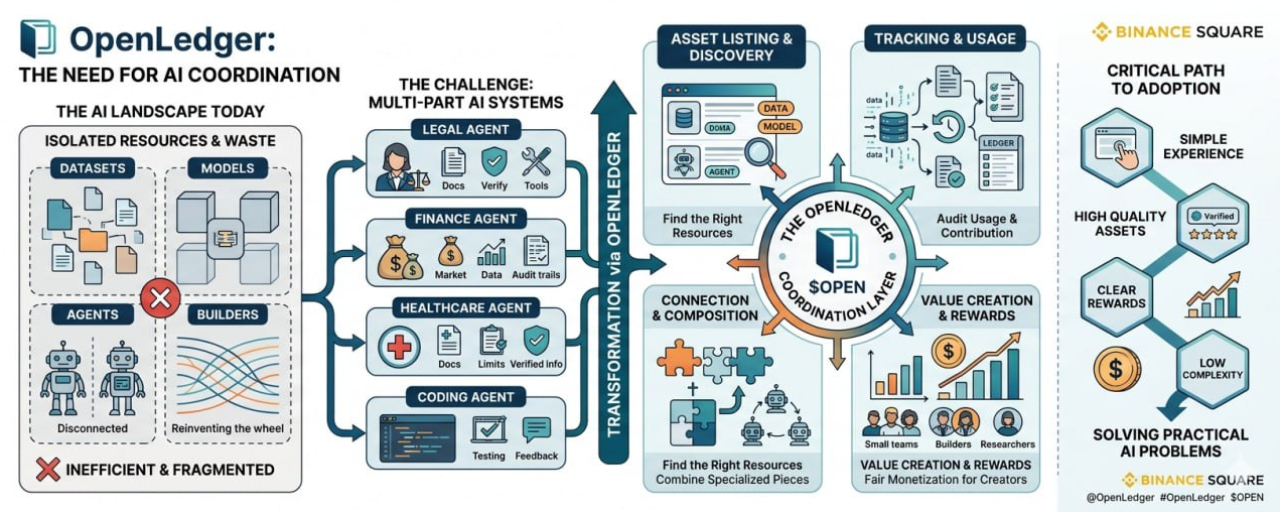
AI is becoming less like one product and more like a set of moving parts. A model may need special data. An agent may need access to several models. A user may want an agent that can handle a task across different environments. A builder may want to plug into useful resources without starting from zero each time.
The more this grows, the more coordination becomes a real problem.
You can usually tell when a market is still early because everyone is building their own version of the same basic pieces. One team builds a dataset. Another team builds a model. Another builds an agent. Someone else builds a tool to connect them. Then another group builds almost the same thing again, because the first version was not easy to access or reuse.
After a while, the issue is not only innovation. It is waste.
Good work gets trapped inside small corners. Useful data is not always easy to discover. Models that could be improved by wider use stay isolated. Agents that might become better through repeated tasks never get enough activity. Builders spend too much time rebuilding the base layer instead of improving the actual experience.
That is where a shared layer starts to make sense.
OpenLedger seems to be working toward a system where AI resources can be listed, used, tracked, and connected in a more open way. The interesting part is not just that these resources exist. They already exist everywhere. The interesting part is whether they can become easier to combine.
Because the next stage of AI may not be about one model doing everything.
It may be about many smaller pieces working together.
A legal agent might need access to legal datasets, document models, verification tools, and task-specific workflows. A finance agent might need clean market data, risk models, and audit trails. A healthcare support agent may need careful boundaries, verified information, and controlled usage. A coding agent may rely on code models, testing environments, and feedback loops from real developers.
Each of these systems depends on more than intelligence.
They depend on reliable inputs, clear permissions, and ways for different parts to work together without losing track of who contributed what.
That is the coordination problem.
And in that sense, OpenLedger is not only about ownership. It is also about making AI resources more usable across a wider network. A dataset has more value when the right model can find it. A model has more value when agents can use it. An agent has more value when users can trust it enough to run real tasks. The pieces become stronger when they are not isolated.
There is also a quieter human side to this.
A lot of AI builders are not giant companies. They are small teams, researchers, independent developers, data collectors, and people working on narrow problems. Some may not have the resources to build a full platform around their work. But they may have something valuable. A clean dataset. A specialized model. A useful agent. A workflow that solves one problem very well.
In the current setup, these smaller contributions can be hard to turn into anything durable.
They may get attention for a moment, then disappear. Or they may be copied into a larger system without much visibility. Or they may never reach the people who could actually use them.
A network like OpenLedger is interesting because it suggests another path. It gives these smaller pieces a place to exist as assets, not just as files or demos. They can be discovered. They can be used. Their activity can be recorded. Their value can grow with demand rather than depending only on attention.
That does not mean it is easy.
Coordination systems are hard to build because they need both sides. Contributors need a reason to bring useful resources. Builders need a reason to use them. Users need tools that feel simple enough. And the whole thing needs to avoid becoming too complex, because complexity kills adoption quietly.
This is where OpenLedger will likely be tested.
The idea sounds natural, but the experience has to feel natural too. If using the network feels heavy, people may stay with simpler tools. If the quality of assets is uneven, builders may hesitate. If rewards feel unclear, contributors may lose interest. These are not small details. They are usually the details that decide whether an infrastructure idea becomes useful or remains mostly theoretical.
Still, the direction is worth paying attention to.
AI is creating more pieces than people can easily organize. More models. More agents. More datasets. More tools. More experiments. At some point, the question is not only who builds the best model. It becomes who helps all these pieces work together in a way that makes sense.
OpenLedger sits near that question.
It is trying to give AI assets a shared environment where they can move, connect, and carry some record of their use. Not as a finished answer to the AI economy, but as one possible structure for it.
And maybe that is the more grounded way to see it.
Not as a loud promise about the future. More like a response to a practical problem that is already showing up. AI is growing in pieces. Someone has to figure out how those pieces find each other.