
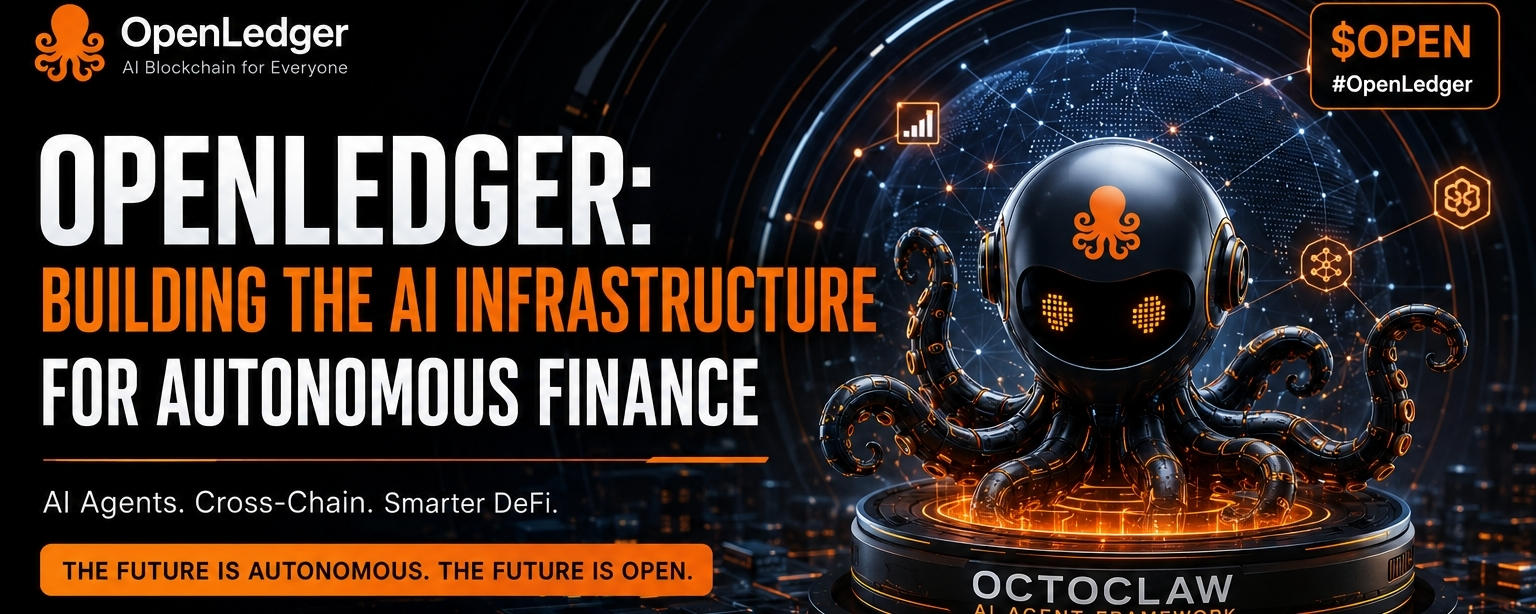
The intersection of artificial intelligence and decentralized finance is quickly evolving from a speculative narrative into a real technological movement. While many projects are still focused on hype cycles and short-term trends, @OpenLedger edger appears to be building something with long-term infrastructure potential. From the Octoclaw launch to trading agents, ERC-4626 integration, cloud configuration systems, vibecoding, and EVM bridge expansion, the ecosystem is quietly positioning itself as a foundation layer for autonomous on-chain execution.
What makes OpenLedger interesting is not just the AI angle itself, but how the project is attempting to create tools that reduce friction between humans, AI agents, and blockchain infrastructure.
Octoclaw Launch: More Than Just Another AI Tool
The launch of Octoclaw represents one of the most ambitious directions within the OpenLedger ecosystem. At first glance, some people may see it as simply another AI-powered product, but the deeper implication is much larger. Octoclaw is part of a broader push toward intelligent autonomous systems capable of interacting with blockchain environments dynamically.
The crypto market is becoming increasingly complex. Traders monitor dozens of chains, multiple liquidity pools, market sentiment shifts, macroeconomic news, and fast-moving volatility all at the same time. Manual execution is no longer enough for many participants. This is where OpenLedger’s vision becomes relevant.
Octoclaw aims to simplify intelligent execution and automation while maintaining decentralized flexibility. Instead of relying purely on centralized trading systems or rigid bots with limited adaptability, the system introduces a more dynamic approach to interacting with DeFi infrastructure.
The launch signals OpenLedger’s intention to move beyond theory and into practical deployment.
Cloud Config: The Missing Layer for AI Automation
One of the underrated aspects of AI-powered blockchain systems is infrastructure management. Many projects talk about AI agents, but very few discuss how those agents are configured, scaled, updated, and deployed efficiently.
OpenLedger’s cloud configuration approach attempts to solve that problem.
Cloud config systems can allow users and developers to manage AI agent behavior without constantly rebuilding workflows from scratch. This is extremely important because AI execution environments need flexibility. Strategies evolve, market conditions change, and agent parameters require optimization.
Instead of treating AI trading or automation as static code, OpenLedger appears to approach it as a living system capable of adaptation. That distinction matters.
As decentralized AI ecosystems grow, scalable cloud-based configuration layers may become essential infrastructure. OpenLedger seems to understand this early.
Trading Agents and the Future of Autonomous Markets
One of the strongest narratives surrounding OpenLedger is the development of trading agents.
Traditional bots operate through predefined logic. AI agents, however, introduce contextual awareness and adaptive behavior. The long-term vision is not just automation, but intelligent automation capable of interpreting data, optimizing execution, and adjusting strategies dynamically.
This could fundamentally reshape how retail and institutional participants interact with markets.
Imagine a future where AI agents monitor volatility, rebalance portfolios, identify arbitrage opportunities, manage risk exposure, and execute transactions across multiple chains simultaneously — all with minimal human intervention.
That is the direction many AI-DeFi projects claim to pursue.
The difference is that OpenLedger appears focused on building infrastructure components that support this vision instead of relying solely on marketing narratives. The combination of trading agents with cloud configuration tools and cross-chain compatibility creates a much stronger ecosystem foundation.
If successful, OpenLedger could become part of the infrastructure layer powering autonomous finance.
ERC-4626 Integration and Smarter Yield Infrastructure
The integration of ERC-4626 is another major development that deserves attention.
ERC-4626 has become an increasingly important tokenized vault standard within DeFi because it improves interoperability for yield-bearing assets. By supporting this framework, OpenLedger positions itself within the broader movement toward standardized and composable DeFi infrastructure.
This matters for AI-driven systems because intelligent agents require efficient access to liquidity strategies and vault mechanisms. Without standardized infrastructure, automation becomes fragmented and inefficient.
ERC-4626 integration potentially allows OpenLedger’s ecosystem to interact more seamlessly with yield protocols, vault systems, and liquidity frameworks across Ethereum-compatible networks.
In simple terms, it creates a smoother environment for autonomous financial execution.
That may sound technical, but infrastructure upgrades like this are often what separate sustainable ecosystems from temporary trends.
Vibecoding and Lowering the Barrier to Entry
One of the most interesting cultural shifts happening in crypto and AI is the rise of “vibecoding” — building and experimenting rapidly without the traditional complexity associated with software development.
OpenLedger embracing vibecoding could become a powerful onboarding mechanism for new developers and creators entering decentralized AI ecosystems.
The easier it becomes to create AI-powered blockchain workflows, the faster ecosystems can grow.
Historically, technical barriers slowed innovation. Projects that simplify deployment and experimentation often gain stronger community-driven momentum. If OpenLedger can successfully combine AI tooling with accessible workflow creation, it could unlock a new generation of decentralized builders.
This is particularly important because the future of crypto may depend less on passive investors and more on active creators building autonomous systems.
EVM Bridge Expansion and Cross-Chain Intelligence
No modern blockchain infrastructure project can ignore interoperability.
The EVM bridge direction within OpenLedger expands the ecosystem’s ability to interact across multiple chains and liquidity environments. As the industry becomes increasingly multichain, isolated ecosystems lose relevance quickly.
AI agents and automated systems require broad access to data, liquidity, and execution environments. Cross-chain compatibility is no longer optional — it is essential.
By focusing on EVM bridge functionality, OpenLedger strengthens its ability to operate in a fragmented blockchain landscape.
This also aligns with the broader vision of autonomous finance. AI agents cannot remain confined to a single chain if they are expected to optimize execution effectively.
Final Thoughts
OpenLedger is positioning itself at the intersection of several powerful narratives: AI infrastructure, autonomous finance, cross-chain interoperability, intelligent trading systems, and accessible decentralized development.
Many projects discuss AI. Few are attempting to build the foundational layers required for scalable decentralized AI execution.
The combination of Octoclaw, trading agents, cloud configuration systems, ERC-4626 integration, vibecoding support, and EVM bridge expansion suggests that OpenLedger is thinking beyond short-term hype cycles.
Whether the ecosystem fully delivers on its long-term vision remains to be seen, but one thing is becoming clear: the conversation around AI in crypto is shifting from speculation toward infrastructure.
And OpenLedger is trying to be part of that foundation.
