Look, I keep running into the same weird feeling every time people start talking about ownership in Web3.
Something doesn't fully add up.
We solved wallet ownership. We solved token ownership. We solved asset ownership... sort of.
But then AI showed up and exposed this giant hole sitting right in the middle of everything.
People contribute data every day. Developers train models. Communities help systems improve. AI agents perform tasks, create outputs, and generate value. But here's the thing nobody really likes talking about: once value actually appears, tracking who deserves credit suddenly gets messy.
Really messy.
I've seen this before.
The internet has always had a habit of quietly absorbing value from users and redistributing it somewhere else. People create things. Platforms capture most of the upside. Everyone acts surprised afterward.
Now AI risks doing the same thing.
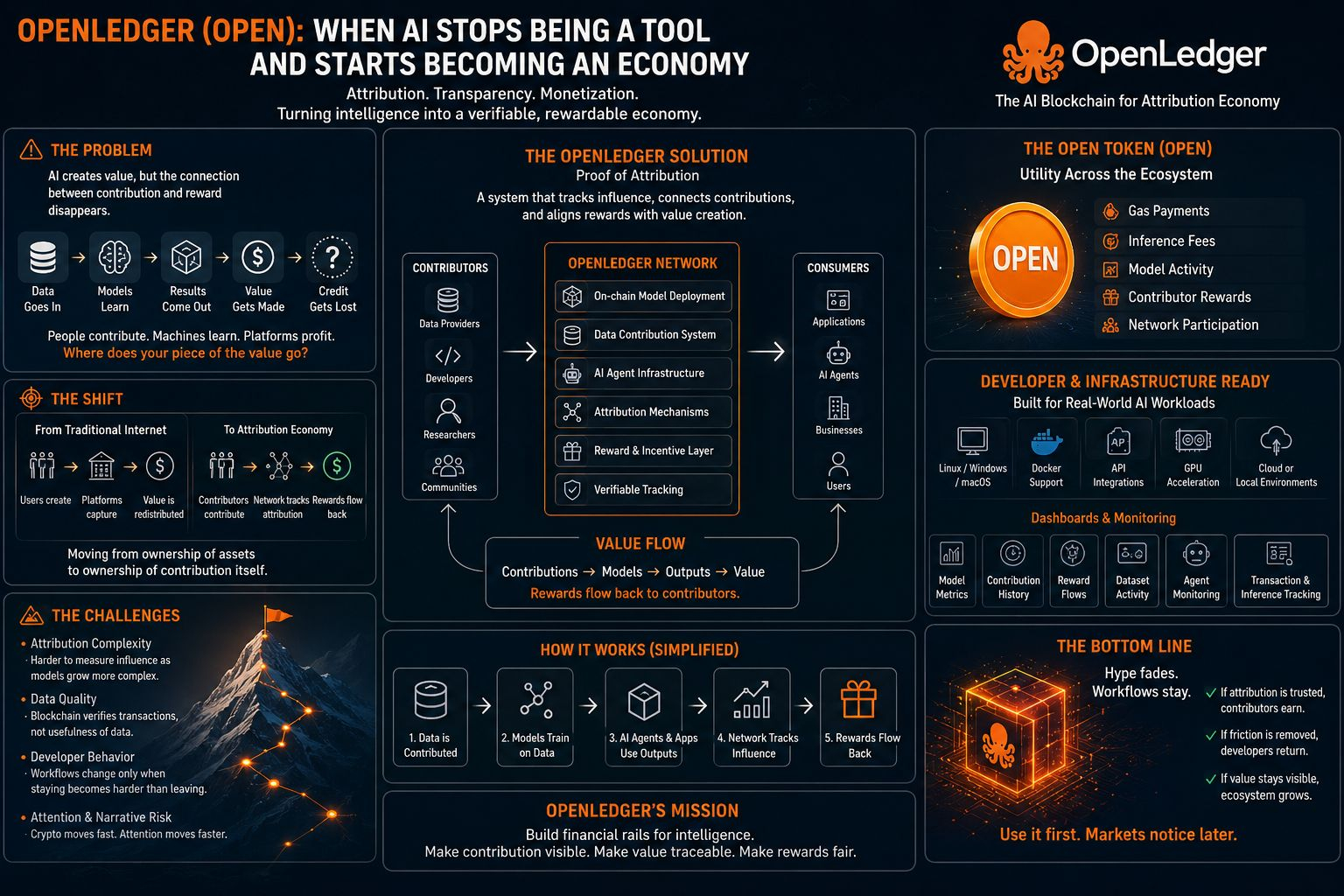
Data goes in.
Models learn.
Results come out.
Money gets made.
And somewhere in the middle, the connection between contribution and reward starts disappearing.
For developers, that's frustrating.
For creators, it creates trust problems.
For people providing data? That's an even bigger issue because suddenly you're asking: if my data helped train something valuable, where exactly does my piece of that value go?
Good question.
Nobody seems to have a clean answer yet.
And let's be real for a second — Web3 users already deal with enough chaos. Multiple wallets, bridges, ecosystems, dashboards, accounts, networks... half the time people spend more effort moving between systems than actually using them.
So adding another black-box AI layer on top?
Not exactly attractive.
The problem probably isn't building smarter AI anymore.
The problem is building systems where value stays visible.
And that's where OpenLedger and its OPEN token start getting interesting.
Notice I didn't say guaranteed.
Interesting.
Because OpenLedger isn't really pitching itself as another AI app. It looks more like infrastructure trying to turn intelligence itself into something that moves through an economy.
There's a difference.
Apps fight for users.
Infrastructure fights for usefulness.
Big difference.
If OpenLedger actually pulls this off, users probably won't ask, "Should I try this?" They'll ask, "Does this make my workflow easier?"
That's the question that matters.
OpenLedger describes itself as an AI blockchain focused on attribution, transparency, and monetization.
Sounds simple at first.
But people don't talk about this enough: attribution sounds easy until you actually try building it.
Imagine thousands or millions of data points feeding models over time. Then imagine trying to determine who deserves rewards when those models create value.
Not fun.
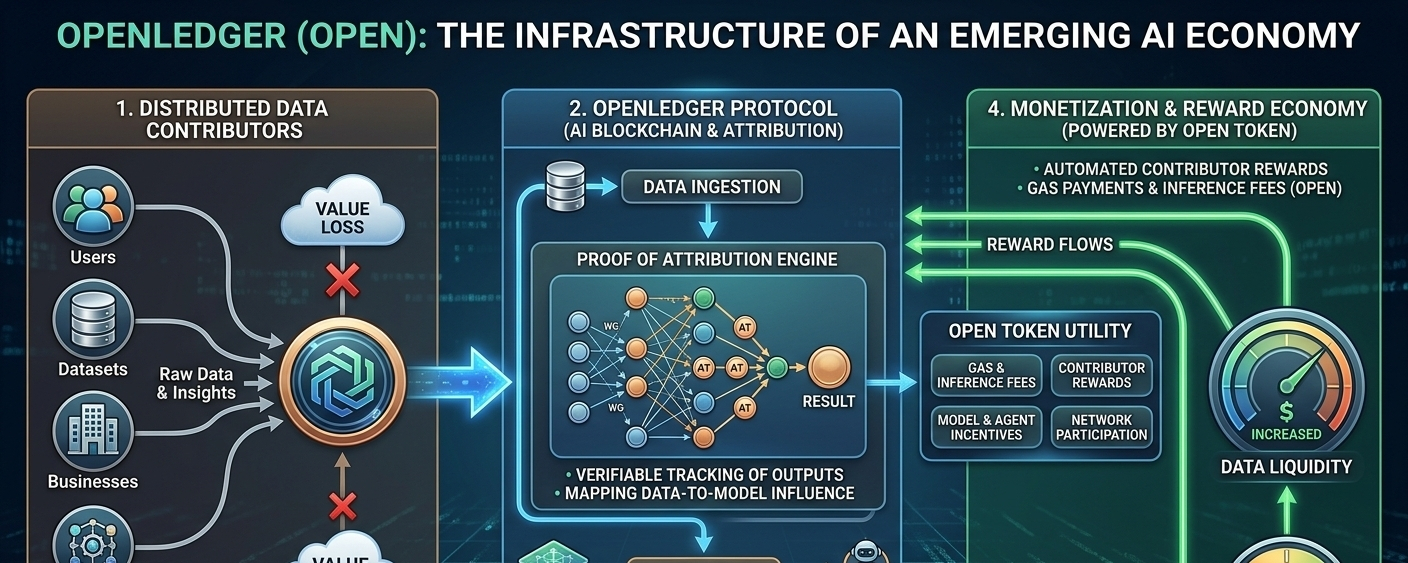
OpenLedger basically says the current AI market has a data liquidity problem.
And honestly, I get the argument.
There are huge amounts of valuable information scattered everywhere — communities, datasets, businesses, platforms — and most of it sits disconnected from meaningful economic systems.
People contribute value.
Then value disappears into the machine.
OpenLedger wants to change that.
The ecosystem introduces multiple connected pieces:
• On-chain model deployment
• Data contribution systems
• AI agent infrastructure
• Attribution mechanisms
• Reward systems through token incentives
• Verifiable tracking of outputs and influence pathways
Instead of asking:
"Did this model generate value?"
The network asks something else.
"What helped create that value?"
"Which dataset mattered?"
"Who actually contributed?"
Honestly, that's where things get interesting.
Because now we're moving away from ownership of assets and toward ownership of contribution itself.
Under the hood, OpenLedger appears to center around something called Proof of Attribution.
And no, this isn't just normal blockchain bookkeeping with a fancy label slapped on top.
The idea seems pretty straightforward:
Someone contributes data.
Models train against those datasets.
Applications and agents consume model outputs.
The network tracks relationships between all those moving parts.
Rewards potentially flow backward toward contributors.
Simple idea.
Hard execution.
Really hard.
Because now you're basically trying to create financial rails for intelligence.
Not just tracking who owns a token.
Tracking who helped create an outcome.
That becomes a much bigger deal once AI agents start becoming normal.
Think about it.
An autonomous AI agent could analyze markets, automate workflows, interact with users, consume APIs, generate content, trigger actions... pretty much operate independently.
Now imagine multiple people helped build the intelligence beneath that agent.
Who gets paid?
Who deserves credit?
OpenLedger tries to answer that.
From a developer angle, repeat usage matters way more than launch announcements.
People get excited about launches for maybe a week.
Sometimes less.
Then reality shows up.
Developers come back only if something saves them time or removes friction from daily work.
Period.
OpenLedger seems designed around recurring activity rather than one-time experiments.
Possible ongoing use cases include:
Dataset publishing and monetization.
Model deployment.
Inference requests.
AI agent creation.
Tracking rewards.
Network participation.
The OPEN token itself handles several functions:
Gas payments.
Inference fees.
Model-related activity.
Contributor rewards.
Participation across the network.
That matters because projects become fragile when tokens only serve one purpose.
I've seen that movie too.
Everyone gets excited until activity slows down and suddenly nobody needs the token anymore.
Multiple utility layers don't guarantee success.
But they usually give systems more room to breathe.
Now let's talk about the less exciting stuff.
The practical stuff.
Because reality always shows up eventually.
Blockchain systems tied to AI usually demand heavier infrastructure compared to basic wallet applications.
Developers interacting with AI environments generally need:
Modern operating systems like Linux, Windows, or macOS.
Containerization support like Docker.
API integrations for inference and model access.
GPU acceleration where workloads become heavier.
Cloud infrastructure or local environments depending on deployment needs.
Dashboards capable of showing:
Model metrics.
Contribution history.
Reward flows.
Dataset activity.
Agent monitoring.
Transaction analytics.
Inference tracking.
Not glamorous.
Necessary.
Now here's where I get cautious.
Because crypto and AI together can create some really loud narratives.
Sometimes too loud.
Infrastructure often arrives before people actually need it.
Markets price expectations long before usage appears.
And this is where things get tricky.
OpenLedger still faces some real challenges.
First problem: attribution itself.
As models become larger and more complicated, figuring out exactly how much influence a dataset had becomes increasingly difficult.
Second problem: data quality.
Blockchain can verify transactions.
It can't magically determine whether uploaded information is useful.
Bad data still exists.
Always will.
Third problem: developer behavior.
Developers usually don't wake up one morning and abandon workflows that already work.
People switch when staying becomes harder than leaving.
That's a high bar.
Then there's attention.
Crypto narratives move fast.
Today everyone talks about AI agents.
Tomorrow it's decentralized compute.
Next week something else steals the spotlight.
Technology competes against technology.
But it also competes against human attention spans.
That's brutal.
Current market data places OPEN around roughly $0.18 with market capitalization above $53 million, daily trading volume around $9.5 million, and a total token supply capped at 1 billion tokens with a portion already circulating.
But honestly?
Price isn't really the part I care about.
I care about behavior.
Because eventually hype slows down.
People stop posting giant threads.
The noise gets quieter.
And one question stays alive:
Are people actually using this thing?
That's the question.
Always.
Because if OpenLedger builds attribution systems developers trust, if contributors repeatedly earn value, and if the ecosystem removes friction instead of adding more complexity, then maybe it grows into infrastructure people actually depend on.
Maybe.
But if workflows feel complicated...
If contribution tracking becomes messy...
If users don't come back after trying it once...
Then none of the bigger ideas matter.
Crypto usually focuses on price first.
The stronger systems usually work backward.
People use them first.
Markets notice later.