

I’ve been watching OpenLedger quietly for a while now, mostly the same way I watch a lot of AI and blockchain projects these days not with instant excitement, but with curiosity mixed with caution. The industry moves so fast that every few months there’s a new narrative everyone suddenly repeats at the same time. One minute it’s modular chains, then AI agents, then data ownership, then decentralized intelligence. After a while, the words start blending together. But OpenLedger keeps showing up in conversations that feel a little more serious than the usual hype cycle.
What interests me is not the branding around being an “AI Blockchain.” I think everyone is using AI somewhere in their pitch now. What catches my attention is the bigger question underneath it: if data, models, and AI agents are becoming valuable digital assets, then who actually owns them, who controls access to them, and who gets rewarded when they’re used? That sounds straightforward when people say it quickly on stage or in Twitter threads, but once you really think about it, the whole thing becomes complicated almost immediately.
At first it sounds simple. People contribute data, developers build models, agents perform tasks, and blockchain infrastructure handles transparency and rewards. Clean idea. But reality is different. Data is messy. Most useful information is private, incomplete, or sensitive in some way. AI systems are expensive to run. Attribution is difficult. And once money gets involved, people stop behaving naturally and start optimizing for incentives instead.
I keep coming back to that idea because it happens in almost every crypto ecosystem eventually. A system launches with good intentions, then incentives arrive, and suddenly people are farming activity instead of creating real value. Metrics go up, engagement looks strong, but underneath it there’s a difference between actual usage and artificial participation. OpenLedger will eventually have to deal with that same pressure if the ecosystem grows. Every network does.
That’s where things get interesting for me. The project feels less like a finished product and more like an experiment happening in public. It’s trying to sit between two industries that both move in completely different ways. AI moves fast, breaks things, and evolves almost monthly. Blockchain moves slower because trust systems can’t afford constant instability. Combining those worlds sounds exciting until you realize they have very different priorities.
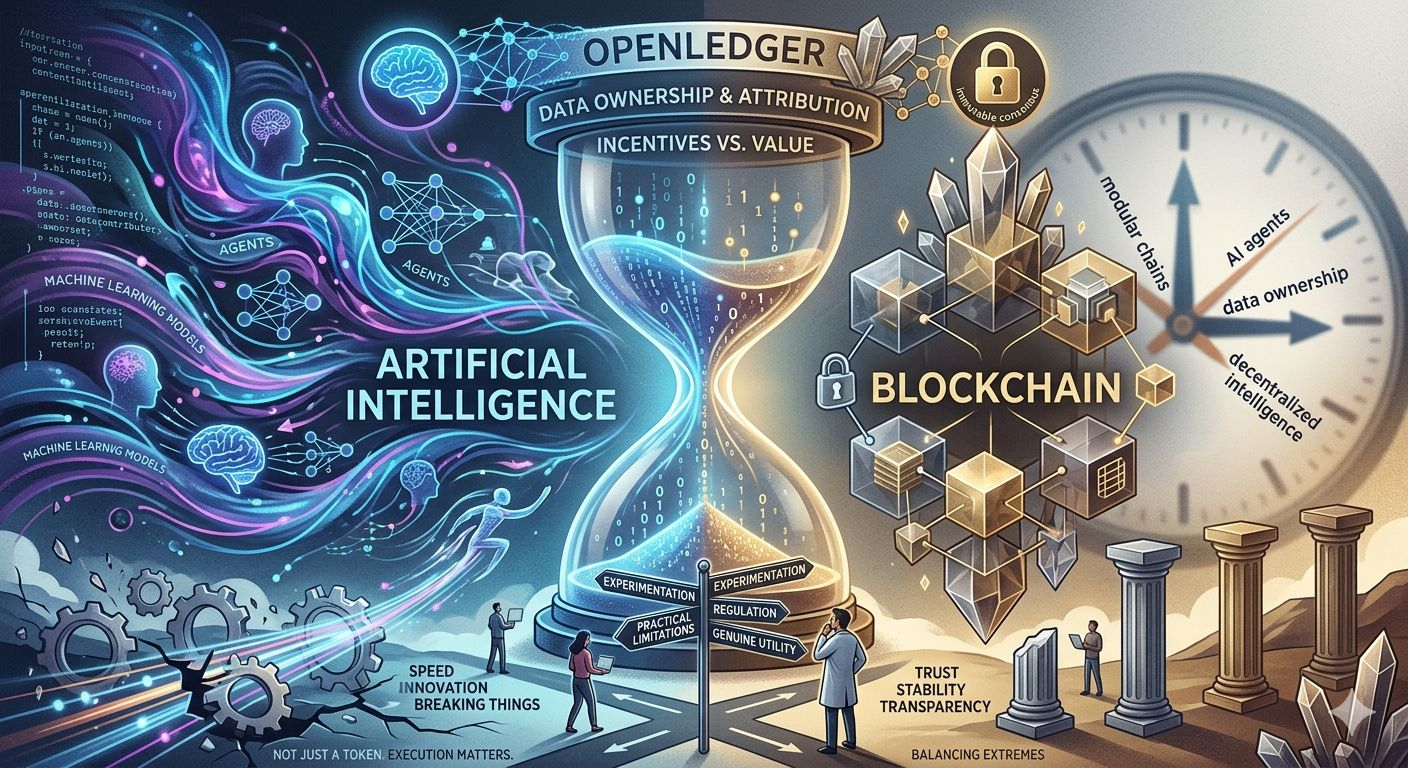
I’m not fully convinced yet, and honestly I think that’s the healthiest mindset to have around projects like this. The crypto industry has trained people to confuse big narratives with actual execution. But execution will decide everything here. Not the token. Not the announcements. Not the partnerships people post online for engagement. The difficult part is building systems that still work once real users arrive, costs increase, regulations tighten, and incentives start changing user behavior.
And regulation is the part people still avoid talking about honestly. Everyone loves the idea of monetizing data until questions about privacy and compliance appear. Who verifies ownership? What kind of data is allowed? What happens if models are trained on information that later becomes legally disputed? These are not small problems anymore. AI is moving into territory where governments are paying attention now, and blockchain projects connected to AI infrastructure will eventually face that pressure too.
Real systems don’t work in extremes. That’s something I keep thinking about whenever I listen to conversations around decentralization. People say they want everything open and permissionless, but they also want security, moderation, speed, and accountability. Usually those things conflict with each other somewhere. So every project ends up making trade-offs whether they admit it or not.
What I find interesting about OpenLedger is that it seems aware of the fact that data itself is becoming part of the economy. Not just content, not just applications, but raw intelligence and machine coordination. That changes the conversation entirely. If AI agents eventually interact with financial systems, marketplaces, research platforms, or digital identities autonomously, then infrastructure around ownership and incentives starts mattering a lot more than people realize today
Still, I think the biggest challenge will be separating genuine utility from noise. The AI narrative is attracting huge attention right now, and attention creates speculation faster than products can mature. I’ve seen enough cycles in crypto to know that some projects disappear the moment the excitement fades. Others survive quietly because they focused more on infrastructure than headlines. It’s still too early to know which category OpenLedger will fall into.
But I keep watching because the core idea touches something real. The internet is changing again. Data has value. AI systems have value. Coordination has value. The question is whether blockchain can organize those pieces in a way that feels sustainable instead of extractive. That answer is still unclear across the entire industry, not just for one project.
For now, OpenLedger feels like one of those projects sitting right in the middle of an important transition. Not fully proven. Not fully dismissed. Just existing in that uncertain space where ambitious ideas meet practical limitations. And honestly, that’s usually the most honest stage for any technology project to be in.
