
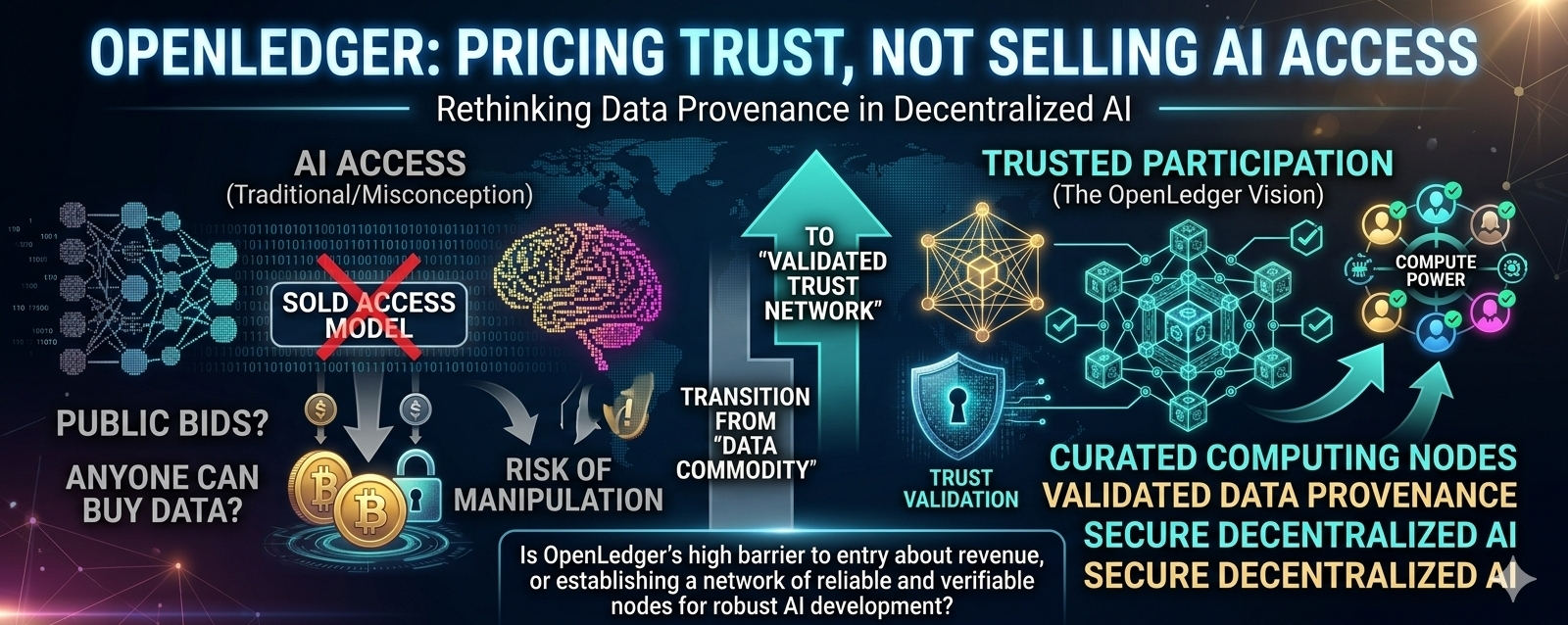
A lot of the AI market still talks as if the biggest opportunity is simply more of everything. More compute, more data, more models, more contributors, more agents, more liquidity, more marketplaces. That story is easy to understand because it sounds like the same infrastructure cycle we have seen before. Scale first, value later. But I am not sure AI will mature that neatly. The closer AI gets to real business workflows, the more obvious it becomes that raw capability is only one part of the equation. The harder question is not always whether intelligence exists. It is whether that intelligence is safe enough, traceable enough, and trusted enough to be used when the outcome actually matters. That is why OpenLedger feels more interesting to me than just another AI marketplace. The surface-level story is simple: contributors bring data, builders use intelligence resources, and $OPEN helps coordinate the network. But the deeper story may be about something much more scarce than supply. It may be about permission.
This is the part I think the market may still be underestimating. In consumer AI, trust problems can look small. A bad image generation, a strange answer, or an imperfect chatbot response might be annoying, but it usually does not create a board-level issue. Enterprise AI is different. If AI is helping with insurance approvals, legal review, financial monitoring, customer access, internal document analysis, or automated agents inside sensitive systems, the questions change immediately. Where did the data come from? Who had the right to contribute it? Can the output be traced back to its sources? Was the model trained on clean material? Who is responsible if something breaks? These are not abstract technical questions. They are the kinds of questions that decide whether a company can actually deploy AI or has to keep it trapped in experiments.
That is where OpenLedger’s attribution layer starts to matter more. Attribution can look like a rewards mechanism at first, and maybe that is part of it. Contributors should be recognized and compensated when their data or intelligence adds value. But attribution can also become something bigger. It can become the record that tells the network who contributed what, under which conditions, with what rights, and with what history. Once that exists, contributions are no longer just random inputs floating inside a marketplace. They become economically different from each other. A dataset with unclear ownership and unknown origin is not the same as one coming from verified contributors with documented provenance and clean usage rights. Both might improve an AI model on paper, but only one reduces future legal, operational, and reputational friction.
This is why I keep coming back to the idea that OpenLedger may not be pricing contribution as much as it is pricing eligibility. That sounds like a small shift, but it changes the whole thesis. Many crypto networks have tried to reward participation, and plenty of them created activity without creating real demand. Paying people to show up is not the same thing as building something the market needs. The more valuable layer may be deciding which participants, datasets, models, and agents are trusted enough to enter important workflows in the first place. As AI becomes more common, intelligence itself may become less scarce. Model quality keeps improving, open-source systems keep closing gaps, and compute eventually gets cheaper or more competitive. But trust does not commoditize as quickly. Permission does not scale as easily. Credibility is slower, harder, and much more valuable once institutions start depending on it.
The same logic applies to AI agents. Everyone likes to talk about autonomous agents as if the only missing piece is better performance. But if agents are going to touch financial processes, contracts, enterprise systems, customer decisions, or external transactions, performance alone will not be enough. No serious operator wants unknown agents wandering through sensitive workflows just because they seem capable. Competence without trust is not an asset. It is liability with a nice interface. The agent economy, if it becomes real, will need ways to decide which agents are allowed near valuable systems, which data they can use, which actions they can take, and who is accountable when something goes wrong. That is not a pure marketplace problem. That is a permission problem.
Most open systems eventually reach this stage. They begin with broad participation and a belief that openness itself will create value. Then they grow, and growth brings noise, bad actors, weak inputs, fraud, uncertainty, and hidden costs. After that, filtering becomes the product. Payments became valuable not only because they moved money, but because they learned how to manage trust and risk. Cloud became powerful not only because it offered infrastructure, but because enterprises could rely on security, permissions, and compliance layers. Social platforms talked about openness, but their real power came from ranking, reputation, and visibility control. AI may follow the same path. The early phase celebrates abundance. The mature phase decides which abundance is allowed to matter.
That is why the “AI marketplace” label feels a little too flat for OpenLedger. A marketplace suggests exchange. OpenLedger’s bigger opportunity may be coordination around trusted participation. If its architecture can make provenance, attribution, rights, and credibility usable at scale, then OPEN becomes tied to something more durable than simple contributor incentives. It becomes linked to the economic importance of knowing who and what is allowed into AI systems. That does not mean the outcome is guaranteed. Permission layers can easily turn into gatekeeping if governance is weak. Reputation can be manipulated. Early trusted participants can become too powerful. The token can become a toll booth instead of real infrastructure. And, as always in crypto, a useful network does not automatically mean the token captures lasting value.
There is also the reality that enterprise adoption moves slowly. Companies do not adopt tokenized infrastructure just because it sounds elegant. Procurement teams like contracts they understand. Legal teams want clear accountability. Executives want vendors they can blame when something goes wrong. OpenLedger would need to prove that its trust and attribution model solves a pain that traditional AI vendors cannot solve as well. That may take longer than token markets want to admit. The market can price a narrative in weeks, but institutions often take years to change how they buy and deploy infrastructure.
Still, the direction feels important. The question may not be whether OpenLedger can become a big AI marketplace. That is probably the obvious question, and obvious questions are not always the most profitable ones. The better question is whether AI is moving into a phase where trusted access becomes more valuable than raw intelligence supply. If intelligence keeps becoming cheaper and more abundant, then the scarce layer shifts toward provenance, rights, reputation, accountability, and permission. Under that lens, OPEN is not just a bet on data contribution. It is a bet that the next valuable AI infrastructure layer will not be the one with the most inputs, but the one that can decide which inputs deserve trust.
