
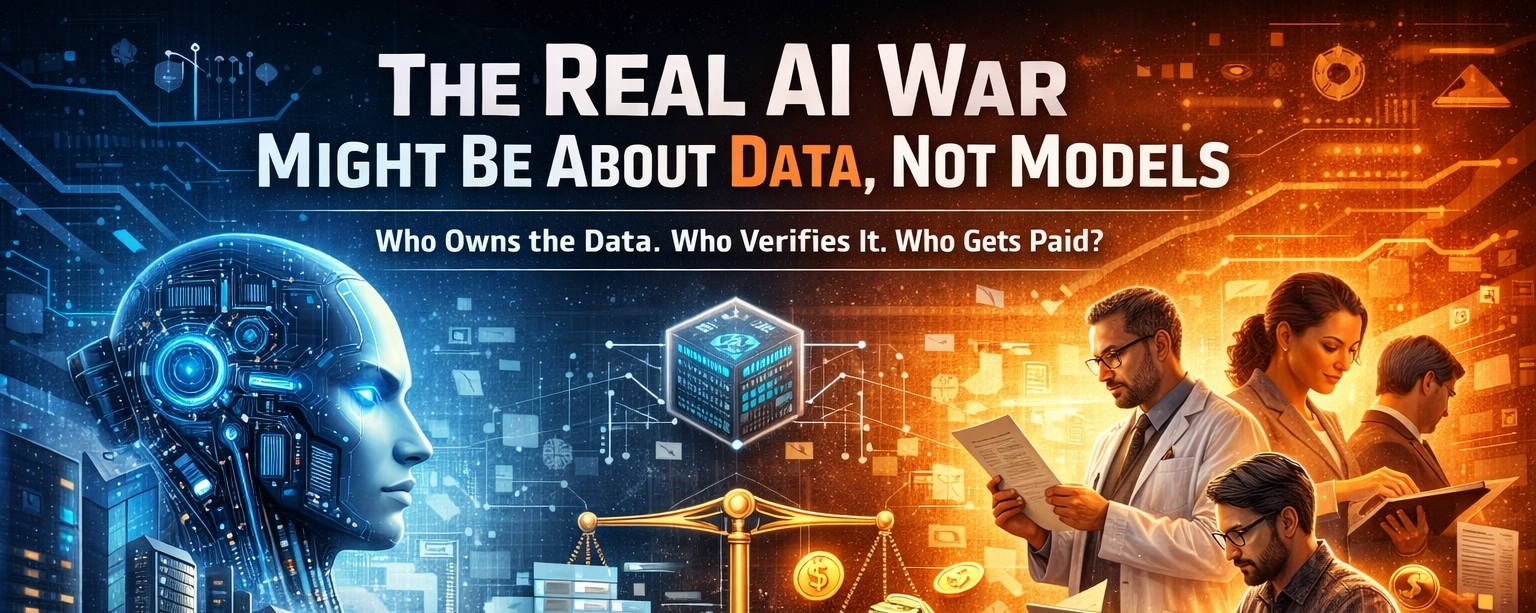
Everyone keeps talking about AI models like they are the only thing that matters. Every week the conversation looks the same — which model reasons better, which company is ahead, who raised more money, whose benchmark score improved. But honestly, the more I watch the industry, the more it feels like people are focusing on the visible layer while ignoring the deeper shift happening underneath. The future AI battle may not be decided only by model intelligence. It may eventually be decided by who owns the data, who can verify it, and who actually gets rewarded when AI systems create value.
What makes this conversation important is that AI systems are not built from nothing. They are trained on massive amounts of human knowledge collected over years — articles, discussions, research papers, feedback, annotations, niche expertise, corrections, public conversations, and countless invisible contributions spread across the internet. The intelligence may look artificial on the surface, but its foundation is still deeply human. And yet once these systems become commercially valuable, the people whose knowledge helped shape them usually disappear from the economic equation entirely.
That imbalance has quietly existed for a long time. The system remembers the data, but the economy forgets the people behind it. I think this is why projects like [OpenLedger](https://www.openledger.xyz?utm_source=chatgpt.com) have started attracting attention recently. Not because every AI crypto project suddenly becomes revolutionary — honestly, most of them recycle the same ideas with different branding — but because this feels like a deeper infrastructure conversation instead of just another hype narrative. What OpenLedger seems to be exploring is the idea that contributors to AI systems should not become invisible once the models start generating value.
Their broader “Payable AI” direction is interesting because it tries to connect contribution with economic participation. In simple terms, the idea is that if certain data improves an AI system, then the people behind that data should potentially receive recognition or rewards. That sounds straightforward at first, but technically it touches one of the hardest problems inside artificial intelligence — attribution.
Large language models do not store information like normal databases. They absorb patterns from billions of pieces of data and compress them into neural weights. Once that happens, outputs become blurred combinations of everything the model has learned. That is why tracing influence back to original contributors becomes extremely difficult. Maybe it will never be perfectly accurate. But honestly, perfection may not even be necessary. The bigger shift is that some projects are finally trying to make contribution visible again instead of treating human input like endless free fuel for AI systems.
I think the timing of this conversation matters too. AI is slowly moving beyond experimentation and becoming real commercial infrastructure. Companies are no longer asking only whether a model is intelligent. They are starting to ask where the data came from, whether it can be verified, whether it is legally licensed, whether outputs can be audited, and whether the system can survive future regulation. Those questions become especially important in industries like healthcare, finance, law, insurance, and enterprise software, where trust matters almost as much as intelligence itself.
And honestly, this may completely reshape how valuable datasets are viewed in the future. Right now people mostly talk about model size and reasoning capability, but eventually verified and legally clean datasets may become just as important. A slightly smaller model trained on trustworthy, auditable, domain-specific data could become more commercially valuable than a larger model trained on uncertain sources. That possibility changes the entire direction of AI infrastructure.
One thing I personally find fascinating is the idea that data may slowly stop being treated as passive fuel and start being treated more like labor. Traceable labor. Economic labor. If a dataset measurably improves model performance, then logically that dataset created value. And once value enters the picture, people naturally begin asking whether contributors deserve participation in the upside too. That changes the psychology of AI ecosystems completely. Contributors are no longer just feeding machines — they become visible participants inside the intelligence economy itself.
Of course, none of this will be easy. In fact, the hardest part probably starts once real financial incentives enter the system. Because wherever money exists, manipulation follows. Low-quality synthetic data, spam submissions, attribution disputes, leaderboard farming, gaming the validation process — all of these problems become unavoidable at scale. That is why the real test for attribution-based AI systems is not during launch announcements or hype cycles. The real test is whether these systems can remain trustworthy once millions of users and economic incentives collide together.
And honestly, I do not think anyone fully knows the answer yet. Maybe nobody has solved this problem completely. But I still think this moment matters because, after a long time, some projects are finally trying to confront the uncomfortable economics underneath AI instead of only competing over model performance. For years the internet economy operated through extraction — users created value while platforms captured most of it. AI risks amplifying that imbalance even further. But attribution-focused infrastructure at least introduces a different possibility, where contributors are not entirely erased once the system becomes profitable.
Maybe that future fully works. Maybe it only partially succeeds. Maybe the technical complexity becomes much harder than expected. But regardless of the outcome, the industry is eventually going to face one unavoidable question: if humans help create AI value, should the system remember them after the money arrives? And honestly, I think that question may become far more important in the future than people realize today.
