
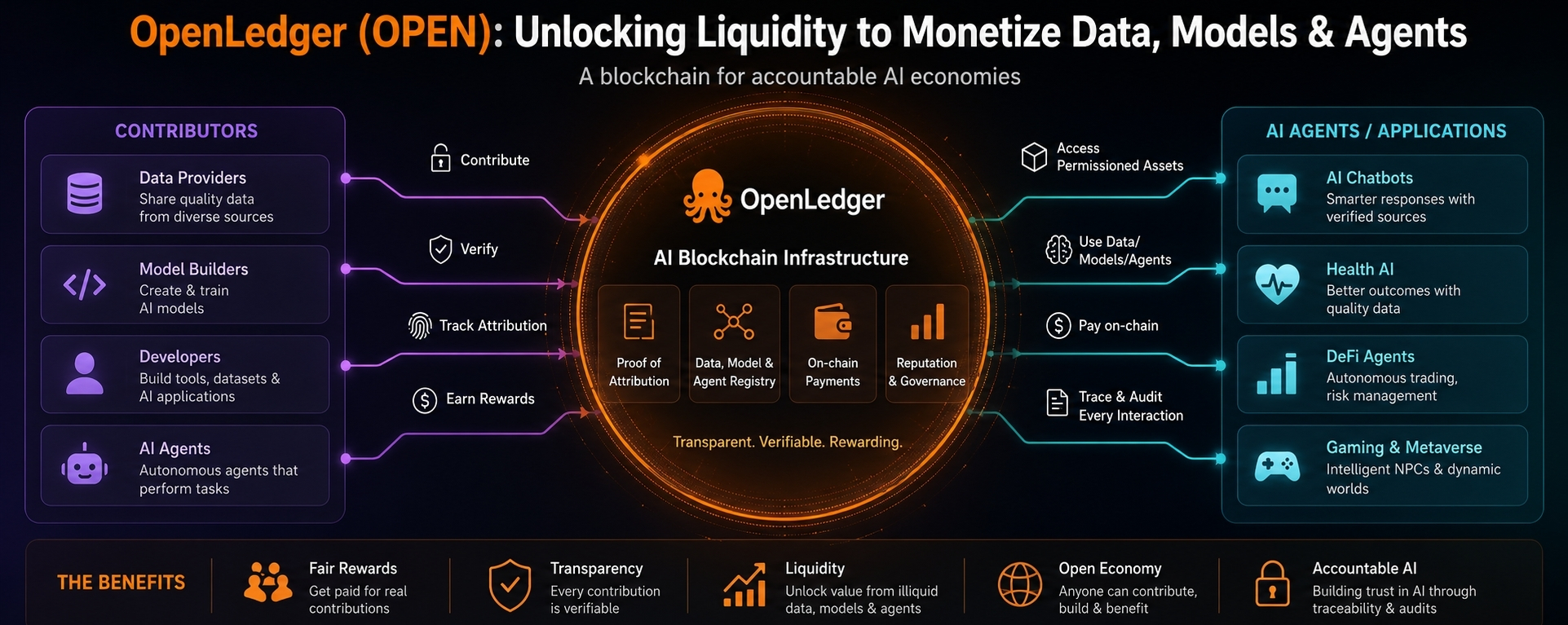

I wasn’t planning to spend time looking into OpenLedger (OPEN).
At this point, every other project seems to attach “AI” to its name and suddenly people act like it’s the next big thing. Most of the time I scroll past because the posts all sound the same — big promises, complicated words, zero substance.
But OpenLedger kept showing up in conversations that felt… normal.
Not forced. Not overly promotional. Just people genuinely discussing where AI is heading and who benefits from it.
That’s what pulled me in.
The more I looked into it, the more I realized the project isn’t really trying to sell some fantasy about robots taking over the world. A lot of the discussion around it is actually about ownership, contribution, and value distribution inside AI systems.
And honestly, I think that topic is going to become way bigger than most people expect.
Right now, AI companies are racing to build smarter models, but very few people talk about the people behind the scenes. The datasets, the contributors, the smaller developers, the communities providing information — all of that matters, but the reward structure still feels pretty uneven.
That’s probably why OpenLedger’s focus on attribution caught my attention.
I saw one discussion recently about tracking where AI-generated value actually comes from, and it made me stop for a second because… yeah, that question matters.
If someone’s data, research, or work helps train systems that later generate money, shouldn’t there be a cleaner way to recognize that?
Maybe I’m overthinking it, but I feel like the internet is slowly moving toward that conversation anyway.
What’s interesting is that the tone around AI has changed a lot compared to last year. Back then everybody was obsessed with who had the most powerful model. Now the discussions feel more grounded. People are starting to ask practical things:
Who owns the data?
How do creators benefit?
Can AI systems be audited?
What happens when AI agents start handling real economic activity?
Those questions feel less theoretical now.
And I think that’s why projects like OpenLedger are starting to stand out a little more. Not because they’re the loudest, but because they’re trying to build around problems that actually exist.
I’m still cautious though.
Crypto has a habit of making everything sound bigger than it is, and AI is probably even worse for that. So I’m trying not to fall into the usual cycle of getting overly excited about narratives.
But at the same time, I can admit when something feels directionally interesting.
OpenLedger feels early. Very early.
Still, I’d rather watch projects experimenting with real infrastructure problems than another token trying to go viral off buzzwords alone.
Maybe nothing comes from it.
Maybe the whole AI-agent economy takes longer than people think.
Or maybe a few years from now, we look back and realize the real opportunity wasn’t just building smarter AI — it was figuring out how the value around AI gets shared in the first place.
That’s the part I keep thinking about lately.