
A few days ago I caught myself thinking about how strange the current AI cycle really is. Everyone talks about models becoming smarter, faster, more autonomous, but almost nobody talks about the people constantly feeding those systems from underneath.
Every interaction online becomes signal.
Every correction improves something.
Every dataset comes from human effort somewhere in the background.
But the relationship between contributors and the systems they improve still feels incredibly disconnected. Platforms accumulate value. Models become more capable. Meanwhile the people supplying behavior, feedback, refinement, and usable data remain mostly invisible once the infrastructure absorbs their contribution.
That imbalance is probably why OpenLedger kept staying in my head after I spent more time reading through the project.
At first I assumed it was another AI-related crypto ecosystem trying to fit itself into the market narrative. There are already too many protocols throwing around words like decentralized intelligence, autonomous coordination, or AI infrastructure without solving anything meaningful underneath.
But OpenLedger feels slightly different to me because the project seems less obsessed with AI hype itself and more focused on the coordination layer forming around AI systems.
That distinction matters a lot.
The more advanced AI becomes, the more important attribution, contribution tracking, and participation structures probably become too. Not because decentralization is automatically better, but because intelligence systems naturally centralize power when ownership layers remain weak.
Whoever controls the data pipelines eventually controls most of the surrounding ecosystem.
And right now most contributors have almost no visibility into the value they help create.
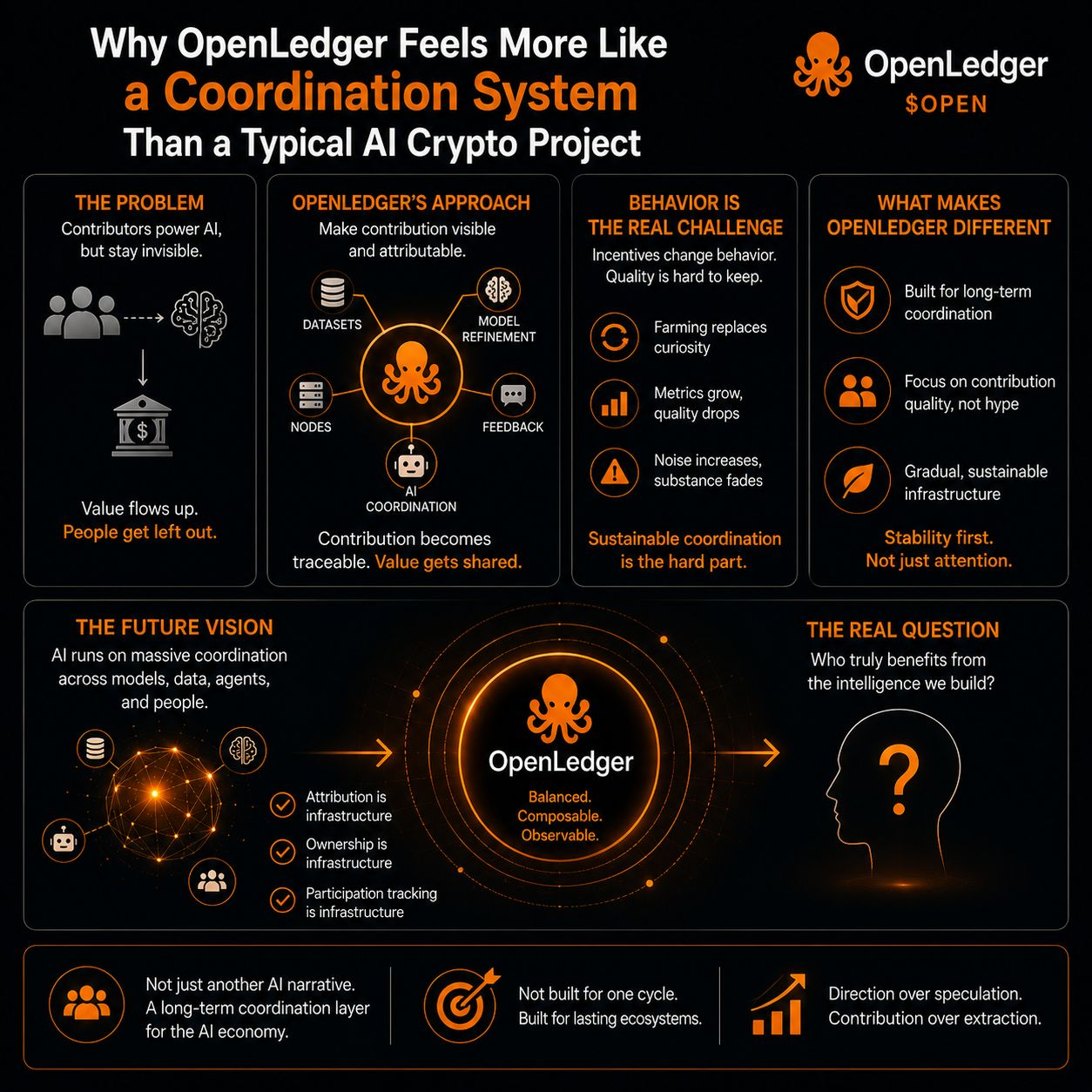
The thing I find interesting about OpenLedger is that the ecosystem appears designed around making participation economically visible instead of treating contributors like passive background infrastructure. Datasets, model refinement, node participation, feedback systems, AI coordination, all of it seems connected through the idea that contribution should remain attributable rather than disappearing into closed systems forever.
That sounds simple when explained casually, but it’s actually a very difficult coordination problem.
Because once incentives enter the system, behavior changes immediately.
I think crypto learned this lesson the hard way over the last few years. Early ecosystems always begin with idealistic participation, but eventually people optimize around rewards instead of quality. Farming replaces curiosity. Metrics replace meaning. Networks become noisy while slowly losing substance underneath.
You can usually feel when that transition starts happening.
The ecosystem looks active on the surface, but interactions become strangely repetitive. The same wallets loop through the same behaviors. Participation stops feeling organic and starts feeling extracted.
That risk absolutely exists for OpenLedger too.
And honestly, I respect that the project sometimes feels more restrained than other ecosystems rushing to maximize attention immediately. Certain expansions appear slower. Some infrastructure pieces seem intentionally gradual instead of aggressively over-marketed.
At first glance slower growth can look unimpressive in crypto because the market is addicted to momentum. But infrastructure systems that survive long term usually optimize differently from projects chasing temporary visibility.
They optimize for stability first.
That part matters more in AI ecosystems than people realize.
Good coordination systems cannot function properly if the underlying participation quality collapses. Once low-quality contribution becomes normalized inside the network, the ecosystem starts training itself toward distortion. Data quality weakens. Reputation systems become manipulatable. Governance loses coherence.
And reversing that later becomes extremely difficult.
That’s probably why OpenLedger feels more like an experiment in behavioral coordination than just another blockchain product to me.
The technical infrastructure matters obviously. OpenLoRA, attribution systems, contribution tracking, model coordination, all of those layers are important. But underneath the architecture, the real challenge seems deeply human.
How do you encourage contribution without encouraging exploitation?
How do you reward participation without turning everything into mechanical farming behavior?
How do you keep ecosystems open without losing accountability entirely?
Those questions are much harder than simply launching AI tooling.
I also think people underestimate how important retention becomes in systems like this. Most crypto projects know how to attract attention temporarily. Very few know how to create environments people continue returning to after the incentives become ordinary.
That’s where real infrastructure usually reveals itself.
When developers stop experimenting casually and begin depending on the system operationally.
When conversations shift away from hype and toward reliability.
When integrations deepen quietly instead of social engagement exploding loudly.
That transition is subtle, but it changes everything.
And I think OpenLedger is slowly moving toward that phase.
The ecosystem conversations already feel slightly different compared to pure narrative-driven projects. Less obsession around short-term visibility, more discussion around contribution quality, sustainability, coordination mechanisms, and how AI participation should actually function economically over time.
That doesn’t guarantee success obviously.
Execution risk is still enormous here.
AI infrastructure itself evolves incredibly fast, and crypto ecosystems are naturally unstable environments because incentives constantly pull participants toward the next opportunity. Open systems are difficult to maintain precisely because human behavior rarely stays aligned for long periods.
But at least OpenLedger appears aware that the problem exists.
That alone separates it from many projects still pretending token incentives automatically create durable ecosystems by themselves.
The broader idea behind the project actually feels more important the longer I think about it.
AI is probably not becoming a single monolithic system controlling everything. More likely it becomes a massive coordination environment filled with specialized models, agents, datasets, workflows, and contributors interacting across different economic layers.
And if that future arrives, attribution becomes infrastructure.
Ownership becomes infrastructure.
Participation tracking becomes infrastructure.
OpenLedger seems built around the assumption that those coordination layers should remain more transparent and economically accessible than the closed systems dominating AI today.
Not fully decentralized in some ideological fantasy sense.
Just more balanced.
More composable.
More observable.
That middle ground is difficult to design well because real ecosystems always involve trade-offs between openness, efficiency, and accountability. Pure centralization creates extraction. Pure decentralization creates fragmentation.
The difficult work happens somewhere between those extremes.
And honestly, that’s probably where OpenLedger is trying to position itself.
Not as another loud AI narrative designed to survive one market cycle.
More like a long-term coordination layer slowly experimenting with how ownership, contribution, and AI infrastructure might coexist without collapsing into pure extraction dynamics.
Maybe it works.
Maybe it doesn’t.
But I think the underlying problem they’re aiming at is very real.
Because eventually people stop asking how intelligent AI systems are becoming and start asking who actually benefits from the intelligence being created.
That’s the question sitting quietly underneath projects like OpenLedger.
And I think it’s going to matter more over time, not less.