
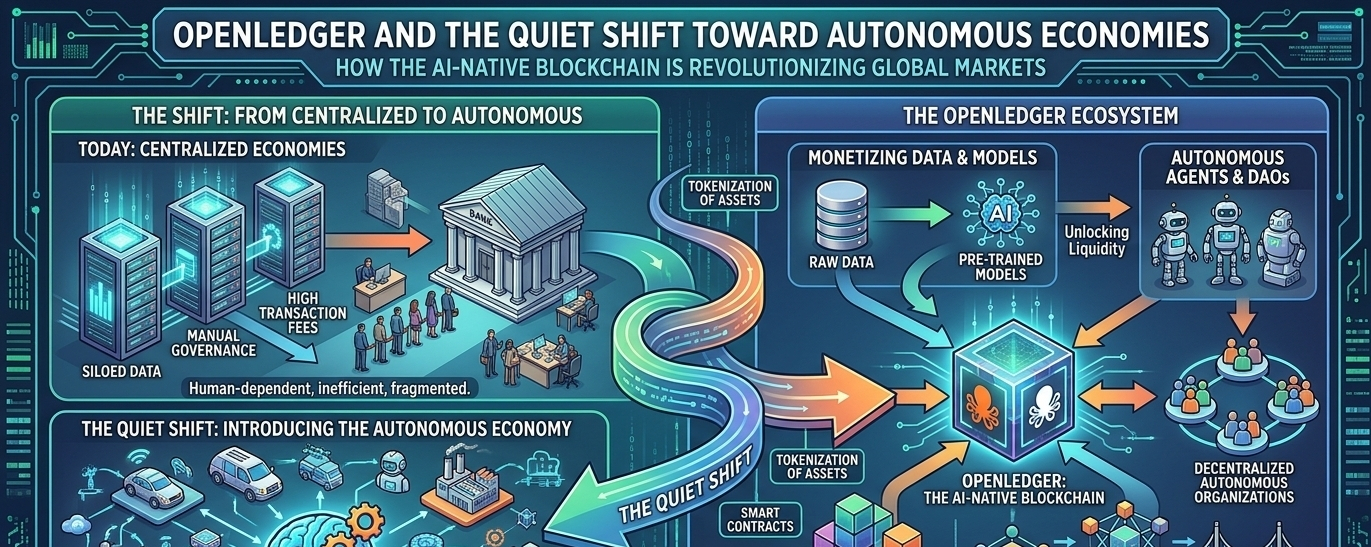
The more time I spend observing projects like OpenLedger, the harder it becomes to think about AI as just another piece of software waiting for instructions. It starts feeling closer to infrastructure under pressure. Not the kind of infrastructure people notice immediately, but the kind operating silently underneath everything else, constantly moving, adjusting, and responding in real time. A model generates an output somewhere inside the network, an agent picks up a task, interacts with another protocol, completes execution, earns compensation, reallocates resources, then continues operating again before the previous process fully settles. Nothing really pauses long enough to feel static. The environment behaves less like traditional software and more like circulation flowing through connected economic systems that remain active whether humans are paying attention or not.
That atmosphere feels very different from the earlier internet most of us grew up using. Older systems depended heavily on human interruption at every stage. Click something. Approve something. Upload something. Refresh something. Even automation still felt limited by pauses between interactions. What is starting to emerge around AI agents feels less interrupted than that. Software reacting to conditions created by other software. Systems adjusting themselves continuously while activity is still happening instead of waiting for human direction to reopen every loop manually. After watching these environments closely for a while, you stop viewing AI as a tool sitting on a screen and start seeing networks trying to coordinate behavior, resources, and incentives at economic scale.
Part of what makes OpenLedger interesting is that it doesn’t treat models, datasets, and agents like completely isolated categories. They function more like interconnected economic components inside the same environment. Data accumulates value through usage. Models generate revenue when accessed. Agents transact on-chain, complete tasks, move liquidity, and continue functioning without needing constant human intervention to restart the process over and over again. The network starts resembling an operational economy more than a collection of separate applications. Everything keeps interacting with everything else, and the movement itself becomes part of the system’s value creation.
The longer you observe systems like this, the more the conversation around “AI economies” stops sounding theoretical. The important questions slowly shift away from intelligence alone. Coordination becomes impossible to ignore. Verification becomes impossible to ignore. Incentive structures become impossible to ignore. What kinds of behavior do these systems reward once autonomous agents begin participating economically at scale? Because the moment incentives start compounding automatically inside open environments, measurable activity can expand extremely fast regardless of whether the outcomes remain useful or meaningful. Networks can become busy long before they become healthy.
You can already feel early traces of this dynamic across the internet. Cheap synthetic content spreads faster than reliable information because scale usually arrives before quality control does. Verification becomes expensive once activity intensifies. Agents optimize toward measurable outputs because measurable outputs are what systems can reward most efficiently. And the strange thing is that AI-generated environments no longer always look obviously fake. Sometimes they just feel oddly flattened, repetitive in subtle ways, like too many systems are training against recycled patterns generated somewhere upstream by other systems chasing the exact same optimization loops repeatedly.
That’s part of what makes OpenLedger fascinating to watch. By exposing liquidity and incentives around models, data, and agents directly on-chain, it makes these tensions visible instead of hiding them underneath abstract technical language. Productivity becomes measurable. Persistence becomes measurable. Attention becomes measurable. But measurable activity and meaningful contribution are rarely identical things once economic incentives begin operating autonomously inside open systems. A network can produce enormous amounts of movement while still struggling to produce lasting value.
Ownership also becomes harder to define in environments like this. An autonomous agent executes work using one model, accesses another dataset, routes through several protocols, generates revenue, then reinvests part of that revenue back into operation. Responsibility spreads across layers extremely quickly. So does control. The system continues moving even when no single participant fully understands the entire operational flow happening across the network at the same time. That’s where these environments stop feeling like ordinary software ecosystems and start feeling more industrial. Continuous infrastructure loops coordinating machine behavior underneath visible applications most users will never directly notice.
And honestly, that may be the biggest shift happening quietly beneath all the AI hype right now. Not just smarter models, but systems learning how to sustain autonomous economic activity continuously without waiting for human coordination at every stage. The infrastructure still feels unfinished in many places. Not broken exactly, just unstable in the way large systems often are while adapting to new forms of participation they don’t fully understand yet. Networks are still figuring out what kinds of behavior they actually want circulating inside them long term once autonomous agents begin optimizing, competing, and coordinating economically at scale.
Maybe that’s why OpenLedger feels interesting beyond the surface narrative. It doesn’t just look like another AI project trying to capitalize on momentum. It feels more like an early glimpse into what happens when machine activity stops behaving like isolated software execution and starts behaving more like persistent economic infrastructure operating continuously underneath the internet itself.
