

I’ve spent the last few weeks going deeper into openledger not through hype clips or recycled Twitter threads, but by reading through its Datanets, Proof of Attribution architecture, and the way the protocol thinks about ownership across the AI stack. The more time I spent with it, the more I realized something important:
OpenLedger is not trying to compete in the usual AI race.
It’s trying to redesign the economic structure underneath it.
Most AI conversations today revolve around the same surface metrics:
bigger models.
faster inference.
more compute.
more automation.
But underneath all of that sits a much quieter question that almost nobody talks about seriously:
Who actually owns the intelligence being created?
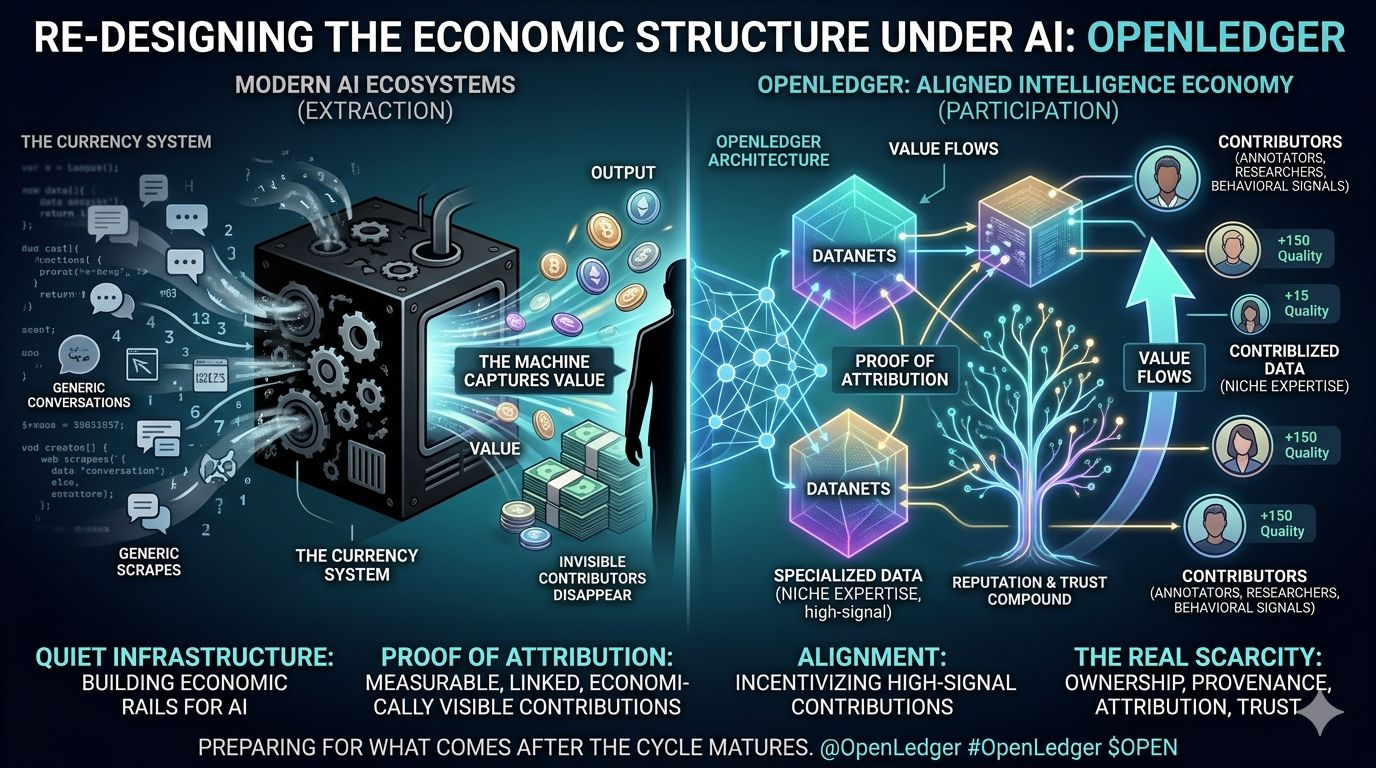
That question becomes uncomfortable once you realize how modern AI systems work. Models are trained on enormous amounts of human contribution — datasets, annotations, research, domain expertise, behavioral signals, conversations — yet the people supplying that value are usually invisible once the model starts generating output.
The machine captures the value.
The contributors disappear behind it.
That’s the part OpenLedger seems obsessed with fixing.
What caught my attention first was the idea of Proof of Attribution. Instead of treating AI outputs like black-box magic, the system attempts to trace which datasets and contributors influenced model behavior and inference generation. Every contribution becomes measurable, linked, and economically visible.
At first glance, that might sound like a technical detail.
I don’t think it is.
I think it fundamentally changes incentives.
If contributors know their data quality directly affects attribution and rewards, behavior changes over time. People become more careful about curation. Specialized datasets become more valuable. Reputation starts mattering. Low-quality spam becomes economically weaker while high-signal contribution compounds in value.
That creates something most AI ecosystems currently lack:
alignment.
And alignment matters more than people think.
Most platforms today optimize for extraction. OpenLedger seems to be optimizing for participation. There’s a difference between using people to improve models and structurally designing a system where contributors remain connected to the value their intelligence creates.
That distinction feels small initially.
Over time, it becomes enormous.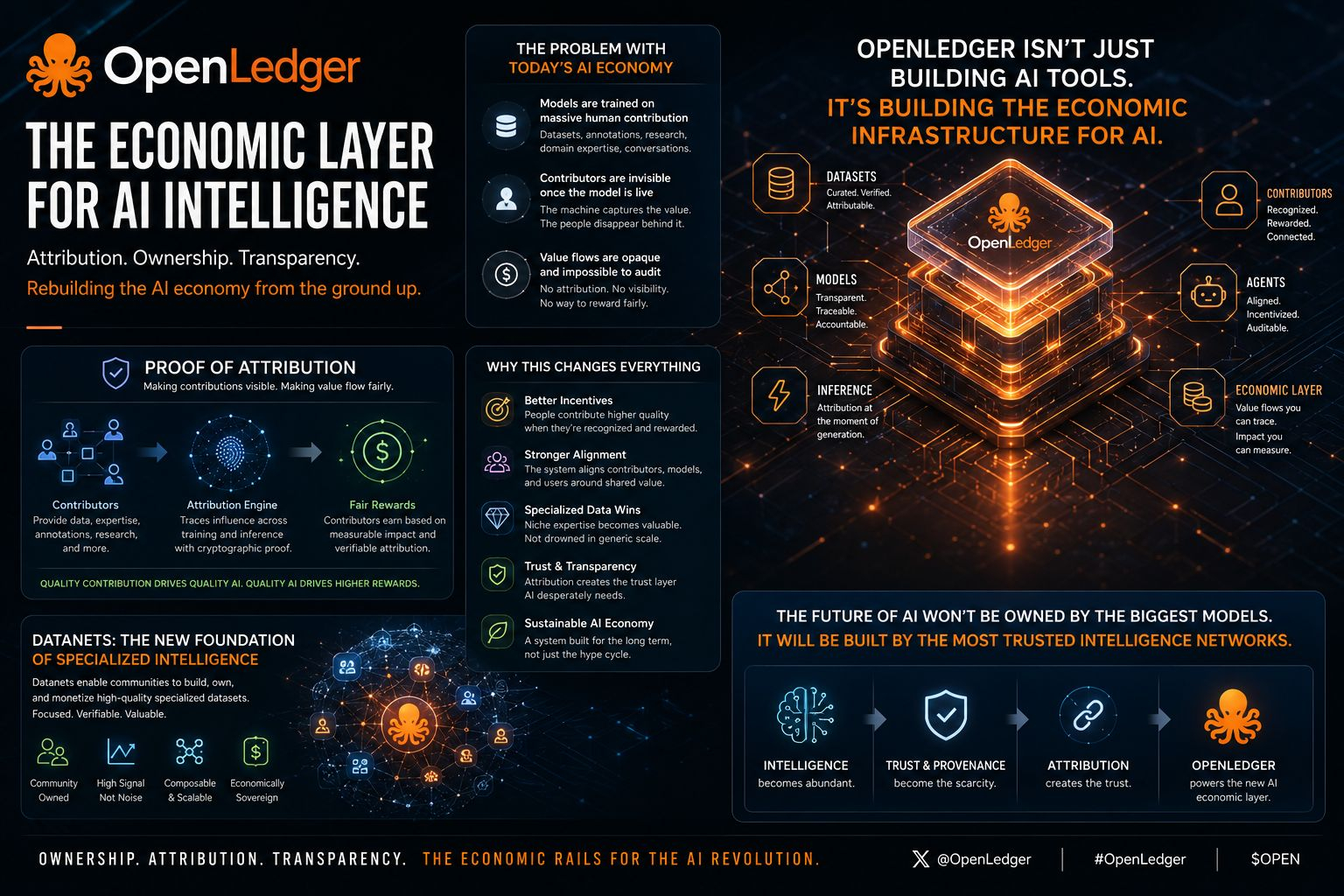
The other thing that stood out to me is how much emphasis OpenLedger places on specialized data instead of generic scale. The architecture around Datanets points toward an ecosystem where niche expertise becomes economically important rather than drowned inside giant generalized models.
I think the market still underestimates this shift.
The future of AI probably doesn’t belong only to the biggest models.
It belongs to the most trusted and specialized intelligence layers.
And trust becomes difficult without attribution.
That’s why OpenLedger feels less like a traditional AI startup and more like infrastructure. Quiet infrastructure usually looks unimpressive in the beginning because it doesn’t rely on spectacle. But infrastructure is often what survives after hype cycles collapse.
That pattern repeats constantly in technology.
The loudest platforms attract attention first.
The deepest coordination layers capture value later.
What makes this even more interesting is that OpenLedger isn’t only building tooling — it’s building economic rails for AI itself. Datasets, models, inference, contributors, agents… everything starts becoming part of a traceable system where value flows can actually be audited instead of guessed.
That changes how I think about AI long term.
Because eventually the AI economy will hit a wall where intelligence alone is no longer enough. Once AI becomes abundant, ownership, provenance, attribution, and trust become the real scarcity.
And projects positioned around those layers may end up mattering far more than people currently expect.
When I step back, OpenLedger doesn’t feel like it’s chasing the AI cycle.
It feels like it’s preparing for what comes after the cycle matures.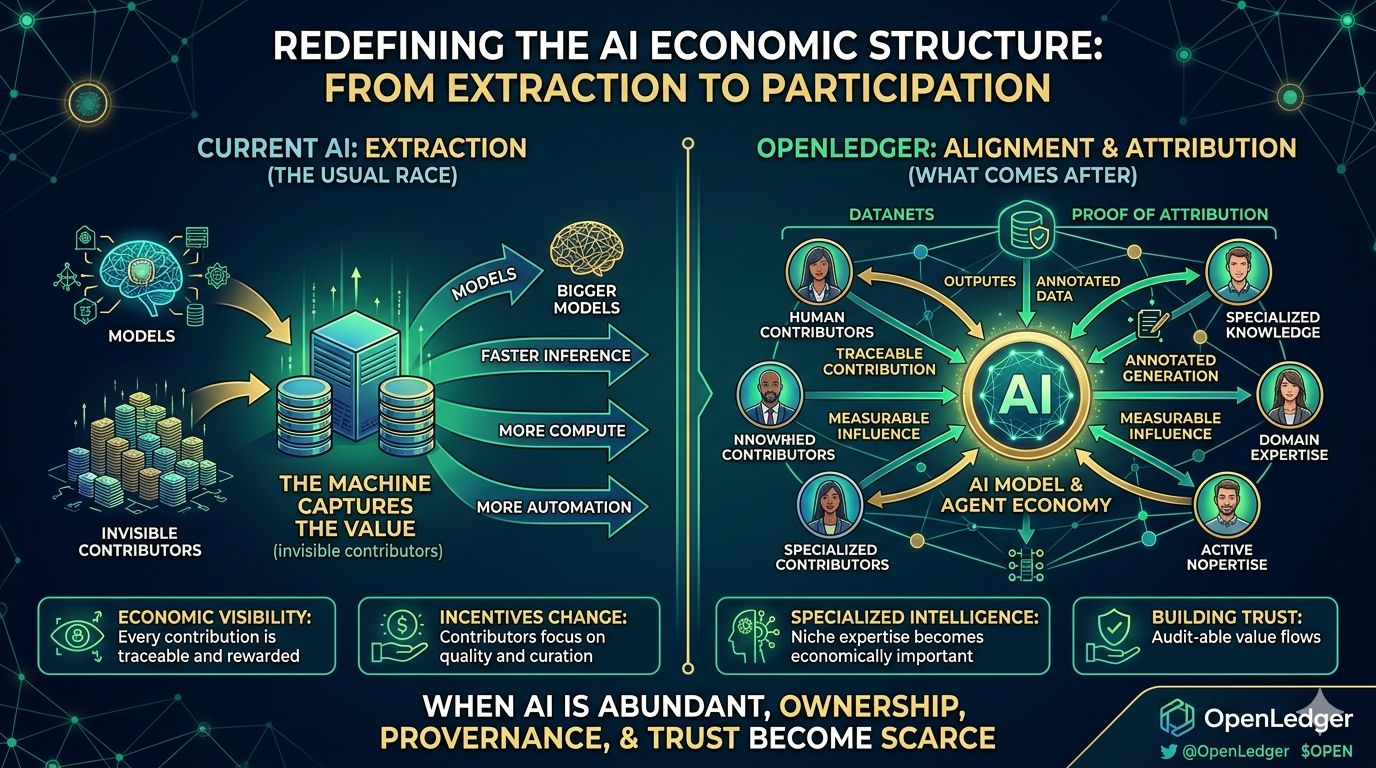
That’s why I keep paying attention to it.
Not because it’s loud.
But because the architecture quietly makes sense once you sit with it long enough.
