
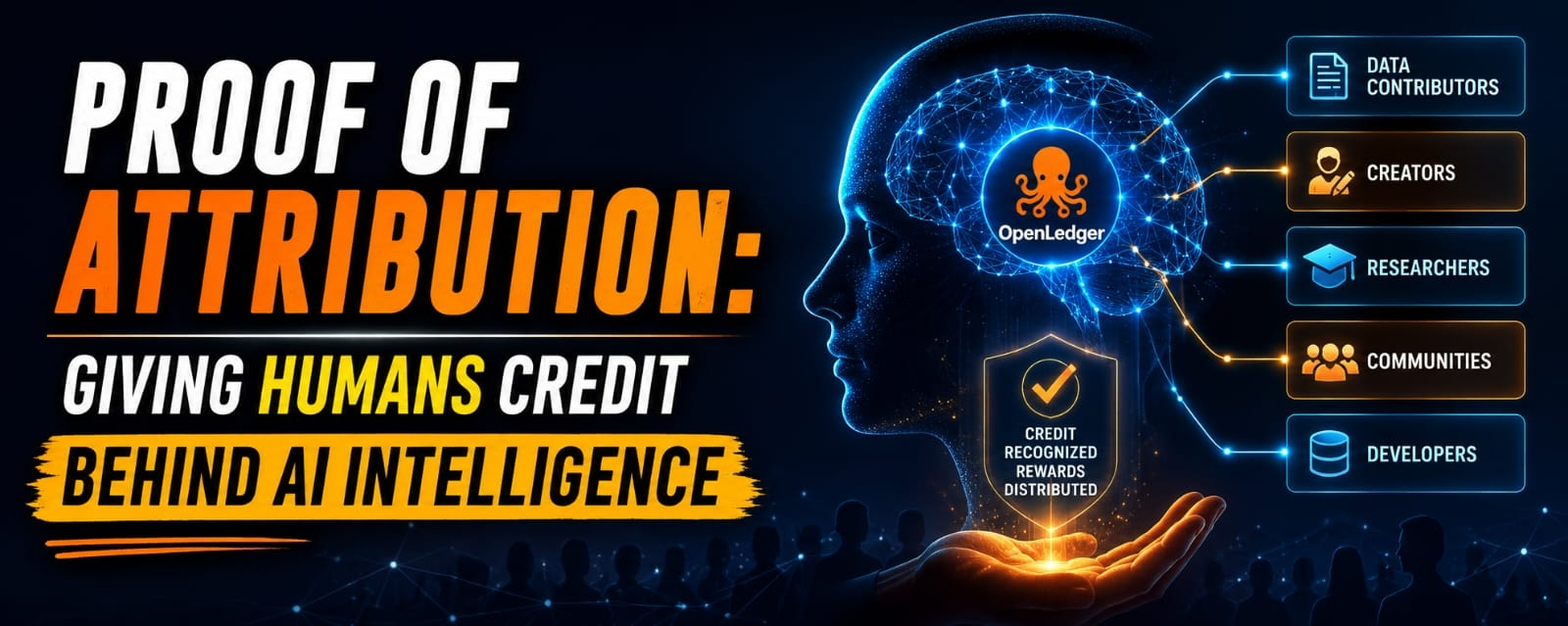
What if the real battle in AI is not about who builds the smartest model, but who gets credit for the data that made it smart?
That thought keeps coming back to me whenever I think about OpenLedger’s Proof of Attribution. AI is moving fast. Very fast. Every day, we see new tools, smarter models, better agents, and more powerful automation. But behind all of this, there is something people often ignore.
Data.
And behind that data, there are real contributors.
There are creators, developers, researchers, communities, experts, and everyday users whose information, knowledge, and work help AI systems become more useful. But most of the time, these people stay invisible. Their contribution becomes part of the machine, and the value moves somewhere else.
I believe this is one of the most important problems in AI right now.
We talk so much about artificial intelligence, but we do not talk enough about ownership. We talk about models, speed, performance, and automation, but we rarely ask a simple question: who actually helped build the intelligence behind these systems?
The way I see it, OpenLedger’s Proof of Attribution is trying to answer that question.
In simple words, Proof of Attribution is a system that helps track which data or contribution influenced an AI output. If someone’s data helped a model generate value, that contribution should not disappear into the background. It should be recognized. And more importantly, it should have a path toward rewards.
That idea feels powerful to me because it changes the relationship between people and AI.
For a long time, the internet worked in a very one-sided way. People created content. People shared knowledge. People uploaded information, built communities, wrote posts, created datasets, and gave platforms massive amounts of value. Then big systems used that value to grow, train, and earn.
But the original contributors? Most of them got nothing.
No credit. No ownership. No real reward.
I have noticed that this same issue is becoming even bigger with AI. When a model learns from data, that data becomes part of its intelligence. But once the model starts producing useful answers, the original source often becomes hard to see. It is like throwing thousands of voices into one machine and then forgetting where the voices came from.
OpenLedger’s Proof of Attribution is interesting because it tries to bring those voices back into the picture.
What makes this important to me is not just the technology. It is the fairness behind it. If someone contributes valuable data, knowledge, or model improvements, then their contribution should have meaning beyond just being used once and forgotten.
Think about a real-world example.
Imagine a group of medical researchers sharing a high-quality dataset. That data helps train an AI model. Later, the AI gives better answers, supports research, or helps someone understand a medical situation more clearly. In a normal system, the people who provided the original data may never know their work had an impact.
But with attribution, that contribution can be traced.
That changes everything.
It creates a system where data is not treated like free fuel for machines. It becomes an asset. Something with value. Something connected to its original contributor.
In my opinion, this could also improve the quality of AI itself. When contributors know their work can be credited and rewarded, they have a stronger reason to share better data. Better data means better models. Better models mean better outputs. And better outputs make AI more useful for everyone.
This is why the topic matters now.
AI is no longer just a cool experiment. It is entering finance, education, healthcare, marketing, coding, research, and almost every digital industry. People are starting to depend on AI for decisions, ideas, analysis, and work. If we do not build fair systems around data now, the same old problem will become even bigger.
A few powerful players may keep benefiting from everyone else’s contributions.
I do not think that is healthy.
The way I see it, the future of AI should not only belong to model builders. It should also include data contributors, domain experts, creators, and communities that make these models useful in the first place.
OpenLedger’s Proof of Attribution points toward that kind of future.
Of course, the idea still needs strong execution. Attribution in AI is not easy. Tracking influence, proving contribution, and distributing rewards fairly can be complicated. But the direction matters. The concept itself feels necessary because AI needs more transparency, not less.
I believe people are starting to care more about where AI answers come from. They want trust. They want clarity. They want to know whether information is backed by real sources or just generated from a black box.
Proof of Attribution can help make AI feel less mysterious and more accountable.
And honestly, I think that is what the next stage of AI needs.
Not just smarter models.
Not just faster agents.
Not just bigger systems.
It needs fairness. It needs memory. It needs a way to recognize the people and data that made the intelligence possible.
Because behind every AI output, there may be someone’s work. Someone’s research. Someone’s experience. Someone’s knowledge.
And maybe the future of AI should not only be about machines becoming more powerful.
Maybe it should also be about making sure humans are not erased from the value they helped create.
