
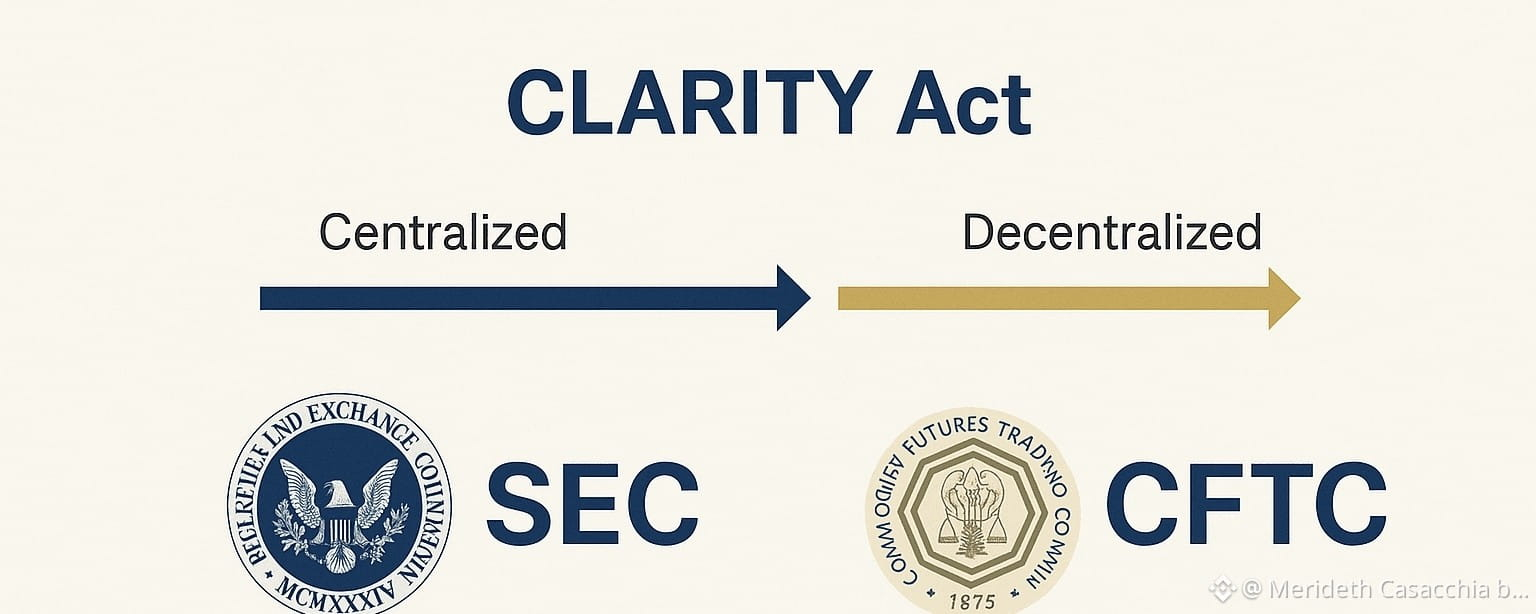
As cryptocurrencies continue moving into the financial mainstream, one issue has consistently frustrated investors, developers, and regulators alike: the lack of clear rules. The proposed CLARITY Act aims to change that by creating a more defined legal framework for digital assets in the United States.
The bill has become one of the most closely watched pieces of crypto legislation in Washington because it could reshape how cryptocurrencies are regulated, traded, and developed for years to come.
Crypto Regulation Illustration



What Is the CLARITY Act?
The Digital Asset Market Clarity Act, commonly called the CLARITY Act, is proposed U.S. legislation designed to define how cryptocurrencies and blockchain-based assets are regulated. Its primary goal is to end the long-running confusion over whether crypto assets should be treated as securities or commodities. (Congress.gov)
For years, the two major U.S. regulators — the U.S. Securities and Exchange Commission (SEC) and the Commodity Futures Trading Commission (CFTC) — have disagreed over who should oversee many crypto projects. That uncertainty has led to lawsuits, enforcement actions, and hesitation from institutional investors.
The CLARITY Act attempts to solve that by creating clearer categories for digital assets and assigning oversight responsibilities accordingly.
Why Was the Bill Introduced?
The crypto industry has argued that existing financial laws were written decades before blockchain technology existed. As a result, many companies have operated in a legal gray area.
Supporters of the bill say the United States risks falling behind countries with more established crypto regulations if lawmakers fail to act. They also argue that clearer rules could:
Encourage innovation
Attract institutional investment
Protect consumers
Reduce regulatory confusion
Keep crypto companies operating in the U.S.
Critics, however, worry that the legislation could weaken investor protections or create loopholes for risky projects.
The Core Idea: Separating Securities From Commodities
One of the biggest features of the CLARITY Act is its attempt to distinguish between:
Digital securities → regulated mainly by the SEC
Digital commodities → regulated mainly by the CFTC
Under the proposal, some crypto tokens may initially be treated as securities during fundraising stages but later transition into commodities if the blockchain becomes sufficiently decentralized. (BeInCrypto)
This matters because securities face much stricter disclosure and compliance requirements than commodities.
For example:
A token launched and controlled by a central company could initially qualify as a security.
If the network later becomes decentralized and community-governed, it may eventually qualify as a commodity.
This framework could provide projects with a clearer legal pathway.
What Could Change for Crypto Investors?
If passed, the CLARITY Act could significantly affect everyday crypto users and investors.
1. More Regulatory Certainty
Investors may finally gain clearer answers about which cryptocurrencies are legally compliant in the U.S.
That could reduce fear surrounding sudden enforcement actions or exchange delistings.
2. Increased Institutional Adoption
Large financial firms often avoid unclear markets. A formal framework may encourage banks, hedge funds, and investment firms to enter the crypto sector more aggressively. (Barron's)
3. Potential Growth for Exchanges
Crypto exchanges could benefit from clearer registration rules and operational standards. Some industry observers believe this could help major platforms expand services legally within the U.S.
4. More Protection for Consumers
The bill also includes transparency and compliance requirements intended to improve consumer safeguards and reduce fraud risks.
What Does It Mean for Bitcoin and Ethereum?
Many analysts believe the CLARITY Act would strengthen the argument that cryptocurrencies like:
Bitcoin
Ethereum
should be treated as digital commodities rather than securities.
That distinction is important because commodity classification is generally viewed as less restrictive and more favorable for open blockchain networks.
Some altcoins may also benefit if they can demonstrate decentralization under the bill’s standards.
Why the Crypto Industry Supports It
Many crypto companies and advocacy groups support the legislation because they see it as a move away from what they call “regulation by enforcement.”
Instead of learning the rules only after lawsuits occur, businesses would have clearer guidelines from the beginning.
Several large firms have publicly pushed for market-structure legislation that clarifies SEC and CFTC responsibilities. (DLA Piper)
Criticism and Concerns
Not everyone supports the CLARITY Act.
Critics argue that:
Some investor protections may be weakened
Decentralization standards could be difficult to define
Certain projects might exploit loopholes
The bill may still leave legal ambiguity in some areas
Others worry the legislation could favor large crypto firms over smaller startups.
Current Status of the Bill
The CLARITY Act has gained bipartisan attention and has advanced through important legislative stages, but it has not yet become law. Different versions and negotiations continue in Congress. (Barron's)
Lawmakers are still debating details involving stablecoins, oversight authority, and ethics provisions connected to digital assets.
Final Thoughts
The CLARITY Act could become one of the most important crypto laws in U.S. history. By defining how digital assets are classified and regulated, the bill may shape the future of cryptocurrency innovation, investment, and adoption in America.
For crypto investors, developers, and companies, the biggest potential impact is simple: clarity.
And in a market long defined by uncertainty, clarity could change everything.#SECPausesNewETFApplicationReview #OpenAIToConfidentiallyFileForIPO $BTC #SocieteGeneraleBlockchainSecuritiesSettlement $ETH $BNB