
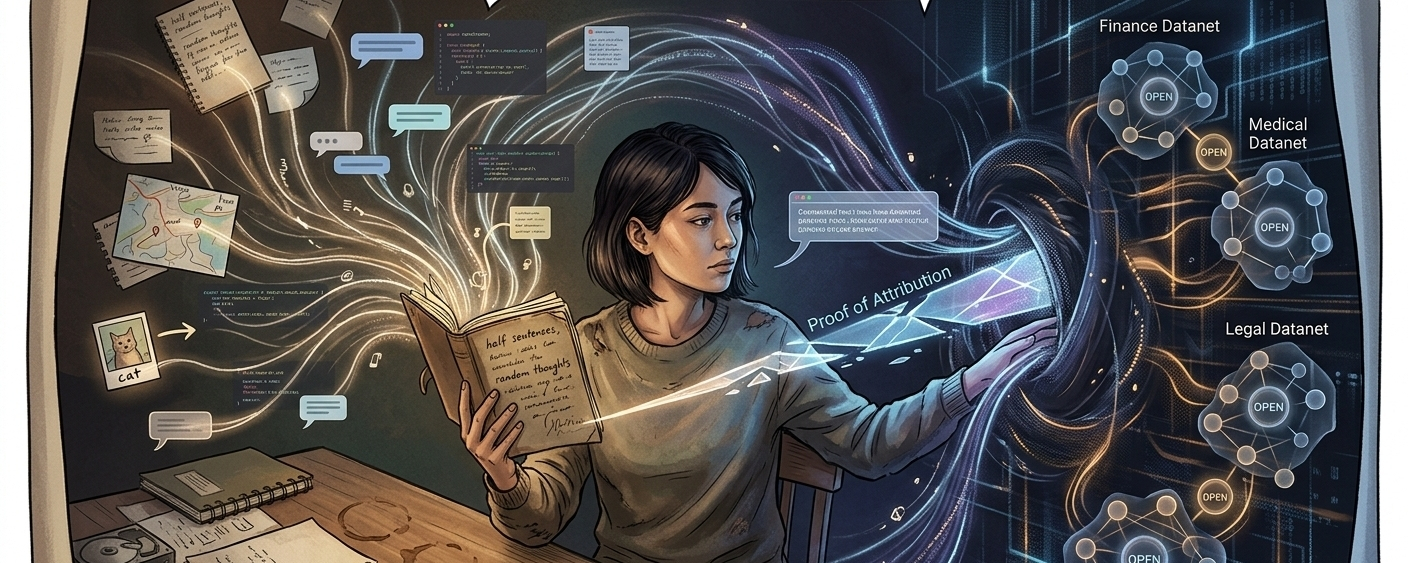
I keep thinking about something small and slightly annoying: most of the internet we’ve lived through is basically unpaid labor that got vacuumed into machines.
Not in a dramatic “AI is stealing everything” way. More mundane than that. You write things, post things, label things, argue in comment sections at 2 a.m., forget about it—and somewhere down the line it quietly becomes part of how these systems talk.
You don’t see it again. You don’t get a receipt. It just dissolves.
OpenLedger starts from that irritation and builds upward from it. Not with a new chatbot, not with a shinier interface, but with a question that feels almost bureaucratic in nature: who gets credited when an AI learns from the world?
And more importantly—who gets paid.
Most of today’s AI economy doesn’t even pretend to answer that. Data goes in, intelligence comes out, and the value concentrates at the top. The rest of the pipeline is invisible by design. That invisibility is the product.
OpenLedger tries to crack that open using something it calls Proof of Attribution. The name sounds heavier than it behaves in practice. What it’s trying to do is trace influence: if some piece of data, somewhere, nudged a model toward a specific output, the system attempts to register that relationship and attach value back to it.
Not cleanly. Not perfectly. But as a structured guess that can be turned into economic distribution.
That shift sounds technical, but the emotional core is simple: turning “you contributed something” into something that actually shows up somewhere other than a forgotten dataset dump.
There’s a reason this hits differently if you’ve ever spent time making things online.
I went back through old notes recently. The kind you don’t expect to matter—half sentences, unfinished ideas, random thoughts scribbled in margins when you were thinking about something else entirely. Stuff I had completely written off.
What struck me wasn’t nostalgia. It was the realization that some version of that mess might already be inside systems like this. Not copied. Not stored neatly. Just… statistically absorbed. Folded into weights and patterns and probabilities.
And the weird part is you don’t feel that transfer happen. There’s no moment where your “contribution” becomes part of the machine. It just disappears from your life and reappears as something that sounds intelligent.
That gap—that missing acknowledgment—is exactly what OpenLedger is poking at.
The way it tries to make this legible is through something called Datanets.
Forget the word for a second. Functionally, these are structured data environments around specific domains. Think finance, medicine, code, legal text—whatever the system is trying to model. People feed data into these spaces. Others validate it. The system tracks quality, reputation, and influence over time.
What matters here is that data stops behaving like a static dataset you download and forget. It becomes something closer to an ongoing marketplace of contributions. Not in a crypto buzzword sense, but in a literal accounting sense: inputs accumulate weight, and that weight is supposed to matter later when models produce outputs.
It’s messy by design, because real-world data is messy. Clean datasets are a fiction we tolerate because they’re convenient.
Then comes the part that makes everything more ambitious—and more fragile.
Proof of Attribution doesn’t just care about training. It tries to extend into inference. The moment you actually use the model.
So when you ask a question, the system isn’t just generating an answer from a black box. It is attempting to reconstruct which underlying data points influenced that answer, and how much each of them mattered.
That influence becomes the basis for rewards.
Every interaction starts looking less like “using AI” and more like triggering a small settlement process. Not in a visible, dramatic way. More like background accounting happening underneath the surface of the response.
This is where things start to feel slightly unnatural, because intelligence was never really designed to be auditable. It’s not modular. It doesn’t break cleanly into traceable pieces. It’s entangled.
But OpenLedger leans into that tension anyway and treats it as something you can approximate, measure, and eventually price.
To make any of this usable, there’s a practical layer sitting underneath it.
ModelFactory is basically a way to lower the barrier for building and tuning models. Instead of requiring a research team and deep ML infrastructure, it turns model creation into something more like configuring a system: pick a base, choose data sources, adjust parameters, deploy.
It shifts model-building from pure engineering toward something closer to product assembly. That matters because the more people who can build models, the more surface area there is for contributions to flow through the system.
Then there’s OpenLoRA, which is less visible but arguably more important. It’s an efficiency layer that lets multiple model behaviors run over shared infrastructure. Think of it as a way to avoid spinning up a separate heavy model for every variation of behavior. Instead, you reuse a base and layer adaptations on top.
Without that kind of compression, the entire idea starts collapsing under compute costs. The economics would break before the philosophy even gets tested.
The OPEN token sits in the middle of all of this, acting as the coordination layer.
It pays for inference. It rewards contributors. It governs parts of the system. It moves across data, models, and usage like a unit of settlement.
The intention is not subtle: make every meaningful action inside the system leave an economic trace.
Data in. Intelligence out. Value redistributed back through the chain instead of staying trapped at the top.
What sticks with me, though, isn’t the architecture. It’s the implication.
We’ve gotten used to thinking of AI as something that “belongs” to whoever builds the model. That’s the dominant narrative. Big labs train, deploy, monetize. Everyone else is either a user or a supplier of invisible raw material.
OpenLedger is basically saying that structure is incomplete. That intelligence isn’t a product sitting at the end of a pipeline—it’s a continuous flow of contributions, and we’ve just been ignoring most of the participants.
I don’t fully buy the elegance of it. Attribution in neural systems is chaotic. Influence is smeared across everything. You don’t get clean lines from output back to input. You get fog.
But I understand the frustration that produced the idea.
Because once you notice how much of modern intelligence is built on unpaid, unacknowledged residue of human activity, it’s hard to unsee it. And OpenLedger is one of the more serious attempts to turn that discomfort into a system that actually tries to account for it.
Whether it succeeds is almost secondary. The more interesting shift is that it asks a question most of the industry quietly avoided:
If intelligence is built from everyone, why does ownership still look like it came from nowhere?
