
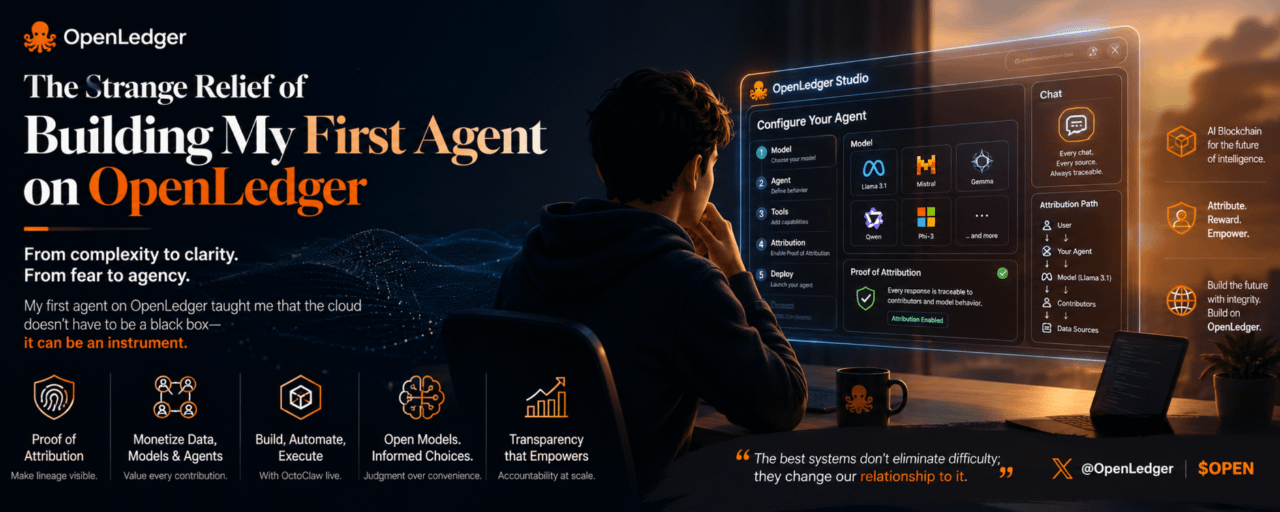
I did not expect cloud configuration to feel personal.
I thought it would feel like administration: a sequence of toggles, a set of permissions, a compromise between what I wanted and what the system would allow.
But when I configured my first agent on OpenLedger, the experience felt less like filing a technical request and more like crossing a threshold I had delayed out of habit rather than necessity.
The thing that surprised me most was not that it worked.
It was how quickly the fear of complexity began to dissolve once I stopped treating the cloud like a locked chamber and started treating it like an instrument.
OpenLedger gave that process a particular shape.
It is built as an AI blockchain that aims to monetize data, models, and agents while preserving traceability through Proof of Attribution.
That matters more than it first appears.
Because the old promise of AI was always haunted by a quiet problem: we could build intelligence, but we could not always explain where its confidence came from, or who had paid the hidden cost of making it possible.
OpenLedger’s core proposition is to make those invisible relationships legible.
Data contributions are meant to be traceable, and attribution is not an afterthought but part of the architecture itself.
That is why the setup felt unexpectedly empowering.
I was not simply launching an agent into a cloud environment.
I was entering a system that already seemed to understand the moral fatigue builders carry when they work with black boxes.
When a platform gives you a model choice, the choice is never only technical.
It is expressive.
It reveals what kind of intelligence you trust, what kind of latency you can tolerate, what kind of tone you expect from the machine.
On OpenLedger Studio, the promise is not just access to open models, but visibility into Proof of Attribution for each chat, so responses can be traced back to the underlying contributors and model behavior.
That transforms model selection from a matter of convenience into a matter of judgment.
I think that is the deeper reason the experience felt so accessible.
The platform does not flatten complexity by pretending it does not exist.
It reduces friction without insulting intelligence.
That distinction matters.
There is a difference between hiding difficulty and making difficulty navigable.
The first is a trick.
The second is design.
OpenLedger’s ecosystem suggests that with OctoClaw live, users can build, automate, and execute with AI agents in real time.
In practice, that kind of cloud readiness changes the emotional center of the work: instead of wrestling with infrastructure before you ever touch the idea, you are able to start from the idea itself.
And yet, accessibility is only half the story.
The more interesting question is what happens when building becomes easier.
We tend to speak about democratization as though it were a purely positive force, but every opening creates new obligations.
If more people can configure agents, then more people can also misconfigure them.
If more models become available, then the burden of discernment grows heavier, not lighter.
The very convenience that lowers the barrier to entry also raises the stakes of taste, restraint, and ethical clarity.
That is where OpenLedger’s insistence on attribution becomes more than a feature and starts to feel like a philosophy.
Proof of Attribution is not merely about rewards, although rewards matter.
It is about making the lineage of intelligence visible.
In a field increasingly addicted to speed, visibility is a kind of discipline.
It forces us to ask uncomfortable questions.
Whose data shaped this answer?
Which model amplified it?
What was borrowed, what was transformed, and what should never have been automated in the first place?
These are not cosmetic questions.
They are the questions that determine whether AI becomes an accountable tool or a graceful form of amnesia.
When I think back to the first agent I configured, I do not remember the process as a checklist.
I remember it as a small reordering of expectations.
I had assumed that working with cloud infrastructure would make me feel smaller, more dependent on abstractions I could not control.
Instead, OpenLedger made the process feel strangely intimate.
It reminded me that good systems do not merely absorb complexity; they return agency to the person using them.
They make room for experimentation without demanding that the builder become an engineer of invisible machinery before becoming a creator.
Still, I do not want to romanticize the moment.
There are always second order effects when a tool becomes easy enough to trust.
Ease can create overconfidence.
Traceability can create the illusion that transparency is identical to wisdom.
A clearly labeled system can still be used badly.
And a beautifully designed platform can still invite people to move faster than their judgment deserves.
That is why OpenLedger’s strongest contribution may not be that it makes agent setup simple, but that it keeps the consequences in view.
It makes the cloud feel usable without pretending the work has become trivial.
So the lesson I take from my first OpenLedger agent is not that the future of AI will be effortless.
It will not be.
The lesson is that effort no longer has to begin with despair.
There is something deeply human in that.
The best systems do not eliminate difficulty; they change our relationship to it.
They make room for confidence without severing accountability, and they let builders begin before they have fully convinced themselves they are ready.
That may be the real breakthrough here.
Not just powerful AI agents.
Not just cloud deployment made approachable.
But a place where building feels less like surrendering to complexity and more like learning how to speak to it.
And perhaps that is what makes the future feel reachable: not certainty, but a new and more honest kind of ease.