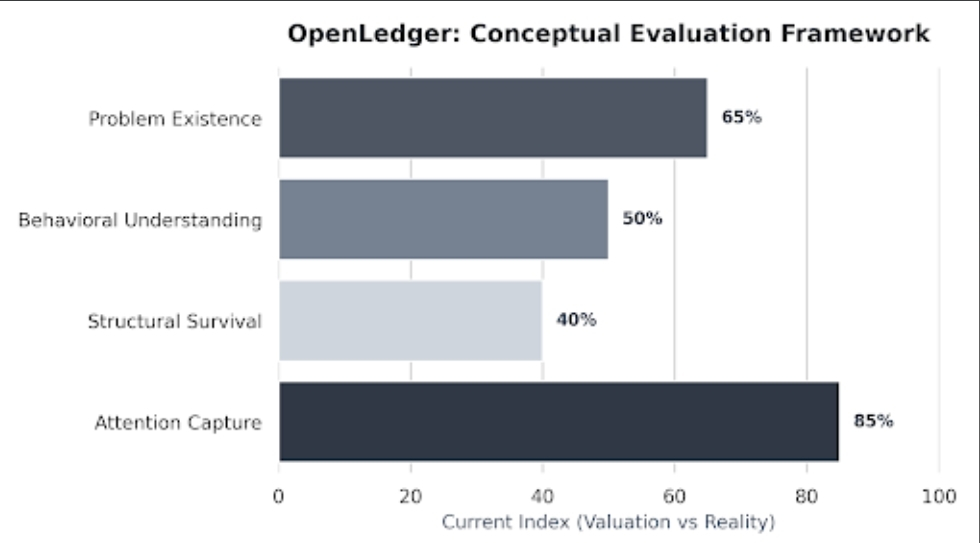
I’m watching OpenLedger (OPEN) in that quiet, slightly distracted way you watch something that hasn’t yet decided what it really is. Not because it looks dangerous or promising in any clear sense, but because it keeps refusing to settle into a single interpretation. One moment it feels like infrastructure, the next it feels like narrative weight drifting through thin liquidity.
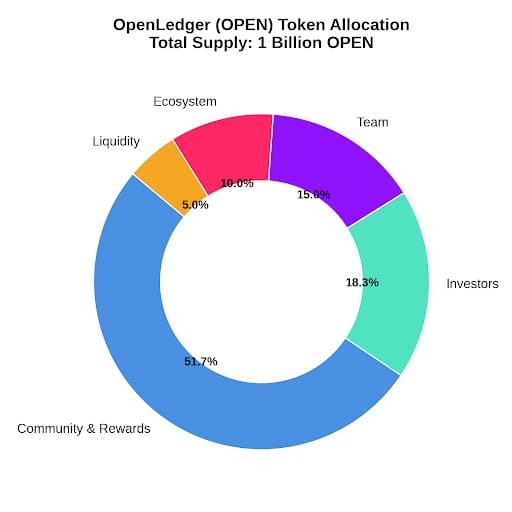
The token sits in that early trading range where nothing feels fully formed. Price moves without much resistance, but also without conviction behind it. Market cap is still in that exploratory zone where it can expand or collapse on relatively small flows. Circulating supply looks like it’s still being absorbed into attention rather than fully understood by it. Volume comes in uneven bursts, like someone opening and closing a door just to see if there’s wind on the other side.
It doesn’t feel like a mature market. It feels like something being tested in public.
And underneath that, there’s this idea trying to hold itself together.
OpenLedger is positioning itself around a simple but loaded claim: that data, models, and AI agents can be made economically legible, something that can be priced, tracked, and rewarded without relying entirely on centralized platforms deciding what counts as value.
It sounds clean when you first hear it. Almost obvious. But the more you sit with it, the more it starts to blur.
Because data is not one thing. Models are not stable objects. And agents… agents are even stranger, because they produce output that can look useful without being reliably useful. There’s always this gap between what is generated and what actually matters. That gap is where most systems either succeed or quietly dissolve.
What OpenLedger is trying to do, at least from the outside, is build a structure where those gaps don’t just get ignored. Where they get accounted for. Or at least priced.
But I keep thinking about how difficult that is in practice. Markets like things they can measure cleanly. Systems like this deal in things that resist clean measurement. So something has to give, either the precision of the system or the honesty of the metrics.
In early trading, though, none of that tension is visible in a stable way. It shows up indirectly. In how quickly attention rotates. In how liquidity appears just long enough to suggest confidence, then disappears before it can harden into anything real. In how the chart reacts more to narrative shifts than to anything resembling fundamental usage.
There’s a kind of familiar unease in that pattern. I’ve seen it enough times to recognize it, even when the names change.
And still, I don’t dismiss it. That would be too easy, and usually wrong in the long run.
Because some systems do start exactly like this. Unclear, overinterpreted, moving faster in story than in structure. And then, slowly, something changes. Not all at once. Just enough to notice if you’re paying attention for the wrong reasons.
The real question I keep circling back to isn’t whether the idea is interesting. It is. It’s whether anything inside it can survive without constant narrative pressure. Whether anything continues to happen when incentives fade a little. Whether the system produces outputs that people actually return to without being paid to return.
That part is still unclear.
Right now, OPEN feels like it’s in that early phase where everything is still being confused with potential. Where activity is taken as evidence, even when it might just be reflex. Where price moves first, and meaning is assigned afterward, almost reluctantly.
I keep watching the trading behavior, but not in a way that feels decisive. It doesn’t tell me much yet, except that attention is present and unstable. Enough to move things, not enough to anchor them.
And the idea itself, while coherent on the surface, still feels like it’s waiting for friction. Real usage tends to introduce friction. Integration does too. Costs, constraints, failures, edge cases. That’s usually where the truth starts to show up, not in the early smoothness of a narrative, but in what breaks when people actually rely on it.
For now, I just keep observing it in motion, without trying to finalize what it is. Because early systems rarely reveal themselves directly. They tend to reveal themselves indirectly, through what persists after attention shifts away.
And that’s what I’ll keep looking for. Not the excitement around it, not the first wave of interpretation, but whatever remains when the market stops trying to describe it and starts accidentally testing whether it actually works.