

OpenLedger feels like it is trying to fix something that crypto people already understand too well.
Not the shiny part.
The ugly part.
The part where value gets created by a crowd, then captured by whoever controls the final system.
Look, we have all seen this happen. A project launches a testnet. People spend weeks clicking, bridging, swapping, minting, giving feedback, making threads, joining calls, helping confused users in Discord. Then the airdrop comes.
And somehow the farmers win.
The real users get dust.
The bots get paid.
The people who actually cared are told the criteria was “fair.”
That feeling is familiar. It leaves a bad taste.
OpenLedger is looking at AI and saying, honestly, the same thing is happening there too.
Data goes in. Models get better. Agents become smarter. Someone builds a product on top. Money starts moving.
But the people underneath?
Gone.
No credit. No trail. No payout. Just swallowed by the machine.
That is the mess OpenLedger is trying to deal with.
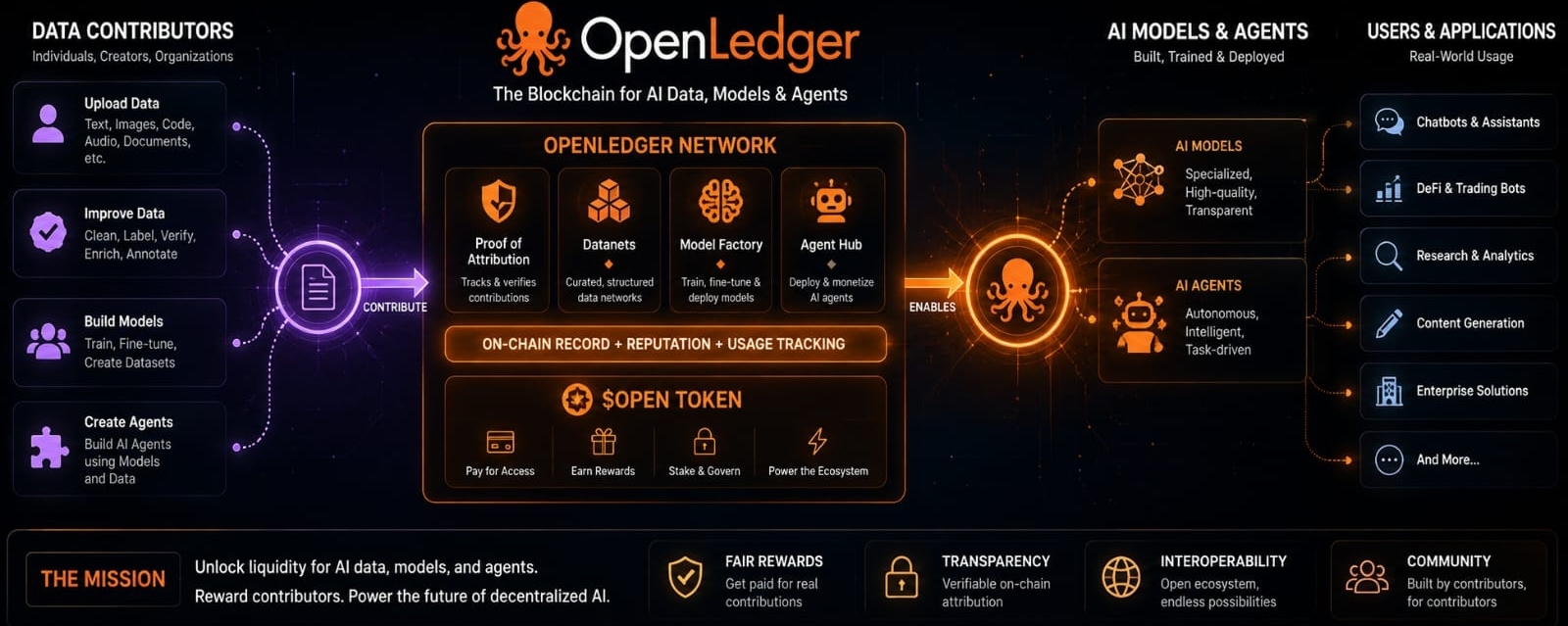
At its core, OpenLedger is about attribution. Not in a soft, social way. In a hard, economic way. It wants to make data, models, and agents traceable enough that value can move back to the people who helped create it.
That sounds boring.
Good.
Some of the most important things in crypto are boring until they break.
Bridges are boring until your funds are stuck.
Gas is boring until one transaction costs more than the trade.
Airdrop rules are boring until you realize fake users got rewarded better than real ones.
Attribution is boring until AI starts making money from work nobody can trace anymore.
That is where OpenLedger fits. It is plumbing. It is the layer under the hood that tries to answer a simple question the market keeps avoiding:
Who actually contributed value here?
The thing is, AI does not make that easy.
A token transfer is clean. Wallet A sends to wallet B. Done. You can see it. You can argue about intent, but not the movement.
AI is different. A model gives an answer, but that answer came from training, fine-tuning, datasets, adapters, prompts, and a lot of hidden behavior. It is not obvious which data mattered. It is not obvious which contributor helped. It is not obvious who deserves a cut when the output becomes useful.
So when OpenLedger talks about Proof of Attribution, I do not hear a victory lap.
I hear someone trying to build accounting for a black box.
That is hard.
Maybe painfully hard.
And it will probably be messy before it works well.
But at least it is aimed at a real wound.
OpenLedger’s Datanets are part of that. They are basically focused data networks, built around specific areas instead of one giant pile of random information. That matters because AI does not always need more data. Sometimes it needs cleaner data. Narrower data. Data from people who actually understand the thing.
That is where this project starts to feel practical.
Not every model needs to be massive. Not every AI product needs to pretend it knows the entire internet. Sometimes a smaller, specialized model with better inputs is more useful than a huge model guessing with confidence.
OpenLedger seems to be building around that idea.
Data comes in.
Models get built or improved.
Agents and apps use them.
Value moves back through the system.
That is the loop.
Simple to describe. Hard to make real.
And OPEN, the token, is supposed to sit inside that loop as the asset used for fees, access, rewards, governance, and activity. Fine. That makes sense on paper.
But crypto people know the paper version is never enough.
A token can be placed in the middle of anything. We have seen that trick too many times. Add token. Add rewards. Add dashboard. Add campaign. Call it adoption.
Then incentives dry up and nobody comes back.
OpenLedger has to prove it is not that.
If people contribute data only because there is a reward campaign, that is weak. If models get used only because users are farming points, that is weak. If agents exist only because the market likes AI words right now, that is weak.
The real test is whether people use the system when there is no easy farm.
When the product has to stand on its own.
That is where most projects get exposed.
Honestly, this is also where OpenLedger could struggle. The idea is clean, but the environment is not. Crypto incentives attract noise. Always.
If data earns rewards, people will upload garbage.
If attribution pays, people will try to game attribution.
If Datanets become valuable, people will try to poison them.
If agents can generate revenue, people will spin up fake activity and call it growth.
That is just the market we live in.
So OpenLedger cannot just build a nice-looking system. It has to build one that survives bad behavior. It has to tell the difference between useful contribution and reward farming. It has to make sure the data layer does not become another landfill with a token attached.
Not easy.
Not quick.
Not something a few clean diagrams can solve.
But I still think the direction matters.
Because AI has a contributor problem, and crypto has already lived through the pain of bad contribution tracking. We know what happens when systems reward the wrong users. We know what fake activity looks like. We know how quickly a good incentive turns into a farm.
OpenLedger is trying to build infrastructure that actually works in that chaos.
Not a perfect system.
A better one.
Something that gives memory to AI contribution.
Something that says, if your data helped, if your model mattered, if your agent created value, the system should not pretend you were never there.
That is the part I like.
It feels less like hype and more like repair.
Still, I would not over-romanticize it. OpenLedger has to earn trust. Proof of Attribution has to work beyond the docs. Datanets have to produce data that is actually useful. Models have to attract real demand. Agents have to do more than look good in demos. OPEN needs activity that is not just speculation wearing a product mask.
That is a lot to ask.
But real infrastructure always looks like a lot to ask in the beginning.
The market usually wants the loud thing. The quick thing. The thing that pumps before anyone asks what it does.
OpenLedger is more interesting when you ignore that noise and look under the hood.
It is trying to make AI less extractive.
Trying to make contribution less invisible.
Trying to stop value from vanishing into someone else’s platform.
Maybe it takes time. Maybe it breaks in places. Maybe the first versions are clunky and people complain because crypto people always complain when the plumbing is visible.
But the scar it points at is real.
We have all watched systems reward fake users and forget real ones.
OpenLedger is trying to build the opposite.
And for now, that is enough to keep watching.