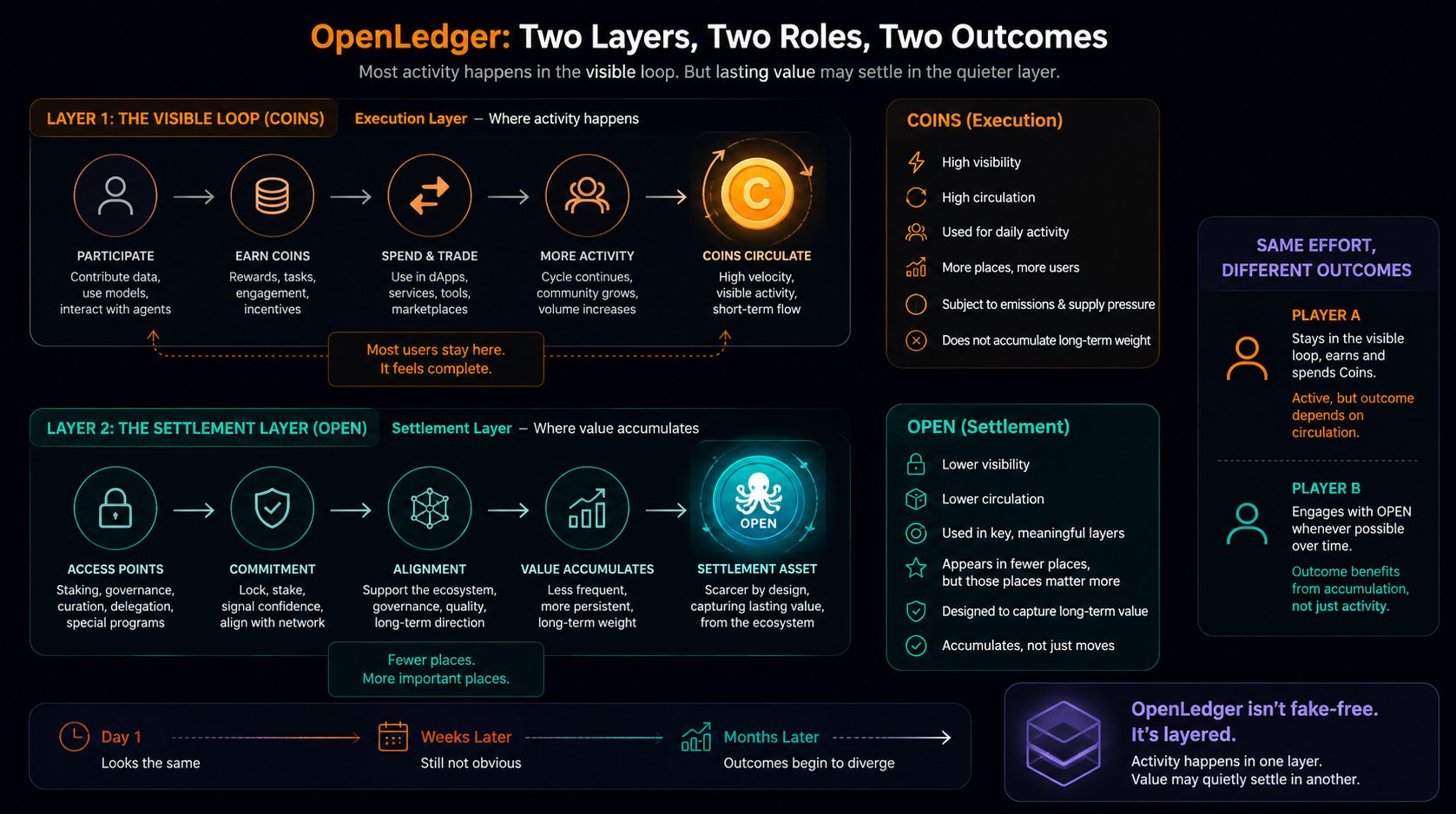
The Part of OpenLedger Most People Might Never Notice
The first thing you notice in OpenLedger is movement.
Coins are everywhere. People earn them, spend them, trade them, talk about them. Most of the visible activity seems to revolve around them. The experience feels open, comfortable, almost familiar. Contribute something, receive something back. Participate, progress, repeat.
Nothing about it feels complicated at first.
But the longer I watched the system, the more a small question kept coming back.
If Coins are everywhere, why does OPEN seem to appear only in certain places?
Not fewer places by accident. Fewer places that somehow felt more important.
That's what made me pause.
Most players naturally spend their time inside the visible loop because that's where the action is. Rewards appear there. Participation happens there. The economy feels alive there. Coins circulate constantly, creating the sense that value is moving throughout the network.
And maybe it is.
But circulation and accumulation are not always the same thing.
It started feeling strange because OPEN rarely sits at the center of everyday activity, yet it seems much closer to the moments where ownership, commitment, and longer-term positioning begin to matter. The difference isn't dramatic enough to notice immediately. It reveals itself slowly.
The easiest way I can describe it is through a game economy.
Coins feel like execution.
OPEN feels more like settlement.
One layer helps activity happen. The other appears to record who ultimately benefits from that activity over time.
The interesting part is that the system never forces you to think about this distinction. Most people can participate for a very long time without questioning it. They earn rewards, complete tasks, contribute data, interact with models and agents, and everything works exactly as expected.
Which is why many players may never consciously notice the layered design at all.
I kept thinking about that.
Imagine two people putting in roughly the same effort. They contribute similar amounts of data. They stay active for the same period. From the outside, their participation looks almost identical.
Yet months later, their outcomes may not be identical at all.
One remained mostly inside the circulating economy. The other gradually found ways to engage with OPEN whenever those opportunities appeared. The difference wasn't visible on day one. It wasn't even obvious after several weeks. But systems often reveal themselves through accumulation, not activity.
That slow divergence is what caught my attention.
Because from the surface, OpenLedger almost feels free-to-play.
Not in the sense that nothing has value, but in the sense that participation feels accessible and frictionless. The visible economy welcomes everyone. The deeper economic layer doesn't announce itself nearly as loudly.
Maybe that's intentional.
Maybe it isn't.
What makes the question interesting is the token structure surrounding it. Unlocks continue. Emissions continue. Additional supply enters circulation over time. That creates the familiar pressure every crypto network eventually faces: activity alone is not enough. The market eventually asks where durable value is actually being stored.
And that answer is not always the asset receiving the most attention.
If most participants stay inside the visible loop, the token can slowly drift away from the behaviors that generate real economic gravity. Activity remains high. Dashboards stay busy. Rewards continue flowing. Yet the relationship between participation and long-term value capture becomes less direct than it first appears.
The strange part is that nothing needs to break for this to happen.
Everything can function exactly as designed.
Maybe that's why I found the Coins versus OPEN distinction more interesting than any individual feature OpenLedger offers. It's not a loud difference. It's not something most users will immediately recognize. It's a gradual separation between the layer where people act and the layer where value may quietly settle.
And once I noticed it, I found it difficult to ignore.
OpenLedger may not be pretending to be something it isn't. The system is fairly transparent about its components. But beneath the comfortable flow of everyday participation, there seems to be another story unfolding—one that many users may never stop long enough to see.