
AI models get most of the attention. Bigger models. Smarter outputs. Faster responses.
But there’s a quieter issue underneath all of it: data quality.
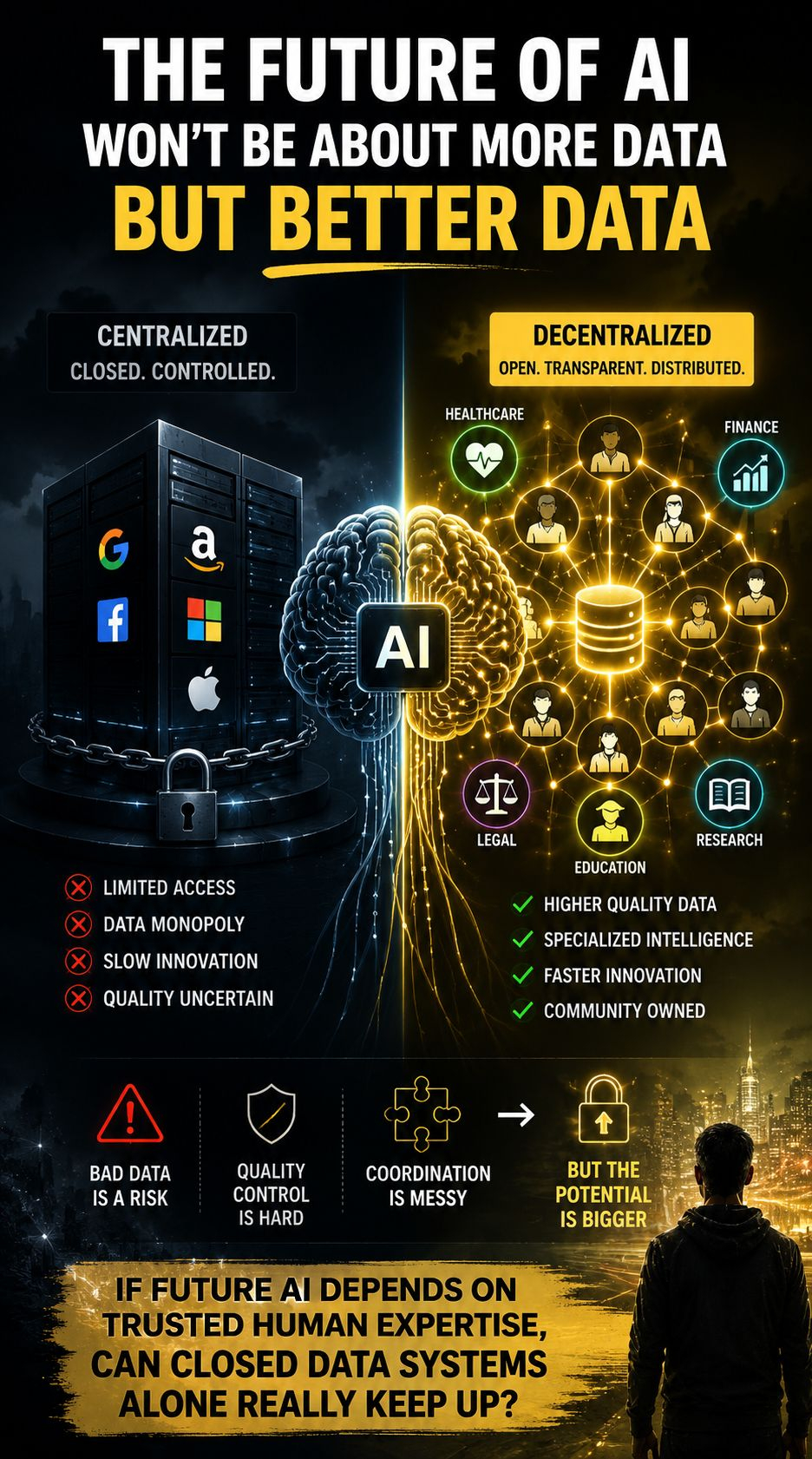
AI is only as useful as the information it learns from. And today, much of that data sits inside closed systems controlled by a small number of platforms. As AI-generated content floods the internet, finding trustworthy, specialized, and high-quality data is becoming harder, not easier.
That’s why decentralized AI data matters.
The argument is simple: future AI may not win through more data, but through better data.
A healthcare AI cannot rely on random internet content. A finance model needs accurate market insight. Legal AI depends on trusted expertise. Specialized intelligence requires specialized datasets.
Decentralized data systems attempt to solve this by making contribution more open, transparent, and distributed instead of depending entirely on centralized pipelines.
The bigger implication is often ignored: if high-quality human knowledge becomes the most valuable input for AI, the systems collecting and organizing that intelligence may matter just as much as the models themselves.
Of course, decentralization creates challenges. Quality control is difficult, coordination is messy, and bad data remains a risk.
Still, one question keeps growing louder:
If future AI depends on trusted human expertise, can closed data systems alone really keep up?
