
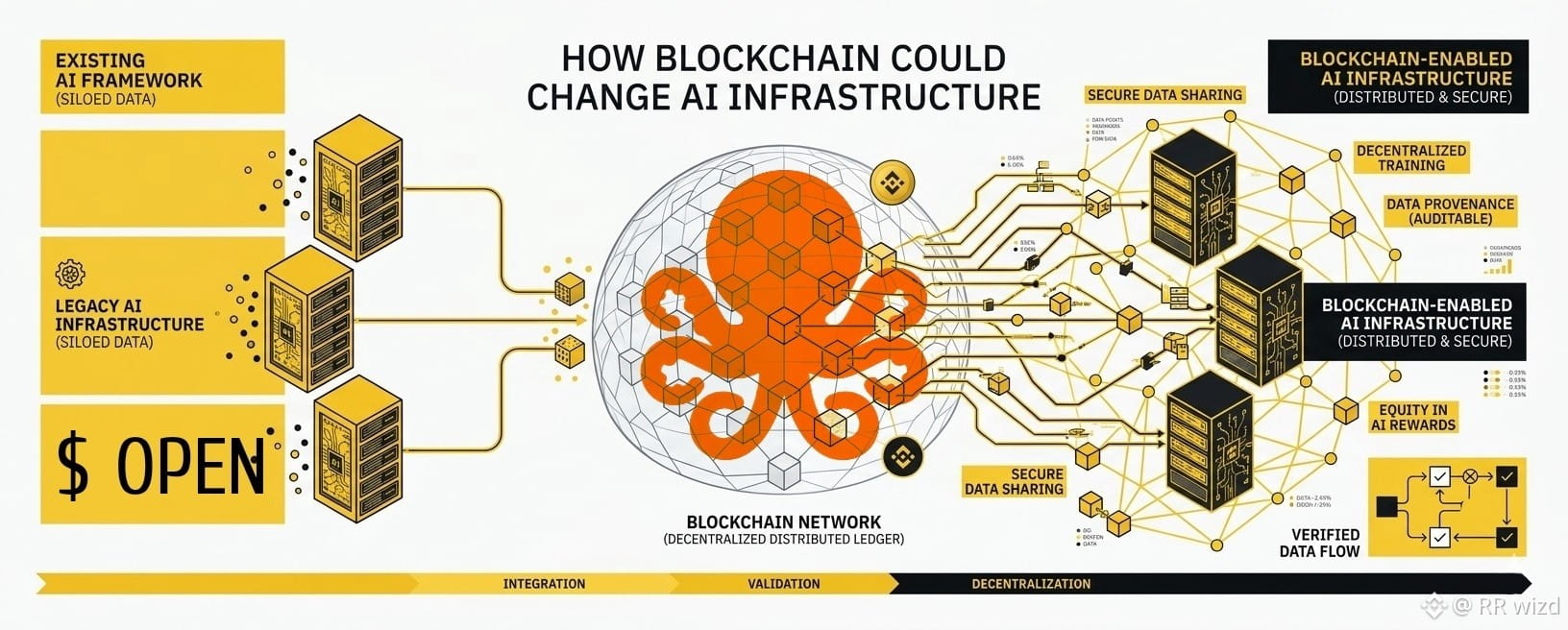
A few days ago, while scrolling through different AI-related crypto projects, I noticed something that honestly started bothering me.
Almost every project was repeating the same narrative.
“AI is the future.”
“Revolutionary technology.”
“Next-generation intelligence.”
At some point, everything began sounding identical.
So instead of looking at marketing, I decided to focus on a much simpler question:
What does AI actually need in order to grow sustainably over the next decade?
And the answer I kept coming back to was surprisingly simple: data, coordination, and infrastructure.
That thought eventually led me deeper into researching @OpenLedger .
The interesting part wasn’t just that the project combines AI and blockchain. A lot of projects claim to do that. What actually caught my attention was the broader idea behind it — exploring whether decentralized systems could eventually play a role in how AI ecosystems are built, coordinated, and rewarded.
And honestly, I think that conversation is becoming far more important than most people realize.
>> The Hidden Problem Behind Modern AI
Most people interact with AI through finished products: chatbots, generators, automation tools, recommendation systems.
But very few people stop to think about the infrastructure underneath those systems.
The reality is that AI doesn’t magically become intelligent on its own.
It depends on:
massive datasets
contributors
training environments
computational resources
coordination systems
And today, a large portion of that infrastructure remains concentrated inside a small number of major technology companies.
The more I thought about this, the more I started wondering:
As AI becomes more integrated into global digital systems, will control remain heavily centralized… or will decentralized alternatives eventually become necessary?
That’s where projects like OpenLedger become interesting.
Because the project appears to be exploring how blockchain-based coordination could support AI ecosystems through transparency, contribution systems, and decentralized participation models.
Whether that vision succeeds long term is still uncertain — but strategically, the direction itself makes sense.
>> Why This Narrative Feels Different
One thing I’ve learned after spending time in crypto is that markets move in cycles of attention.
At first, people chase hype.
Later, they start looking for infrastructure.
Right now, most AI-related crypto discussions are still heavily driven by excitement and speculation. But eventually, investors usually begin asking deeper questions:
Who owns the data?
Who benefits from network growth?
How are contributors rewarded?
Can ecosystems scale sustainably?
This is where OpenLedger feels different from many surface-level AI projects.
The project appears more focused on ecosystem structure rather than simply market excitement.
And personally, I think infrastructure narratives often become more important over time — especially when an industry matures.
>> Where Blockchain Actually Fits Into AI
I’ll be honest: for a long time, I used to think many “AI + blockchain” narratives felt forced.
Not every technology needs a blockchain attached to it.
But the deeper I researched decentralized AI ecosystems, the more I realized there may actually be meaningful overlap between the two sectors.
AI systems need:
coordination
contribution layers
transparent incentives
scalable participation
Blockchain technology naturally introduces:
ownership systems
transparent records
decentralized governance
reward mechanisms
That overlap creates interesting possibilities.
Instead of ecosystems being controlled entirely by centralized entities, decentralized infrastructure could eventually allow contributors, developers, and communities to participate more directly in network growth.
And in crypto, participation-driven ecosystems often create some of the strongest long-term communities.
That’s one reason I think this sector deserves more serious attention moving forward.
>> Thoughts on OPEN and Ecosystem Incentives
Whenever I research newer ecosystems, I try not to focus entirely on price action.
Short-term speculation is everywhere in crypto.
What matters more to me is whether the ecosystem structure actually encourages sustainable participation.
For any protocol to survive long term, incentives need to align between:
users
contributors
developers
builders
the network itself
From what I’ve observed so far, OpenLedger seems focused on building around contribution-driven infrastructure rather than purely speculative attention.
That becomes important because the future AI economy may eventually reward ecosystems capable of coordinating participation at scale.
Still, ideas alone are never enough.
Adoption matters more than narratives.
If developer activity, ecosystem growth, and user participation fail to expand over time, even strong concepts can struggle.
That’s the reality every AI-related crypto project will eventually face.
>> Risks That Shouldn’t Be Ignored
Even though AI remains one of the strongest narratives in crypto right now, competition inside this sector is becoming intense extremely quickly.
New AI ecosystems launch almost every week.
That means projects like OpenLedger will eventually need to differentiate themselves through:
execution
ecosystem growth
real adoption
strategic integrations
sustainable network activity
Another challenge is narrative saturation.
As more projects combine “AI” and “Web3” branding, investors may become increasingly selective about which ecosystems deserve long-term attention.
And honestly, that’s healthy.
Because eventually, the market stops rewarding promises and starts rewarding execution.
>> Final Thoughts
After researching OpenLedger more closely, I don’t see the project as just another short-term AI trend.
I see it as part of a much larger conversation: how AI infrastructure, ownership systems, and decentralized coordination could evolve together over the next decade.
Of course, the sector is still early.
There are still major questions around scalability, adoption, sustainability, and real-world implementation.
But strategically, I think projects exploring decentralized AI infrastructure are entering one of the most important technological discussions currently happening across both crypto and traditional technology markets.
And personally, that alone makes OpenLedger worth watching carefully.
The bigger question is:
As AI continues reshaping the digital world, will future infrastructure remain controlled by a few centralized giants…
or will decentralized participation eventually become part of the next evolution of AI itself?