
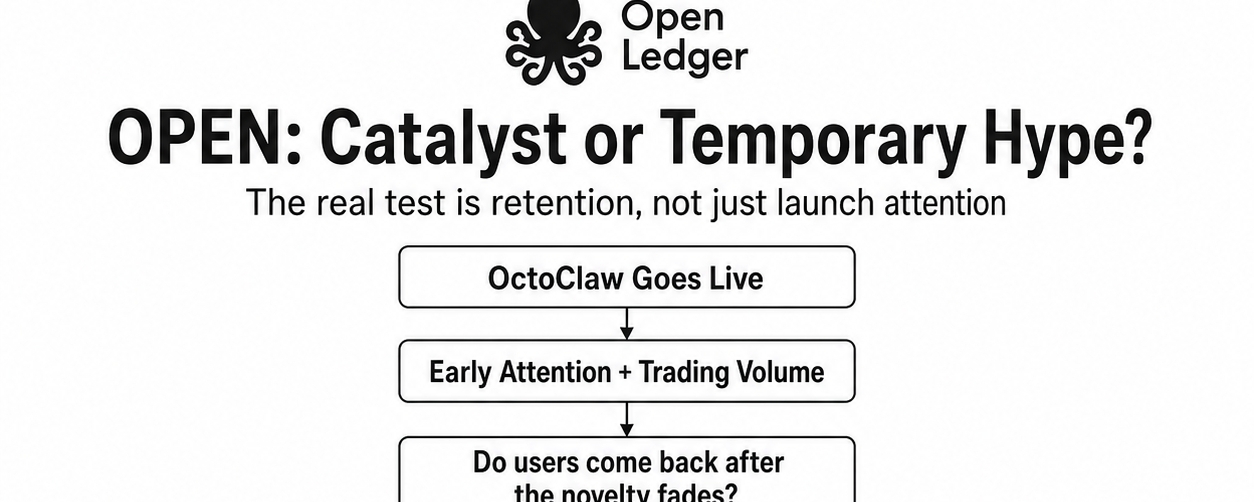
I think everyone is wrong about OpenLedger’s Octoclaw launch because they’re still looking at it like another AI headline, while the real threat is much closer to the trader’s desk.
I had that thought last night while flipping between charts, token pages, and a few posts about OPEN. The price was sitting around $0.20, volume was active, and the market cap was floating near the $58M to $60M range depending on which tracker you trust. Nothing insane on the surface. Not a giant valuation. Not a dead microcap either. Just that awkward middle zone where traders either dismiss it too quickly or chase it without asking what actually changed.
But Octoclaw made me pause. OpenLedger’s own site now says OctoClaw is live, with the pitch being simple enough: build, automate, and execute with AI agents in real time. That sounds clean, but the trading implication is messier. If agents can monitor on-chain conditions, automate workflows, act faster than humans, and eventually plug into attribution-based AI infrastructure, then the market edge shifts again. Not from retail to whales. That already happened. From manual traders to systems that don’t sleep, don’t panic, and don’t need five Telegram groups to decide what to do next.
That’s why the title sounds harsh. “Make most traders obsolete” doesn’t mean nobody will trade anymore. It means the average trader who survives only by reacting late to information could lose even more ground. We’ve already seen this movie in smaller forms. Bots catch listings before humans. Market makers shape liquidity before retail notices. AI tools summarize news faster than manual researchers. Octoclaw fits into that same direction, but with a more direct on-chain execution angle.
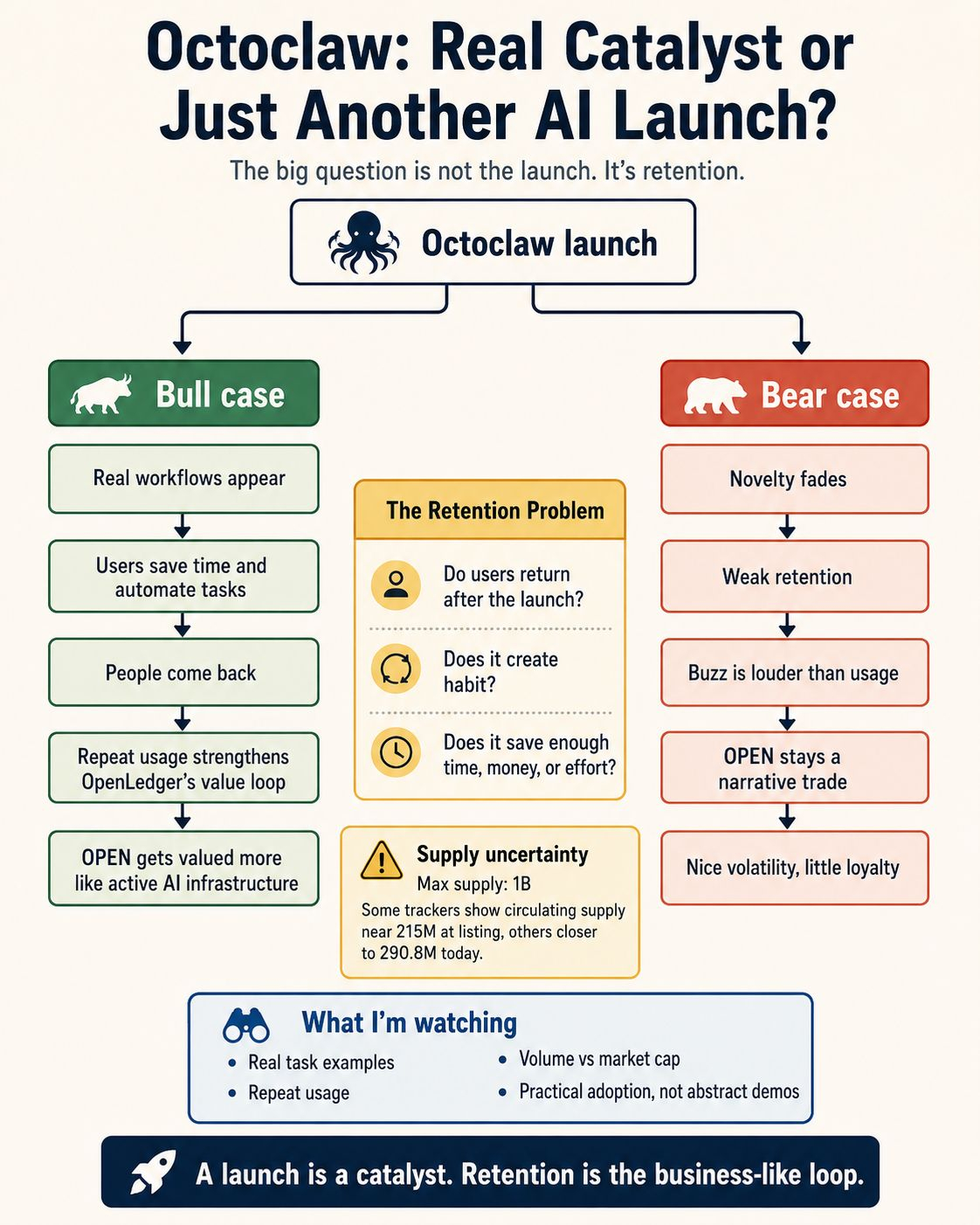
Now here’s the thing. I’m not saying OPEN deserves blind buying because an agent product went live. That’s lazy thinking. The actual question is whether Octoclaw creates repeat usage that can feed back into OpenLedger’s broader value loop. OpenLedger is trying to monetize data, models, and agents. Binance described OPEN at listing as an AI blockchain focused on unlocking liquidity around those three layers, with a 1B max supply and 215.5M circulating at listing. Today, some platforms show the circulating supply closer to 290.8M, while others still show around 215M to 220M. That mismatch matters. Traders hate uncertainty when token supply is involved, and they should.
Still, the numbers aren’t meaningless. At roughly $0.20, a $58M market cap, and daily volume around the mid-$30M range on Binance and CoinMarketCap, OPEN has enough liquidity to be tradable without being fully priced like a dominant AI token. The volume-to-market-cap ratio is worth watching because it tells you attention is still moving through the asset. If a token does $30M plus in daily volume against a market cap under $70M, that usually means traders are actively rotating in and out, not just holding quietly. Good for opportunity. Bad if you confuse momentum with conviction.
The bull case is pretty clear to me. If Octoclaw becomes a real execution layer for AI agents, OpenLedger moves from “AI data attribution project” into something more practical. Traders don’t just value ideas. They value usage. If users start coming back because agents help them automate wallet actions, monitor opportunities, run workflows, or interact with on-chain systems more efficiently, OPEN gets a stronger story than most AI tokens that only sell future imagination. A $58M to $60M market cap leaves room if the market begins valuing it closer to active AI infrastructure instead of just another narrative coin.
But the bear case is just as real. AI agent products are easy to announce and hard to retain users around. That’s the Retention Problem, and it’s the part most traders ignore because it doesn’t look exciting on a chart. A launch can pull attention for a few days. A working product can pull early users. But can Octoclaw make people come back after the novelty fades? Can it create habits? Can it save users enough time, money, or effort that they keep using it when the token isn’t pumping?
That’s the difference between a catalyst and a business-like loop. My frustration with many AI crypto projects is that they talk like infrastructure but behave like campaigns. Big idea, short burst, then silence until the next announcement. If Octoclaw falls into that pattern, the market will probably treat OPEN like another tradeable AI beta asset. Nice volatility. No deep loyalty. And if supply unlocks, reward emissions, or circulating supply confusion become louder than usage growth, the chart won’t care how smart the product sounds.
What would change my mind on the bearish side? Weak usage after launch. No clear examples of real workflows. Traders trying it once and never returning. A rising market cap with falling volume. Or worse, OpenLedger leaning too hard on buzz while leaving practical adoption vague.
What would make me more bullish? Simple. I want to see Octoclaw used in ways normal traders can understand. Not abstract demos. Real tasks. Real execution. Real reasons to open it again tomorrow. If a trader can say, “This saved me time,” or a builder can say, “This helped my agent act on-chain,” then OpenLedger starts building something harder to fade.
For now, OPEN is not a comfortable hold for me. It’s a watchlist asset with a live catalyst, decent liquidity, and a real question hanging over it. That’s actually more interesting than a clean story. Clean stories usually get crowded fast.
So I’m watching Octoclaw less like a product launch and more like a warning shot. If agents start doing the slow, repetitive, reaction-based work better than human traders, then the edge won’t belong to whoever stares at the chart longest. It’ll belong to whoever understands how to use the machines before the machines price them out.
Are you watching Octoclaw as a real OpenLedger catalyst, or do you think traders are overestimating another AI launch again?
