What keeps standing out to me about the current AI market is how quickly the conversation collapsed into a compute race.
Every discussion eventually circles back to GPUs, model size, inference speed, training costs, or who raised the biggest infrastructure round. The assumption underneath all of it feels fairly straightforward: whoever controls the most computational power eventually controls the market.
And maybe that was true during the first phase of AI expansion.
But I’m not fully convinced it remains true as these systems become economically integrated into real workflows.
Because once AI stops being a novelty layer and starts participating inside operational environments, the problem changes completely. The bottleneck stops being generation quality alone. It becomes coordination. Attribution. Permissioning. Trust. Provenance. Accountability.
That sounds subtle until you look at how institutions actually operate.
Large enterprises do not adopt systems simply because they are intelligent. They adopt systems they can audit, attribute, monitor, permission, and govern. Especially when outputs influence money movement, compliance decisions, customer interactions, healthcare recommendations, financial execution, or internal operations.
The market still talks about AI as though intelligence itself is the scarce resource.
I think the deeper scarcity may eventually become trusted intelligence.
And honestly, those are not the same thing.
The internet already showed us what happens when information scales faster than verification systems. Distribution exploded. Trust fragmented. Platforms became overwhelmed by attribution problems, manipulation, synthetic activity, and incentive distortion.
AI may be accelerating into a similar phase now, except with much larger economic consequences.
Because this time the systems are not only distributing information. They are increasingly making decisions, triggering actions, coordinating workflows, allocating capital, interacting with APIs, managing liquidity, optimizing operations, and eventually negotiating with other autonomous systems.
That changes the infrastructure requirements entirely.
The more interesting question is no longer whether AI can produce output.
It clearly can.
The more important question becomes: how do markets determine whether an AI system should be trusted operationally?
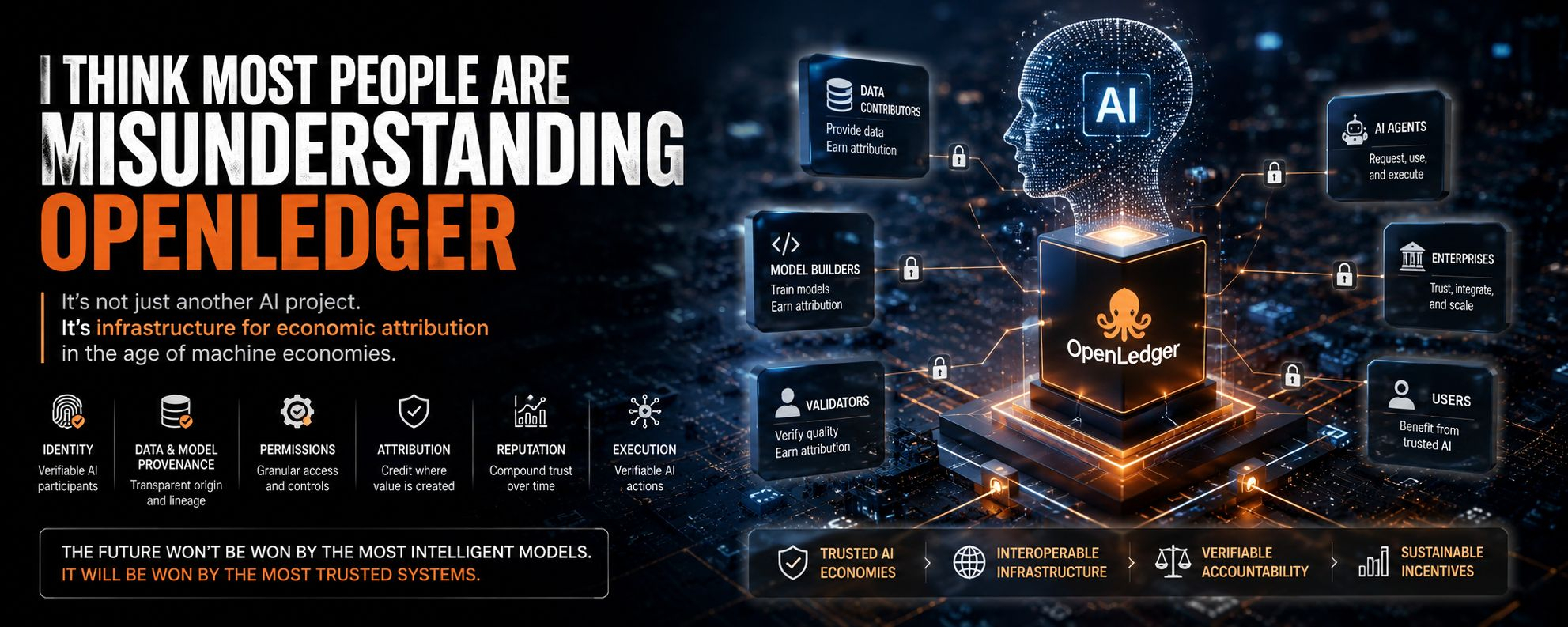
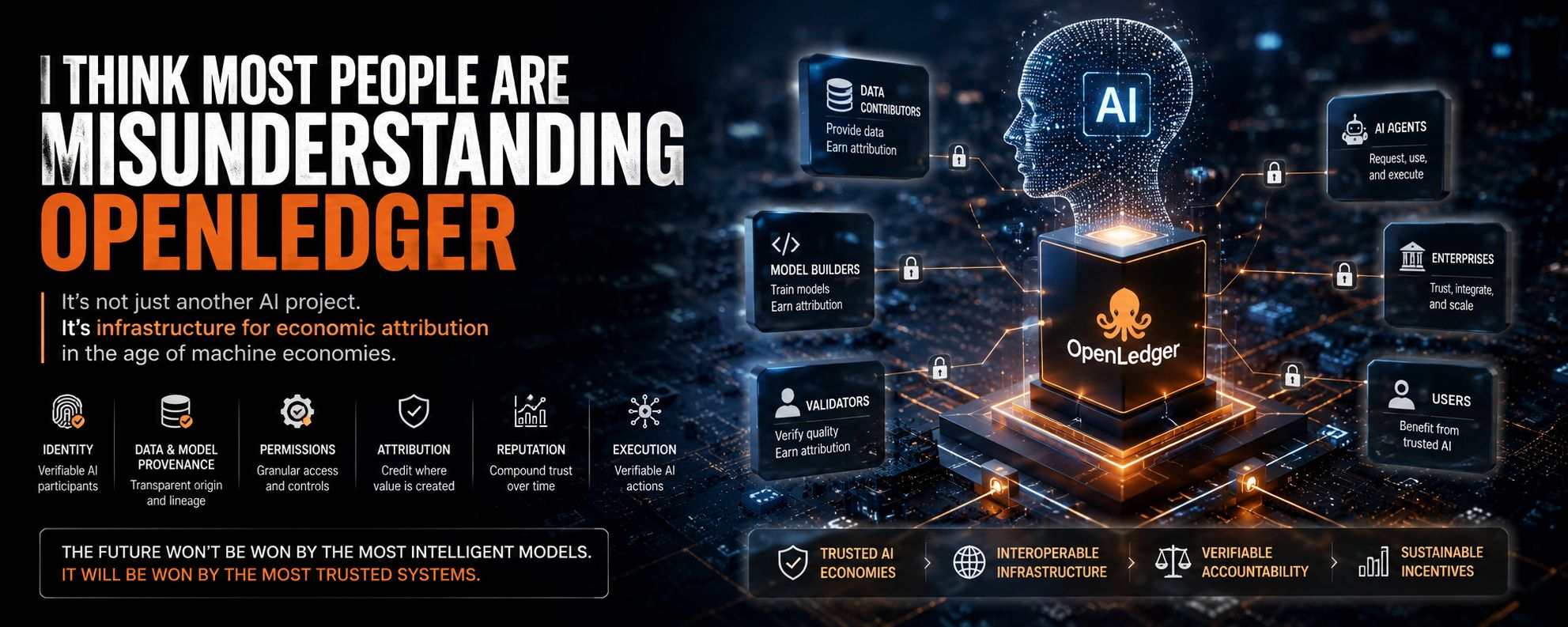
And I think this is where a lot of people may be misunderstanding @OpenLedger.
Most people still categorize it inside the usual crypto AI bucket. Another token attached to another AI narrative. Another marketplace. Another coordination layer. Another infrastructure protocol attempting to tokenize data contribution or model participation.
But the deeper shift may actually be happening somewhere else.
OpenLedger increasingly looks less like a simple AI marketplace and more like infrastructure for economic attribution itself.
That distinction matters more than people realize.
Because attribution is quietly becoming one of the hardest problems in machine economies.
If an AI agent generates value inside a multi-agent workflow, who gets credited?
If a model was trained on distributed datasets contributed across multiple entities, who owns the downstream economic rights?
If autonomous systems begin interacting financially with one another, how does reputation compound over time?
How do institutions verify the provenance of outputs?
How do enterprises distinguish between trusted execution systems and probabilistic black boxes?
And maybe most importantly, how do you build economic systems where participation quality matters more than raw extraction speed?
I keep coming back to that last point.
Crypto historically struggled with incentive durability. Many networks optimized heavily for participation quantity while underpricing participation quality. That produced liquidity for a while, but not necessarily trustworthy coordination.
AI introduces a similar risk at a much larger scale.
If every agent can generate endless outputs cheaply, then output abundance itself stops carrying economic weight. Markets eventually need filtering systems. Reputation systems. Permission systems. Contribution systems.
Otherwise machine-generated noise simply overwhelms machine-generated value.
That feels increasingly relevant when looking at where OpenLedger seems to be positioning itself.
Not around AI hype cycles alone, but around the operational layer underneath AI coordination.
There’s an important difference between building a model and building infrastructure capable of verifying who contributed, who executed, who authorized, who trained, who validated, and who should economically benefit from downstream activity.
Those sound like backend problems until large-scale financial systems start integrating AI more deeply.
Then suddenly provenance becomes operationally critical.
Take enterprise AI adoption for example.
Most corporations are not hesitant about AI because they doubt model capability anymore. The hesitation increasingly comes from governance uncertainty. Data lineage uncertainty. Compliance uncertainty. Attribution uncertainty.
Who becomes legally responsible when autonomous systems make mistakes?
Which datasets influenced a decision?
Can outputs be traced?
Can permissions be segmented?
Can internal data remain compartmentalized?
Can execution rights be limited?
Can behavior histories be audited?
These are not glamorous questions, but infrastructure markets are often built around unglamorous bottlenecks.
Cloud computing became valuable because operational scalability mattered. Payment networks became valuable because settlement coordination mattered. Search became valuable because information filtering mattered.
AI infrastructure may evolve similarly.
And honestly, I suspect the market still underestimates how much institutional adoption depends on operational trust layers rather than raw intelligence layers.
That is partly why I think the “AI compute supremacy” narrative may eventually become incomplete.
Compute probably still matters enormously.
But over time compute itself risks commoditization.
Open-source models continue improving. Inference costs continue compressing. Smaller specialized models are becoming increasingly capable. Distributed training approaches are expanding rapidly. Even frontier capability advantages may narrow faster than expected.
If that trend continues, scarcity may migrate upward into coordination infrastructure instead.
Not who can generate intelligence.
But who can verify, permission, govern, coordinate, attribute, and operationalize intelligence safely at scale.
That feels closer to where OpenLedger is trying to sit.
Still, there are real uncertainties here.
Institutional AI adoption moves slower than crypto markets prefer. Governance systems remain immature. Attribution frameworks are still evolving legally and technically. Multi-agent coordination introduces enormous complexity. Reputation systems themselves can become manipulable. Permission layers can introduce centralization risks.
And token economics around AI infrastructure remain difficult to price correctly because value accrual mechanisms are still highly experimental.
There is also the possibility that enterprises simply build closed internal systems instead of relying on open coordination frameworks.
That risk is real.
But even closed systems eventually require interoperability standards once external coordination becomes economically necessary. Financial systems learned this. Internet systems learned this. Supply chains learned this.
AI systems probably will too.
Especially if machine-to-machine economies continue developing.
Because autonomous systems interacting economically with other autonomous systems creates entirely new trust requirements.
A human can rely partially on intuition, legal systems, or social context.
Machines cannot.
Machines require structured trust frameworks.
Reputation frameworks.
Permission frameworks.
Attribution frameworks.
Execution validation systems.
And honestly, that may become one of the largest infrastructure markets of the next cycle.
Not AI as entertainment.
Not AI as novelty.
But AI as operational infrastructure embedded directly into economic systems.
The market still seems heavily focused on intelligence generation itself because that is the easiest layer to visualize. Bigger models create visible progress. Better outputs create visible excitement.
Coordination infrastructure is less visible.
But historically, invisible infrastructure layers often end up capturing disproportionate long-term value because they become economically necessary once systems scale.
The internet eventually needed identity layers.
Finance eventually needed settlement layers.
Global commerce eventually needed trust layers.
AI may eventually need attribution and permission layers in the same way.
And maybe that is the part most people are still missing about OpenLedger.
Not whether AI becomes larger.
But what kind of infrastructure becomes unavoidable once AI starts participating directly inside real economic coordination.