Market was doing nothing interesting today. Sideways grind, low volume, the kind of session where you end up reading things you wouldn't normally read.
So I went back to something I'd been meaning to sit with properly @OpenLedger the whole Verifiable AI thesis. $OPEN has been getting more attention lately and I wanted to understand it past the surface.
I was mostly curious about the attribution angle. The idea that every dataset, every training input, every inference gets recorded on-chain and contributors get paid when their data gets used. That's the pitch. Proof of Attribution. Payable AI. It sounds almost too clean.
And honestly, going through the docs, the mechanism is real. It's not vaporware. The chain exists, the attribution trails exist, the smart contract logic for routing rewards based on influence weight exists. #OpenLedger built something technically coherent. That part checks out.
But somewhere in the middle of reading, something shifted for me.
Here's what I kept circling back to: the narrative is about fairness for contributors. Data providers, model trainers, the people who actually build the intelligence. They get credited, they get paid. That's the stated mission.
Then I looked at the governance structure.
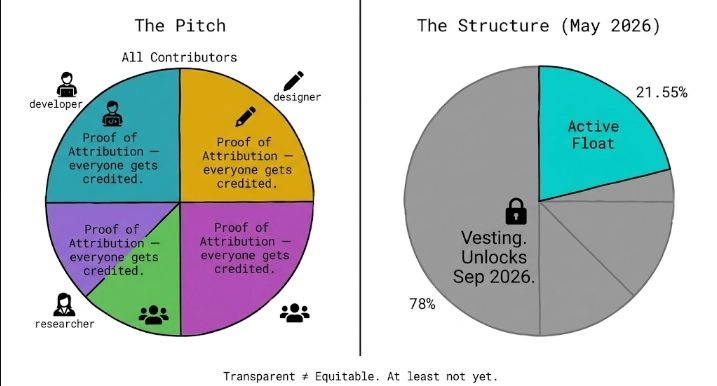
To participate in governance to actually vote on reward schedules, fee parameters, how the whole system gets calibrated you convert OPEN to gOPEN, one to one. Clean. Except right now, only about 21.55% of the total OPEN supply is even circulating. The rest is locked. Team and investor allocations don't start unlocking until September 2026, then linear release over 36 months after that.
So the people who will eventually hold the most governance power… aren't voting yet.
The contributors uploading datasets and training models right now are participating in a system where the rules feel democratic, but the actual weight of future votes is sitting in a vesting schedule. Whatever governance habits form between now and September who proposes changes, who pushes through fee adjustments, what quorum looks like in practice those patterns are forming with a fraction of the eventual float.
I kept thinking about it like this: imagine you're designing a fair election system and you announce it before most voters have received their registration cards.
The system is technically fair. The process is transparent. But who's actually in the room when the early decisions get made?
I want to be clear about something, because I almost talked myself out of this. The unlock schedule is public. The docs spell it out. This isn't hidden OpenLedger literally published the cliff and linear vesting in their tokenomics documentation. So it's not a scandal.
It's just… a structural reality that gets less attention than the attribution story.
And that's the part that stayed with me. Transparent doesn't automatically mean equitable at this specific moment. A system can have perfect on chain records of who contributed what and simultaneously concentrate near term governance power with a smaller group while the larger float is still locked. Both things can be true.
But here's where I'm not fully convinced this holds under pressure: what happens when the September unlock hits and a significant chunk of supply enters the governance pool at once? Does it dilute early established patterns, or do early governance participants have enough institutional momentum by then that the influx doesn't actually change much? I genuinely don't know.
The optimistic read is that 36 months of linear vesting is slow enough that power shifts gradually and organically. The less optimistic read is that the first year of governance on any protocol tends to define its character for a long time.
There's also the question of whether most data contributors actually convert to gOPEN and vote, or whether they just collect rewards and stay passive. Governance participation on most protocols is low.
If the people the system is supposedly designed to empower don't actually show up for votes, then the fairness architecture is real but the fairness in practice is a different story.
This isn't me saying OpenLedger is broken or misrepresenting itself. The technical layer is serious work, and the attribution problem in AI is real someone should be solving it. The OPEN unlock structure is also pretty standard for this space, 12 month cliff, 36 month linear, nothing unusual there.
I just think the gap between "fair by design" and "fair right now" is worth sitting with. Because those two things can diverge quietly, and usually do, before anyone notices.
Anyway. Volume's still flat. I'll probably check back on this in the fall once the cliff breaks and see what governance actually looks like with more of the float in play. That'll tell me more than the docs will.