
There’s a point you eventually reach in crypto where excitement starts feeling repetitive. Not because innovation disappears, but because the emotional rhythm becomes familiar. A new protocol emerges. A clean whitepaper appears. Influencers repeat phrases like “infrastructure layer,” “paradigm shift,” or “future of coordination.” Liquidity arrives. Timelines become euphoric for a few weeks. Then, slowly, reality starts pressing against the architecture. Users lose interest. Complexity reveals itself. Incentives weaken. The next narrative replaces the previous one almost overnight.
After watching that cycle repeat for years, I’ve become less interested in what projects promise and more interested in what human behavior eventually does to them.
That’s probably why @OpenLedger caught my attention in a different way than most AI-related crypto projects recently. Not because it sounded revolutionary, but because the project seems to be asking a slightly more uncomfortable question than the industry usually likes to confront.
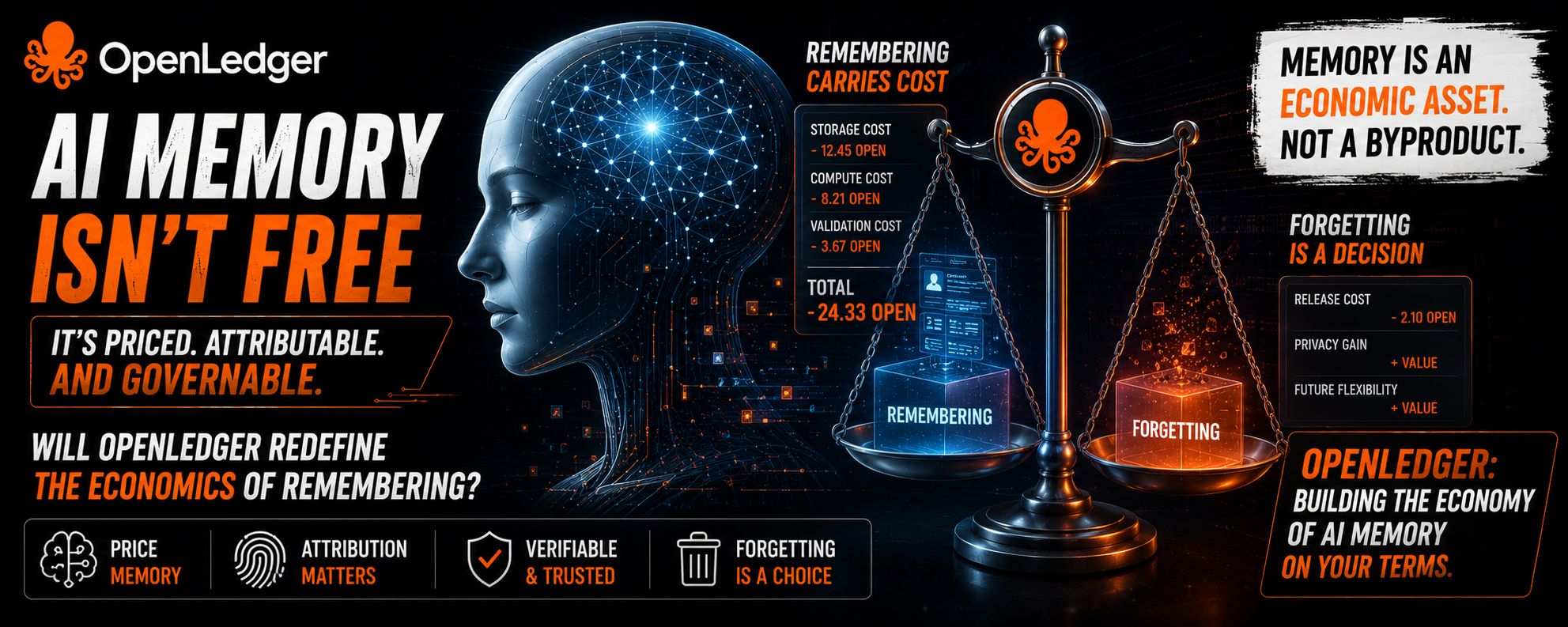
What if AI memory itself becomes an economic object?
Not storage in the simple blockchain sense. Actual memory. Context. Retained interactions. Persistent intelligence. Information that an AI system chooses to keep, reference, prioritize, or discard over time.
Most people still talk about AI memory as if it’s free infrastructure, something abstract sitting invisibly behind applications. But OpenLedger appears to be moving toward a model where memory carries economic weight. Where remembering has cost. Where attribution matters. Where retention decisions become part of a larger economic system instead of an invisible technical process.
Conceptually, I think that’s one of the more intellectually honest directions I’ve seen in this space.
Because memory is never actually free.
Someone stores it. Someone validates it. Someone pays for the computational overhead. And as AI systems become more persistent and agent-driven, memory itself starts behaving less like cached data and more like infrastructure with long-term consequences.
Still, I’ve been around crypto long enough to know that recognizing a real problem and solving it sustainably are two very different things.
The broader blockchain industry already struggles with one version of this issue through radical transparency. Most chains default to permanent visibility. Every wallet exposed. Every interaction publicly traceable forever. Early crypto culture treated that openness almost as a philosophical virtue, partly because it emerged as a reaction against opaque financial systems.
But the longer the industry matures, the stranger that assumption begins to feel.
Transparent ledgers work reasonably well for speculative assets and public financial coordination. They become more uncomfortable when systems move toward AI, identity, memory, and behavioral infrastructure. Serious businesses don’t necessarily want operational logic permanently exposed. Users may tolerate transparent token swaps, but persistent AI systems remembering and exposing long-term interaction histories is an entirely different psychological threshold.
And honestly, I don’t think the industry has fully processed that shift yet.
OpenLedger seems to recognize the tension, at least structurally. The project’s direction around verifiability, attribution, and selective transparency feels like an attempt to build a middle layer between complete opacity and total exposure. Information can remain economically accountable without becoming universally visible.
That sounds rational.
But rational architecture often collides with irrational human behavior.
One thing I’ve learned after years in crypto is that users rarely optimize for ideological purity. They optimize for convenience, familiarity, and emotional comfort. Privacy matters right up until it introduces friction. Governance sounds empowering until participation becomes mentally exhausting. Decentralization feels important until centralized alternatives become easier to use.
That’s why I remain cautious whenever projects start introducing highly sophisticated economic coordination systems around things most users barely think about consciously.
Will ordinary users genuinely care whether AI memory is attributable, governable, or economically priced? Maybe enterprises will. Maybe developers building persistent AI systems will. But mainstream adoption requires behavioral simplicity on top of architectural complexity. That translation layer is where many projects quietly fail.
And memory itself creates difficult incentive problems.
If remembering becomes economically valuable, systems may become biased toward retention. Data accumulates because retention generates economic utility. AI agents preserve context because forgetting carries opportunity cost. Suddenly the network has to decide not only what should be remembered, but whether forgetting itself requires governance, incentives, or payment structures.
That introduces an unusual inversion compared to traditional digital systems.
Normally forgetting happens automatically. Data disappears because nobody values it enough to maintain indefinitely. OpenLedger’s framing appears to challenge that assumption by treating memory as a persistent economic layer.
Philosophically, I find that fascinating.
Operationally, I think it becomes dangerous very quickly if not handled carefully.
Because once memory acquires financial gravity, participants start optimizing around it. They always do. Crypto ecosystems eventually become mirrors of incentive structures whether teams intend it or not. If retaining information generates rewards, networks may drift toward excessive accumulation. If pruning memory becomes economically discouraged, inefficiencies compound quietly over time.
And then there’s the developer experience problem, which I think the crypto industry still chronically underestimates.
Elegant infrastructure means very little if building on top of it feels exhausting.
OpenLedger’s architecture around attributable AI memory, verifiable coordination, and governable retention sounds coherent in theory. But coherence alone doesn’t create adoption. Developers care about latency, tooling, simplicity, reliability, and operational clarity. Users care even less about architecture than developers do. Most people won’t interact with systems because the underlying philosophy is intellectually interesting.
They interact because something feels useful enough to justify the cognitive load.
That’s where my skepticism still lingers.
Not because I think OpenLedger lacks thoughtful ideas. If anything, I think the project may be more thoughtful than much of the current AI crypto landscape. Most AI-blockchain narratives still feel oddly shallow to me, usually some variation of decentralized compute marketplaces or generic “AI economies” with little reflection on how memory, attribution, and persistence actually reshape incentives.
OpenLedger at least appears to be engaging with deeper coordination problems rather than simply wrapping AI terminology around token infrastructure.
But crypto history is full of projects that correctly identified future problems years before the market was emotionally ready to care about them.
Timing matters almost as much as architecture.
There’s also the uncomfortable possibility that the market itself may not value accountable AI memory enough to sustain long-term economic demand. People say they care about privacy, attribution, and control. Then they continue using systems that sacrifice all three because convenience feels easier.
That contradiction has shaped most internet business models for the last twenty years.
Why would blockchain suddenly erase it?
I keep coming back to that question whenever I look at projects like OpenLedger. The intellectual framework makes sense to me. AI memory probably will become economically meaningful infrastructure eventually. Persistent agents, long-term contextual systems, and attributable intelligence almost require some form of governable memory coordination if they scale seriously.
But crypto veterans learn to distrust inevitability narratives.
Technology doesn’t win simply because it feels philosophically correct. It wins when human behavior, incentives, usability, and timing align long enough for adoption to stabilize. That alignment is rare. Much rarer than early-stage communities usually believe.
So when I think about OpenLedger and the OPEN ecosystem, I don’t really wonder whether the ideas are ambitious enough. They are. I wonder whether treating AI memory as a priced, attributable, and governable economic object creates a system people will actually tolerate using once speculation slows down and the emotional energy of early campaigns disappears.
Because eventually the market stops rewarding curiosity alone.
And when that happens, the real question becomes much quieter and much harder: will the OPEN token and the broader OpenLedger ecosystem still feel necessary enough for developers, businesses, and ordinary users to keep participating when remembering itself finally starts carrying real economic cost?$OPEN
