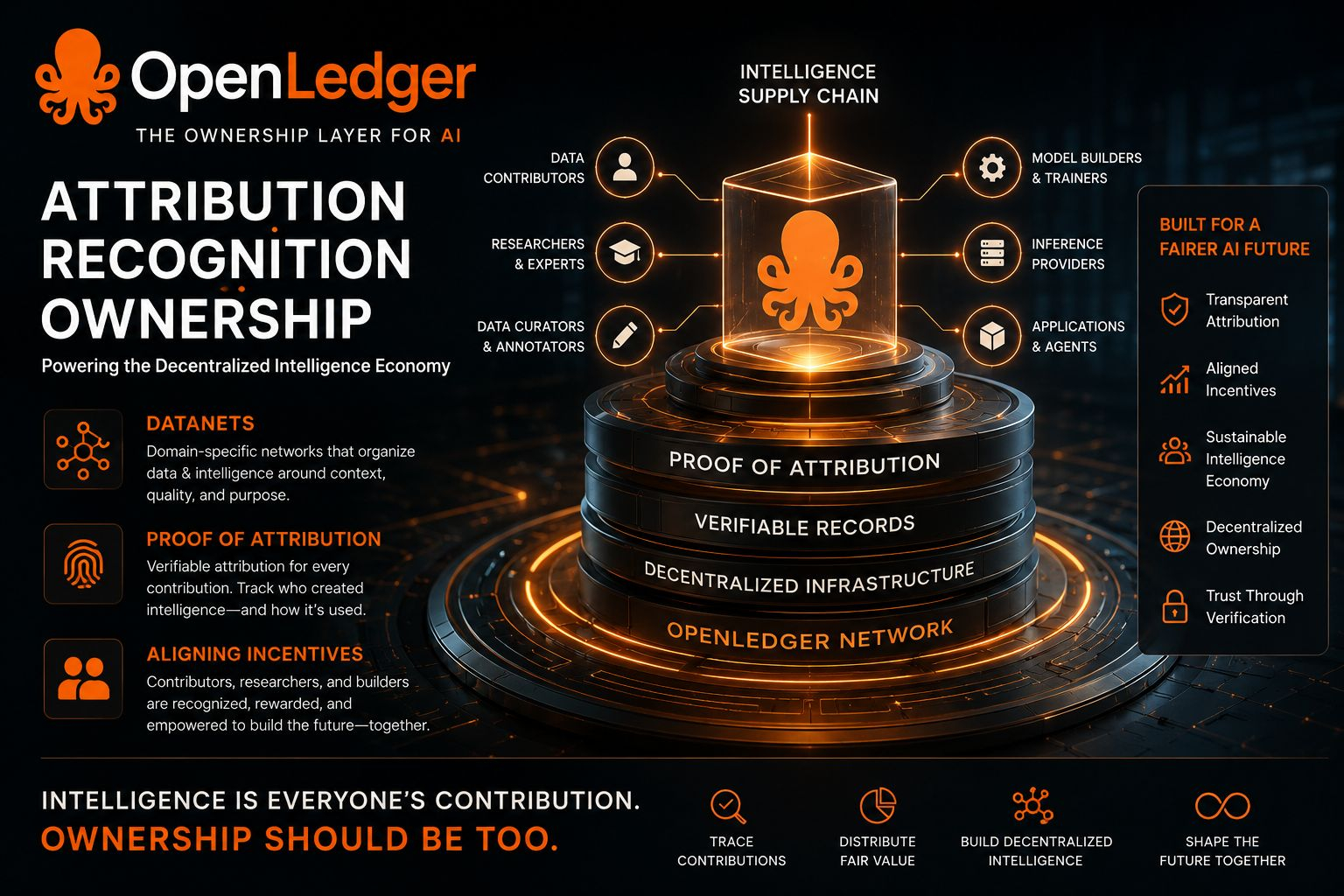
@OpenLedger There’s a strange imbalance forming inside artificial intelligence right now. The systems are becoming more powerful every month, yet the people and resources that quietly shape those systems remain mostly invisible. Data contributors disappear into datasets. Researchers become footnotes. Niche experts train intelligence that generates billions in value, while ownership flows upward into a small set of centralized platforms.
After spending time studying OpenLedger, that imbalance feels like the exact problem the project is trying to confront. Not loudly. Not through theatrical branding or exaggerated promises. But through infrastructure.
That distinction matters.
A lot of AI-related crypto projects seem designed around attention cycles. They market speed, virality, and excitement because the market rewards visibility before sustainability. OpenLedger feels almost disconnected from that rhythm. The more I looked into it, the more it resembled plumbing beneath a city rather than a billboard above it. You do not always notice infrastructure immediately, but eventually you realize entire systems depend on it functioning correctly.
OpenLedger appears to be built around a simple but uncomfortable observation: AI currently has no reliable ownership layer.
Models are trained on oceans of human contribution, yet attribution is vague. Economic rewards are uneven. Valuable data flows into black boxes where the people refining, structuring, labeling, or contextualizing that data often lose visibility the moment it enters the machine. The AI economy extracts value at incredible speed, but the mechanisms for tracking who created that value still feel primitive.
That gap becomes more obvious the deeper AI integrates into daily life.
Most people think about AI through interfaces. They see chatbots, image generators, assistants, agents, or productivity tools. But underneath those visible layers sits an invisible economy made of datasets, model tuning, inference requests, specialized knowledge, human corrections, ranking systems, and domain expertise. The future value of AI may not come only from who owns the model, but from who owns the intelligence supply chain feeding that model.
That is where OpenLedger starts becoming interesting.
The project introduces ideas like Datanets and Proof of Attribution not as decorative technical terminology, but as structural mechanisms attempting to solve a coordination problem. Datanets, from what I observed, create specialized environments where data and intelligence can be organized around specific domains or purposes. Instead of treating data like an undifferentiated raw material, the system recognizes that context matters. Expertise matters. Quality matters.
A dataset built by medical researchers should not be treated the same way as random internet scraping. A financial analyst refining structured intelligence contributes differently from a casual user generating noise. Traditional AI pipelines often flatten these distinctions because existing systems prioritize scale first and accountability later. OpenLedger seems to move in the opposite direction. It tries to make contribution measurable before value distribution occurs.
That changes incentives in a surprisingly important way.
When people know their contributions can be tracked, attributed, and economically connected to downstream usage, behavior changes naturally. Researchers become more willing to share niche expertise. Data curators become more careful about quality. Model builders can prove provenance rather than relying on vague credibility claims. Even inference activity becomes part of a visible economic map rather than disappearing into opaque infrastructure.
The longer I thought about this, the more it reminded me of how property rights historically shaped economies. Before ownership systems existed clearly, value creation was unstable. People hesitate to invest effort into systems where contribution disappears without recognition. AI today feels similar. Massive value is being generated, but attribution mechanisms remain fragmented and weak.
Proof of Attribution may end up being one of the more quietly important concepts emerging from this sector because it attempts to answer a difficult question: who actually helped create intelligence?
Not just who funded it. Not just who deployed the interface. But who refined the underlying capability itself.
That distinction feels increasingly important as AI systems become collaborative by nature. Modern intelligence is rarely produced by a single entity anymore. It emerges from layered interactions between datasets, annotators, researchers, feedback loops, domain experts, agents, and infrastructure providers. Existing systems often compress all of that complexity into centralized ownership models that reward only the final platform layer.
OpenLedger seems to recognize that intelligence itself is becoming composable.
And once intelligence becomes composable, attribution becomes economically necessary.
Without attribution, AI risks evolving into an extraction economy where contributors continuously feed systems they do not meaningfully participate in. With attribution, the structure starts looking more sustainable. Contributors become stakeholders rather than disposable inputs.
That might sound philosophical at first, but the implications are extremely practical.
The long-term success of AI will likely depend less on flashy demos and more on incentive alignment. Most weak systems eventually fail because participant incentives drift apart. If data providers feel exploited, quality declines. If researchers are not rewarded fairly, innovation narrows. If specialized experts cannot capture value from their expertise, knowledge becomes siloed rather than shared.
OpenLedger appears designed around aligning these layers instead of treating them as secondary concerns.
What stood out to me most was how calm the architecture feels compared to the surrounding AI narrative. There is no obsession with pretending every development changes civilization overnight. The project feels more concerned with accountability than spectacle. More interested in economic coordination than social media momentum.
In many ways, that restraint made the project feel more credible.
The crypto industry often celebrates visible consumer products because they are easier to market. Infrastructure tends to look boring until the moment the market realizes it cannot function without it. OpenLedger sits much closer to infrastructure. It resembles a ledger system for intelligence contribution itself — a way to trace how value moves through decentralized AI ecosystems.
And honestly, that may become one of the defining problems of the next decade.
AI creates value faster than existing systems can distribute fairly. That imbalance is already visible. Large language models absorb collective human output at enormous scale while economic recognition remains concentrated. The faster AI advances, the larger that tension becomes. At some point, ownership frameworks stop being optional governance discussions and start becoming operational necessities.
That is why OpenLedger feels less like a temporary crypto narrative and more like an architectural adjustment forming underneath the industry.
The project is not trying to compete with AI itself. It is trying to organize the economics surrounding AI.
That difference is subtle but extremely important.
Most people underestimate how much civilizations depend on invisible accounting systems. Markets require ledgers. Property requires records. Commerce requires attribution. Once economies scale, trust cannot rely purely on assumption anymore. AI is entering that exact phase now. The intelligence economy is becoming too large, too collaborative, and too valuable to operate through vague ownership assumptions.
OpenLedger seems to understand this earlier than many projects.
The idea of Datanets especially stayed in my mind because it reframes data from being passive fuel into active infrastructure. Instead of data existing as an extracted commodity, it becomes part of a living economic network where contributors retain traceable participation. That creates a healthier feedback loop. Better contributors receive recognition. Better recognition attracts stronger expertise. Stronger expertise improves model quality.
Incentives begin reinforcing quality instead of quantity.
That matters because AI systems are approaching a stage where trust may become more valuable than raw scale. A smaller, highly attributable intelligence network could eventually outperform larger systems polluted by unverifiable or low-quality data. OpenLedger’s structure seems aligned with that future.
There is also something psychologically important about attribution itself. Humans contribute differently when effort becomes visible. Anonymous extraction creates detachment. Recognized contribution creates responsibility. OpenLedger’s architecture appears built around that human reality rather than ignoring it.
And maybe that is why the project feels unusually grounded compared to many AI narratives circulating today.
It does not promise escape from economic reality. It tries to build accounting systems for it.
After weeks of reading through the ecosystem, that became the strongest impression I took away. OpenLedger is not really selling entertainment. It is not attempting to become another short-lived AI spectacle driven by hype cycles and temporary excitement. It is trying to solve a structural coordination issue that becomes more urgent every time artificial intelligence grows more capable.
Ownership. Attribution. Accountability. Incentive alignment.
These are not glamorous concepts, but infrastructure rarely is.
Roads are less exciting than sports cars, yet entire economies collapse without roads. Ownership systems are less visible than products, yet markets depend on them existing. OpenLedger feels similar. Quiet infrastructure tends to look unimpressive until the surrounding system becomes impossible to manage without it.
The future AI economy will probably produce extraordinary amounts of value. The real question is whether that value flows through systems designed for concentration or systems designed for measurable participation. OpenLedger appears to be positioning itself inside that question rather than chasing temporary attention.
And that may ultimately be why the project feels significant.
Not because it shouts the loudest.
But because it quietly recognizes that intelligence without attribution eventually becomes unstable.
In that sense, OpenLedger feels less like a sprint chasing the latest trend and more like a compass pointing toward where AI ownership may eventually need to go.