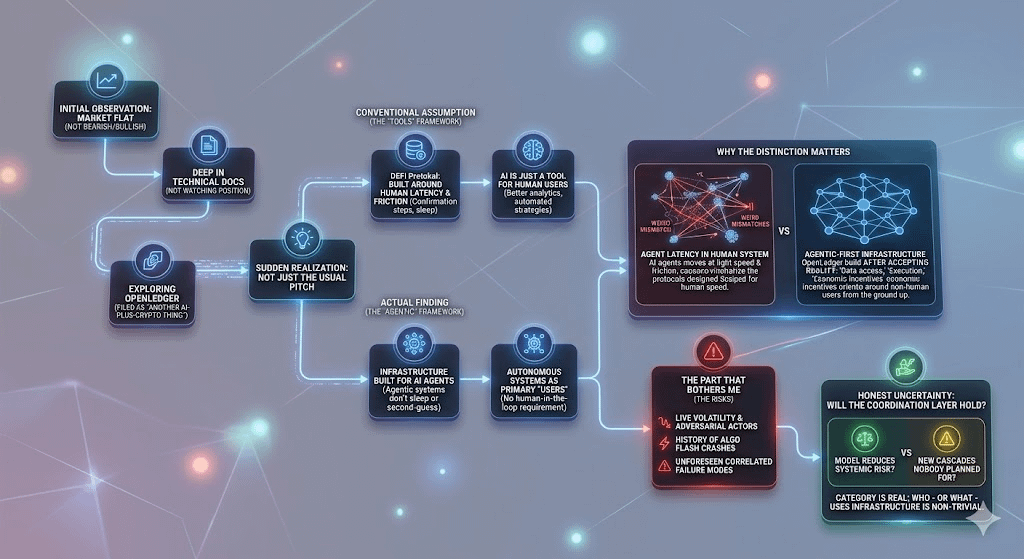
The Part Nobody's Talking About With OpenLedger
Market felt weirdly flat today. Not bearish, not bullish — just that grey, indifferent kind of trading session where nothing really moves and you end up clicking through things you'd normally ignore. I ended up deep in some technical docs when I probably should've been watching a position.
So I started looking at OpenLedger. Not for any particular reason — someone mentioned it in a thread about AI infrastructure plays and I half-dismissed it. Filed it under "another AI-plus-crypto thing," which honestly describes like forty projects right now.
But then something stopped me.
I kept reading expecting to find the usual pitch. You know the format: DeFi is inefficient, AI makes it smart, here's the token. Clean narrative, digestible deck, move on.
Except that's not really what's happening here. And the more I sat with it, the more I realized I'd been framing it completely wrong — and I think most people are too.
The assumption is that OpenLedger is building AI tools for DeFi users. Better analytics. Smarter routing. Automated strategies that humans configure and deploy.
That's not it.
What OpenLedger is actually building is infrastructure where AI agents are the users. Not tools that humans pick up and put down. Autonomous systems that operate inside the financial layer without waiting for a person to approve each move. The ecosystem isn't being designed around humans who occasionally use AI — it's being designed for AI that doesn't need humans in the loop at all.
I thought about that for a while. Then I thought about it again.
Here's why that distinction matters more than it sounds.
Every DeFi protocol today is built around human interaction patterns. Wallets, approvals, gas decisions, timing — all of it assumes a person sitting somewhere making choices, even if slowly. The infrastructure has friction baked in because humans need friction. We need confirmation steps. We second-guess ourselves. We sleep.
Agentic systems don't do any of that.
So when you drop autonomous AI agents into infrastructure built for human latency, you get weird mismatches. The agents can move faster than the system expects. They can execute strategies at volumes and frequencies that weren't really considered when the contracts were written. It creates edge cases. Sometimes it creates opportunities. Sometimes it creates cascades nobody planned for.
What OpenLedger seems to be doing — and this is the part that actually clicked for me — is building the rails after accepting that reality instead of pretending the old rails just need an AI layer painted on top. The architecture assumes agents from the ground up. Data access, execution, coordination, economic incentives — all of it oriented around the idea that the primary "users" will be systems, not people.
That's a meaningfully different design decision. And it's subtle enough that most of the coverage I've seen completely glosses over it.
But here's the part that bothers me.
Agentic systems operating autonomously inside financial infrastructure sound elegant in a whitepaper. In live conditions, with real liquidity, real volatility, and real adversarial actors — I'm not fully convinced this holds under pressure.
The history of algorithmic trading is littered with systems that worked beautifully until they didn't. Flash crashes. Feedback loops. Correlated failure modes that nobody modeled because nobody imagined that many agents doing that many things simultaneously in the same direction.
OpenLedger is betting that their coordination layer handles this. That the incentive structure keeps agents aligned and the architecture absorbs the stress. Maybe it does. Maybe the agentic model actually reduces systemic risk compared to fragmented human decisions happening across a thousand interfaces.
I genuinely don't know. I'm not convinced either way yet. That uncertainty is honest.
What I do think is that the category is real even if the execution is still being tested. We're at a point where the question of who — or what — actually uses financial infrastructure is becoming non-trivial. If even a meaningful fraction of DeFi activity shifts to autonomous agents over the next few years, the projects that assumed human-scale interaction are going to have structural problems. Not because they did anything wrong. Just because they were built for a world that's quietly moving.
I thought about a conversation I had with someone a few months back who was convinced that AI in crypto was mostly narrative. Marketing language wrapped around the same old yield products. And honestly I mostly agreed with him at the time. I thought — but actually, the specific design decision of building for agents rather than building tools used by agents is a real technical distinction. It's not just a positioning choice.
Whether OpenLedger executes on it is a separate question. But the angle itself isn't nothing.
Anyway, the market's still doing that flat thing. I'll probably just sit with this one a bit longer before forming a strong view. There's enough moving parts here that confidence would feel premature.