

Honestly, the AI industry today feels a little broken.
Not because the technology is weak AI is advancing faster than almost anyone predicted but because the ownership structure behind it has become extremely concentrated. Every major breakthrough in artificial intelligence is now controlled by a handful of companies with enormous amounts of capital, proprietary data, and centralized infrastructure. The same names dominate every conversation: OpenAI, Google, Microsoft, Anthropic. They own the models, the compute, the distribution channels, and most importantly, the data pipelines feeding modern AI systems.
But there is a hidden contradiction inside this entire ecosystem.
The internet collectively produces the data that trains AI. Researchers publish open-source breakthroughs. Communities generate conversations, images, ideas, feedback loops, and behavioral patterns that shape machine learning models. Independent developers contribute tools and optimization techniques. Yet almost none of these contributors participate in the economic upside once AI systems become profitable.
The data disappears into black boxes.
A creator’s work may improve an AI model worth billions, but there is no transparent mechanism showing how their contribution influenced the system or how much value it generated. In the current structure of AI, attribution is practically invisible, and compensation is almost nonexistent.
That is the exact fracture OpenLedger is trying to solve.
OpenLedger is not positioning itself as another hype-driven AI token chasing short-term market attention. The project is attempting something far more ambitious: building a blockchain economy where data itself becomes a monetizable financial asset. Instead of treating artificial intelligence as a centralized product controlled by large corporations, OpenLedger envisions a world where AI becomes an open economic network owned collectively by contributors, developers, and communities.
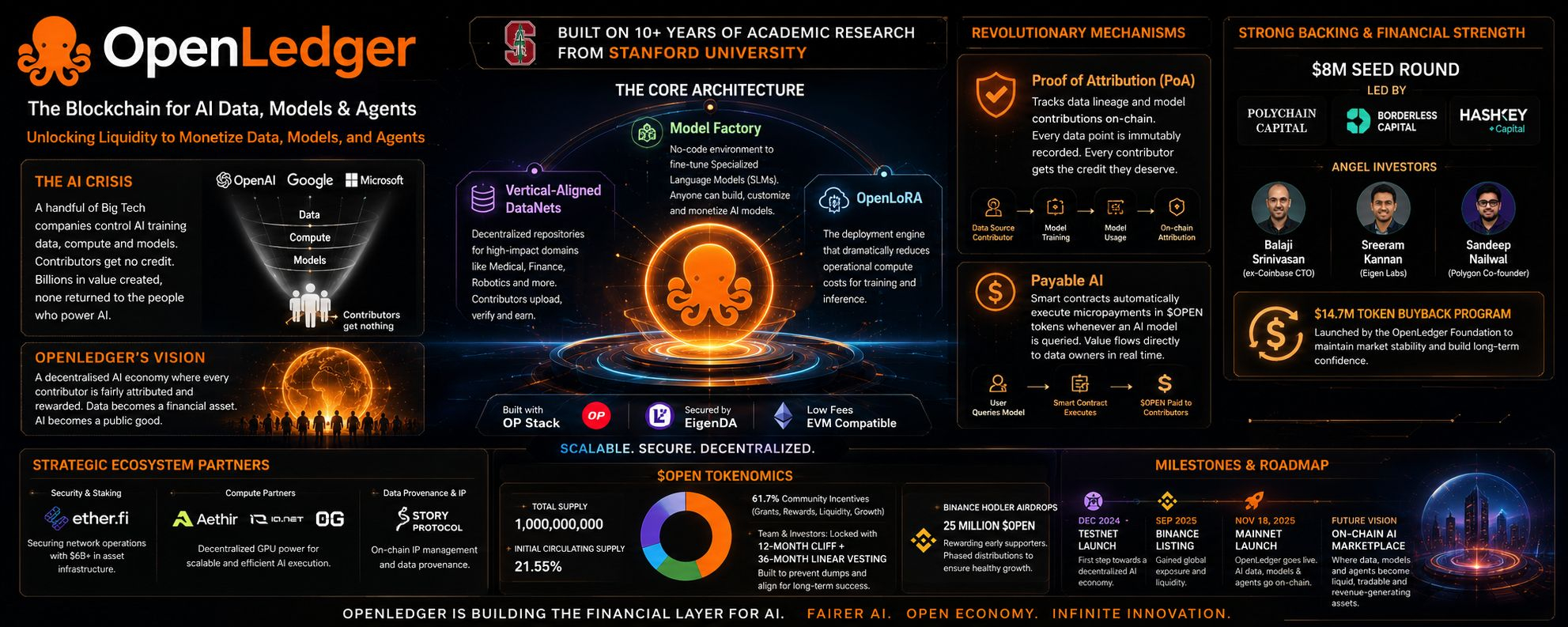
At its core, OpenLedger is an Ethereum Layer-2 blockchain specifically designed for AI data, AI models, and autonomous AI agents. The protocol combines decentralized infrastructure with attribution systems, allowing data contributors to be identified, verified, and compensated whenever their information helps power an AI model.
What makes the story even more interesting is that OpenLedger did not emerge from a random narrative rotation inside crypto Twitter. The project traces its intellectual foundation back to more than ten years of academic research connected to Stanford University. That academic background matters because OpenLedger feels less like a speculative meme and more like a deliberate attempt to redesign the economics of machine intelligence.
And timing matters.
The AI industry is entering a phase where data is becoming more valuable than the models themselves. Large foundational models are slowly commoditizing. The real competitive advantage now comes from highly specialized datasets capable of training domain-specific intelligence. Healthcare AI needs medical data. Robotics models need sensor information. Financial intelligence systems need structured market behavior. Whoever controls those datasets controls the next generation of AI systems.
OpenLedger wants to decentralize that control.
The project gained major institutional attention after securing an $8 million seed round backed by some of the largest names in crypto infrastructure investing. Polychain Capital, Borderless Capital, and HashKey Capital collectively supported the protocol during its early development phase. In crypto, capital alone does not guarantee success, but the type of investors backing a protocol often reveals how serious the market perceives the infrastructure to be.
The angel investor list is equally telling.
Balaji Srinivasan joined the project as an early supporter, which feels philosophically aligned with his long-standing views about decentralized ownership systems and network-driven economies. Sreeram Kannan also became involved, bringing credibility from Ethereum’s modular infrastructure ecosystem. Then there is Sandeep Nailwal, whose presence signals deeper alignment with Ethereum scaling architecture and Layer-2 adoption strategies.
But OpenLedger’s financial strategy extends beyond fundraising headlines.
One of the more aggressive moves made by the OpenLedger Foundation was the launch of a $14.7 million token buyback program. In crypto markets, buybacks are often interpreted as confidence mechanisms. Instead of allowing token markets to drift entirely on speculative liquidity, the foundation actively deployed treasury capital to support ecosystem stability and reduce excess volatility.
That decision matters because AI infrastructure is not a short-cycle business.
Building decentralized AI systems requires enormous amounts of compute coordination, data verification, model optimization, and developer onboarding. Most projects fail because they underestimate how capital-intensive AI infrastructure becomes at scale. OpenLedger appears aware of that reality from the beginning.
Technically, the architecture behind OpenLedger is where the project becomes genuinely fascinating.
Most AI-related blockchain projects focus on one narrow category. Some build decentralized GPU marketplaces. Others launch AI agent frameworks or tokenized inference systems. OpenLedger instead tries to connect the entire AI production pipeline into one integrated blockchain economy.
The first major layer inside this architecture is what OpenLedger calls “Vertical-Aligned DataNets.”
Think of them as decentralized repositories designed specifically for high-value industries. Instead of building one generic AI data marketplace, OpenLedger separates information into specialized sectors like medicine, finance, robotics, and enterprise automation. This is important because modern AI increasingly depends on high-quality domain-specific information rather than random internet-scale scraping.
The future of AI will likely belong to specialized intelligence rather than universal chatbots.
A healthcare model trained on verified medical imaging behaves very differently from a generic large language model trained on internet conversations. Financial AI systems require real-time structured economic data. Robotics intelligence depends on sensor environments and simulation layers. OpenLedger’s DataNets create environments where contributors can upload, validate, and monetize these specialized datasets while maintaining transparent ownership records.
That alone changes the economic structure of AI training.
Instead of centralized companies silently absorbing data into proprietary systems, OpenLedger creates a marketplace where datasets themselves become productive digital assets capable of generating recurring value.
Then comes the Model Factory.
This layer acts as a no-code environment allowing users to fine-tune Specialized Language Models, commonly known as SLMs. This part of the infrastructure feels especially important because the AI industry is shifting away from the obsession with giant universal models toward smaller, highly optimized systems designed for specific tasks.
Training frontier-scale AI models requires billions of dollars. Fine-tuning specialized models does not.
OpenLedger lowers the barrier dramatically by allowing enterprises, developers, and communities to deploy AI systems without needing massive machine learning engineering teams. The protocol abstracts much of the technical complexity behind model training and deployment, creating a more accessible AI production environment.
And then there is OpenLoRA.
This may quietly become one of the most important components inside the ecosystem. LoRA, or Low-Rank Adaptation, has become one of the most efficient techniques for fine-tuning models without retraining entire architectures from scratch. OpenLedger’s OpenLoRA infrastructure reduces compute costs while improving deployment scalability. That matters enormously because inference efficiency is becoming the real battlefield inside AI economics.
The industry is slowly learning that bigger models are not always better models.
OpenLedger appears built around that understanding.
Underneath all these systems sits blockchain infrastructure powered by OP Stack and EigenDA. Using OP Stack gives OpenLedger low-fee EVM compatibility while maintaining alignment with Ethereum’s broader scaling ecosystem. EigenDA enhances data availability throughput, which becomes critically important for AI workloads processing large datasets across distributed environments.
But the most revolutionary idea inside OpenLedger is not the blockchain architecture.
It is the economic mechanism called Proof of Attribution.
Right now, most AI systems function like black holes for data ownership. Once information enters training pipelines, attribution disappears completely. Nobody knows exactly how much a specific dataset contributed to a model’s output, and contributors rarely receive compensation even if their work materially improves the AI system.
OpenLedger wants to make attribution immutable.
Proof of Attribution tracks data lineage directly on-chain. Every contribution becomes cryptographically linked to future model outputs. If a dataset improves a healthcare model and that model later generates revenue through API usage or enterprise deployment, the original contributors can theoretically receive automated compensation tied to their impact.
That is an enormous conceptual shift for the AI industry.
Suddenly, AI no longer behaves like extractive infrastructure. It becomes participatory infrastructure.
And this is where OpenLedger introduces another idea called Payable AI.
Whenever a model gets queried, smart contracts can automatically distribute micropayments in $OPEN tokens directly to the contributors whose data helped train the system. In practical terms, this means AI itself becomes an autonomous financial network where value flows continuously between users, models, datasets, and infrastructure providers.
It feels less like software and more like an economic organism.
The implications become massive if this model scales successfully. Researchers could monetize datasets indefinitely. Developers could earn recurring revenue from fine-tuned models. Communities could collectively own AI systems. Autonomous agents could transact with one another without centralized intermediaries.
That future still sounds experimental today, but many of the largest technological shifts initially sounded unrealistic before infrastructure matured.
OpenLedger’s ecosystem partnerships also reveal how seriously the project approaches scalability.
Its alliance with Ether.fi provides infrastructure connected to billions in staked assets, strengthening validator coordination and network security. Compute integrations with Aethir, io.net, and 0G connect OpenLedger to decentralized GPU ecosystems critical for AI inference and training workloads.
And perhaps most strategically important is the partnership with Story Protocol.
As copyright wars around AI intensify globally, provenance infrastructure may become mandatory. Story Protocol specializes in programmable IP systems, which aligns perfectly with OpenLedger’s attribution-focused architecture. Together, these protocols could create frameworks where AI-generated value is transparently linked back to original intellectual contributions.
The tokenomics behind $OPEN also feel intentionally designed around long-term sustainability rather than rapid speculation.
The total supply is capped at 1 billion tokens, with only 21.55% initially circulating. More importantly, team and investor allocations remain locked behind a 12-month cliff followed by 36-month linear vesting. That structure significantly reduces immediate sell pressure while aligning insiders with longer-term ecosystem growth.
What stands out most, however, is the community allocation.
OpenLedger dedicated 61.7% of the ecosystem toward community incentives, developer growth, liquidity programs, and contribution rewards. That distribution reflects the project’s broader thesis that AI networks should reward participants rather than merely extracting value from them.
The phased Binance HODLer Airdrops involving 25 million OPEN tokens further expanded global awareness after the project’s listing on Binance in September 2025. Combined with the mainnet launch on November 18, 2025, OpenLedger officially transitioned from infrastructure concept into a live decentralized AI economy.
And honestly, that may be the most important part of the story.
Because OpenLedger is not simply building another blockchain.
It is trying to answer a far bigger question:
Who should own artificial intelligence?
Should AI remain concentrated inside trillion-dollar corporations controlling proprietary systems behind closed walls? Or can AI evolve into an open economic network where data contributors, developers, researchers, and communities all participate in the upside they collectively create?
OpenLedger is betting on the second future.
And if decentralized AI becomes one of the defining technological narratives of this decade, projects focused on attribution, ownership, and economic coordination may ultimately become more valuable than the models themselves.