

What struck me when I first looked at the current AI race is how familiar it feels to anyone who has watched commodity markets. Everyone is obsessed with output. Faster models, bigger benchmarks, more parameters, lower latency. But markets rarely reward output alone for long. They reward systems that solve the incentive problem underneath.
That may be the more interesting AI story now.
For the last two years, the dominant narrative in artificial intelligence has been straightforward. Better models win. OpenAI, Anthropic, Google, xAI, Meta, and a growing field of challengers have been locked in a capability race where technical performance is treated as the ultimate scorecard. GPT-4 changed expectations. Claude pushed reasoning quality higher. Open-source models compressed the gap. Meanwhile, Nvidia crossed a market capitalization above $3 trillion at one point because the infrastructure layer became the obvious economic bottleneck.
But focusing only on model capability misses something important.
AI is not just a software problem. It is an economic coordination problem.
That distinction matters more than most investors realize.
A model can be brilliant and still sit on weak foundations if the incentives feeding it are misaligned. High-quality data does not appear magically. Human feedback does not materialize without motivation. Ecosystems do not remain healthy if value extraction consistently flows in one direction.
Right now, much of AI operates on an extraction model.
The surface story looks efficient. Platforms gather public data, scrape content, contract labeling work at scale, and refine outputs into increasingly polished products. Underneath, the incentives are often thin. Contributors rarely share meaningfully in upside. Data provenance remains murky. Participation feels rented rather than earned.
That creates a quiet structural weakness.
Consider data quality. McKinsey estimated that generative AI could contribute between $2.6 trillion and $4.4 trillion annually across industries. That number gets repeated often because it sounds massive, but what it actually reveals is dependency. If trillions in projected value rely on training inputs, then the economics of securing trustworthy inputs become foundational.
Poor incentives degrade that supply.
A contributor who feels underpaid produces lower-quality work. A creator who believes their content is being extracted without compensation opts out. A developer who sees centralized platforms capturing all upside builds elsewhere.
Understanding that helps explain why AI progress may increasingly be constrained not by architecture, but by participation.
Crypto investors should recognize this pattern immediately.
Blockchains were never just databases. Their deeper contribution was incentive engineering. Bitcoin worked because miners had clear economic motivation to secure the network. Ethereum expanded that logic into programmable coordination. DeFi succeeded, at least in its strongest moments, because liquidity providers were given explicit reasons to participate.
AI has not fully absorbed this lesson yet.
That is where newer models like OpenLedger become interesting, not necessarily because they claim superior intelligence, but because they are asking a different question. What if the scarce resource is not compute alone, but aligned contribution?
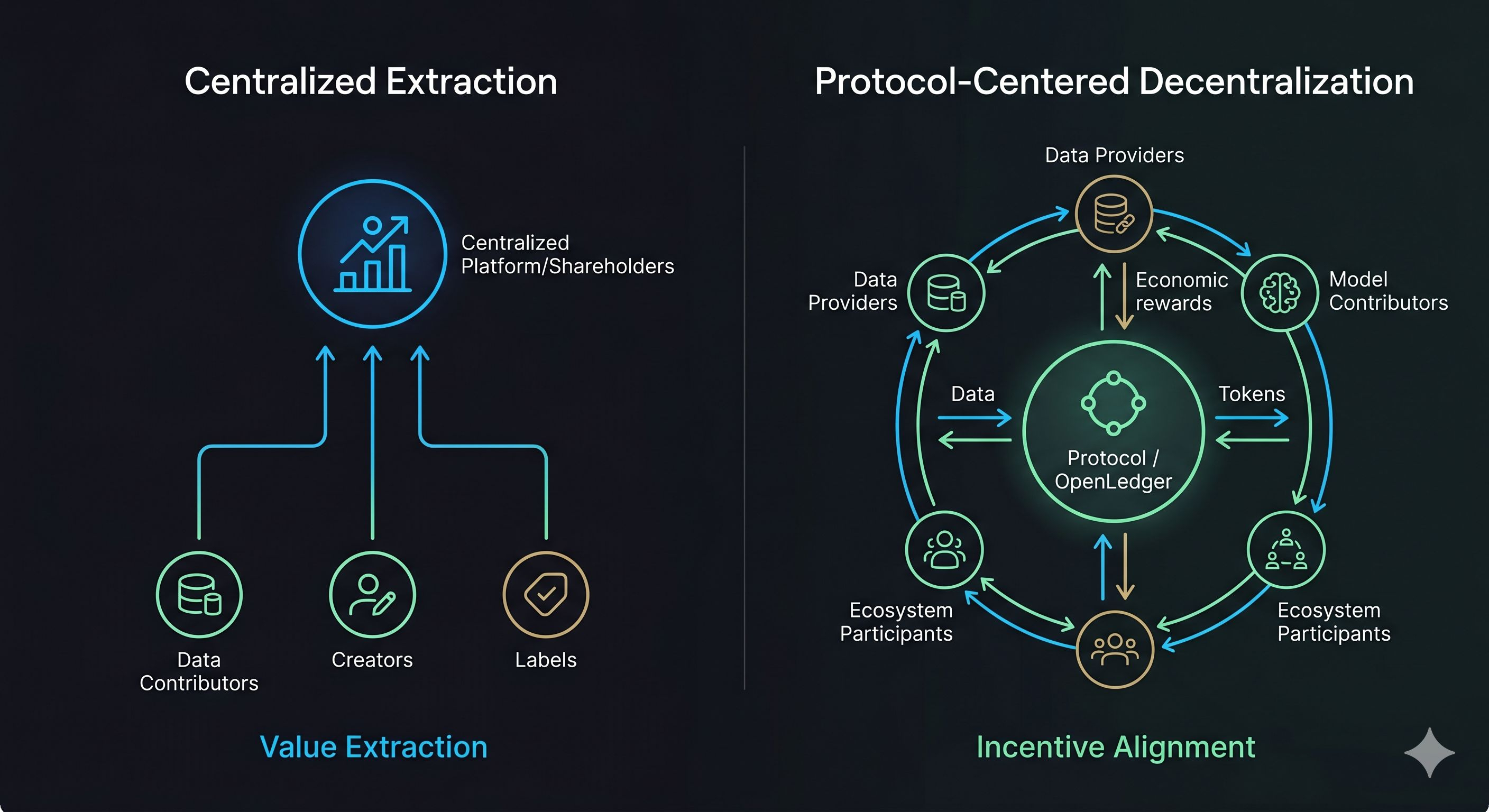
The premise is simple enough in plain language. Instead of AI systems treating contributors as disposable inputs, the protocol attempts to tie participation directly to economic reward. Data providers, model contributors, and ecosystem participants can theoretically capture value linked to actual network usage.
If this holds, that changes the texture of the system.
A centralized AI company behaves like a traditional firm. It acquires resources, internalizes value, and distributes upside primarily to shareholders. A protocol-centered AI network behaves differently. It externalizes contribution and potentially decentralizes reward.
That does not automatically make it better.
Crypto markets have already shown how badly incentive systems can fail when tokenomics become detached from real utility. Yield farming in 2021 looked compelling until much of it became circular speculation. Tokens rewarded participation, yes, but often without sustainable economic foundations.
The same risk exists here.
An incentive-centric AI model only works if rewards are tied to genuine value creation rather than synthetic activity. Otherwise, the system simply pays people to game metrics.
Still, the strategic direction deserves attention.
Because AI’s current structure has clear cracks.
Training frontier models is becoming extraordinarily expensive. OpenAI CEO Sam Altman has publicly discussed the immense capital intensity involved in scaling next-generation systems. Some estimates place advanced model training runs in the hundreds of millions of dollars, with infrastructure trajectories pointing even higher.
That capital burden naturally favors concentration.
Meanwhile, concentration creates its own problems. Fewer dominant players mean tighter control over data access, model behavior, monetization, and ecosystem rules. Innovation continues, but participation narrows.
Markets usually push back against that kind of centralization eventually.
That momentum creates another effect. Developers and contributors begin looking for alternative frameworks where participation feels economically rational.
This is where decentralized AI narratives are gaining traction across crypto circles. Not because decentralization is inherently superior, but because incentive alignment is becoming a real competitive variable.
Look at current market behavior. AI-linked crypto tokens continue attracting speculative attention even in volatile conditions because investors sense a convergence trade. AI needs new economic models. Crypto specializes in economic coordination. The overlap feels intuitively attractive.
The danger, of course, is narrative excess.
Not every AI-plus-crypto project deserves serious consideration. Many remain thin wrappers around generic token issuance. Others confuse decentralization with efficiency. Distributed systems often introduce latency, governance friction, and fragmented execution.
A centralized provider can simply move faster.
That counterargument matters.
If enterprises care primarily about reliability and performance, they may continue preferring vertically integrated AI platforms. Economic inclusivity sounds appealing, but procurement teams buy consistency, not ideology.
Yet that may be too narrow a lens.
Because some of the most durable systems are not the fastest at launch. They are the ones with the strongest incentive foundations underneath.
Ethereum was slower than many alternatives. Bitcoin remains operationally inefficient by conventional standards. Yet both sustained relevance because their economic design created durable participation loops.
AI may face a similar sorting process.
The next phase may not be won solely by whoever releases the smartest chatbot.
It may be shaped by whoever builds the most economically coherent ecosystem around intelligence.
That includes questions most benchmark charts ignore. Who gets paid for data? Who governs contribution standards? How are outputs monetized? How transparent is value distribution? Can participants verify their role in the system?
Those are economic architecture questions, not pure engineering questions.
And markets eventually care about architecture.
For Binance Square readers, this is where investment thinking gets more nuanced. Chasing AI exposure through headline momentum is easy. Identifying infrastructure models that create sustainable participation is harder.
The distinction matters because speculative enthusiasm can price narratives quickly, but sustainable networks earn value more slowly.
OpenLedger represents one expression of this broader thesis. It may succeed, or it may expose the difficulty of aligning decentralized incentives with real AI utility. Early signs remain incomplete.
But the underlying idea feels worth tracking.
Because when industries mature, performance advantages often compress. What remains defensible is the system beneath performance.
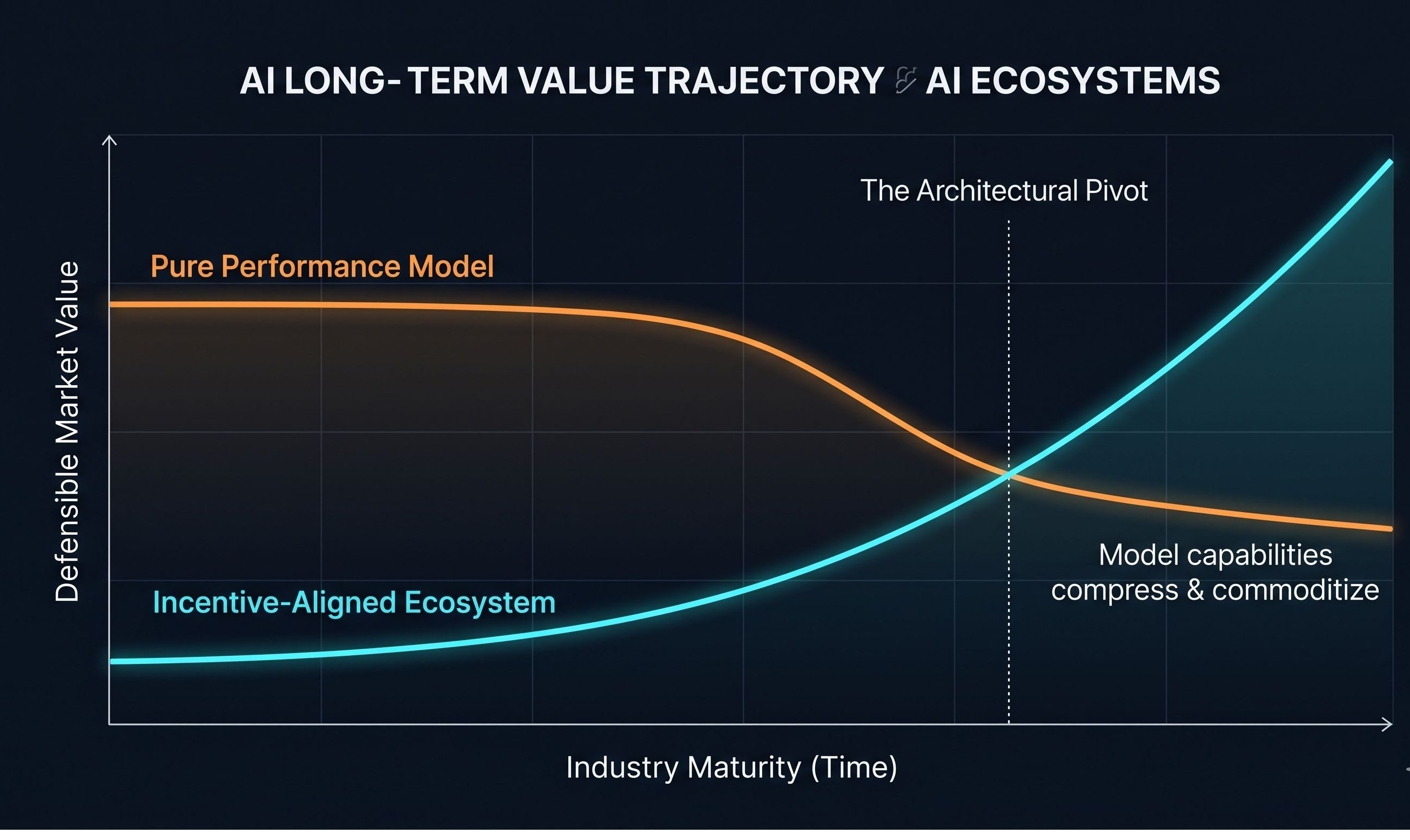
Airlines learned this through network economics. Marketplaces learned it through liquidity loops. Blockchains learned it through incentive design.
AI may be approaching the same realization.
The most valuable intelligence system may not be the one that thinks best.
It may be the one that gives everyone a reason to keep making it smarter.
@OpenLedger $OPEN #OpenLedger