
A lot of people talk about AI as if intelligence is the main thing.
That makes sense on the surface. We notice when a model writes well, answers quickly, or handles a task that used to take time. We notice the smoothness of the response. We notice how close it gets to what we wanted.
But after using AI for a while, another thing becomes clear.
Intelligence without context is limited.
A model can be very capable and still miss the point. It can understand language but not understand a specific business. It can explain general ideas but fail when the answer depends on local knowledge, private data, niche rules, or the small details that only matter inside one field.
That is where OpenLedger becomes interesting from a different angle.
It is not only about data, models, and agents as assets. It is also about context becoming something that can be owned, shared, and valued.
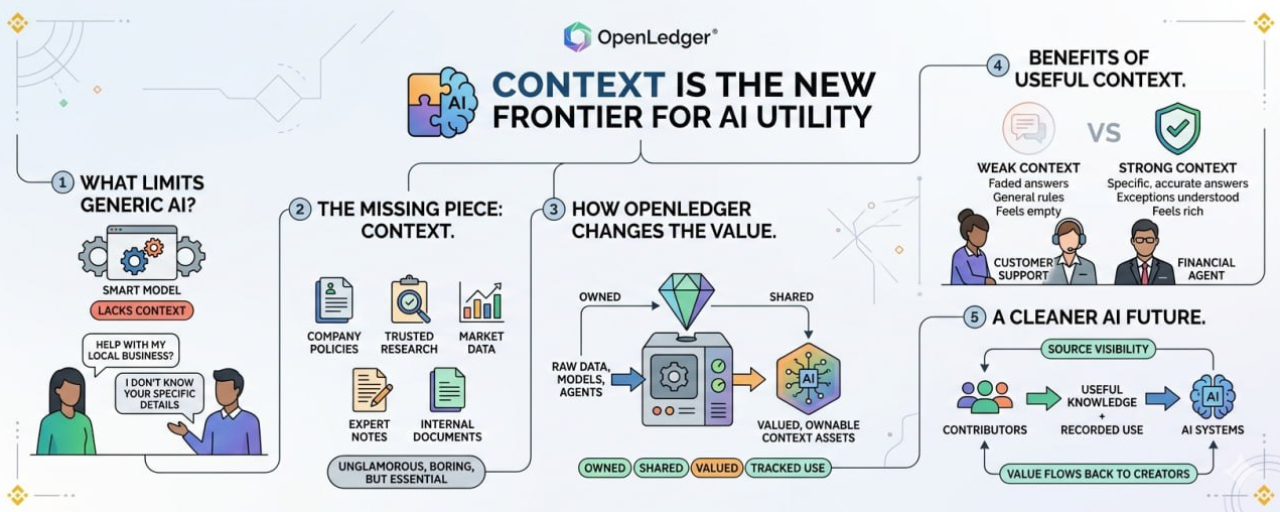
This matters because the next wave of AI may not be won only by bigger models. Bigger models help, of course. But many useful AI systems will depend on very specific information. A customer support agent needs company policies. A research agent needs trusted sources. A finance agent needs clean market and portfolio data. A legal assistant needs jurisdiction-specific documents. A supply chain agent needs details that are often boring, messy, and hidden inside internal systems.
That kind of context is not always glamorous.
It may sit inside spreadsheets.
It may live in old documents.
It may come from expert notes.
It may be collected over years by people who never thought of it as an AI resource.
But once AI starts using it, the value changes.
The question is no longer just, “Can this model think?” The question becomes, “What does this model know about the world it is being asked to work in?”
That shift feels important.
OpenLedger seems to sit near that shift. It gives people a way to treat context as something more than raw material. Data, models, and agents can be placed into a system where their use can be tracked and their value can be connected to real activity. In simple terms, the things that make AI more useful do not have to disappear into the background.
You can usually tell when an AI system has weak context. It gives answers that sound fine but feel slightly empty. It knows the common version of something, but not the specific version. It explains the general rule, but misses the exception. It talks like it understands, but it has not really touched the material that matters.
That is not always a model problem.
Sometimes it is a context problem.
And context is often owned by people outside the biggest AI labs. Small businesses have it. Developers have it. Research groups have it. Communities have it. Independent experts have it. Industry workers have it. Even users have it, though they may not think of it that way.
This is why OpenLedger’s idea feels less abstract when viewed through context. It is not just trying to create a market for AI components. It is pointing toward a world where useful knowledge can become part of AI systems without being completely swallowed by them.
That is a subtle difference.
In many systems today, once data enters a model or platform, the original shape of that data becomes hard to see. The source becomes less visible. The contribution becomes difficult to separate. The person or group behind it may not have much control after that point.
OpenLedger appears to ask whether AI can work in a cleaner way.
Can context be used without losing its identity?
Can contributors remain connected to what they provide?
Can an AI asset keep a record of how it is used?
Can value move back toward the people who made the system more useful?
These are not loud questions, but they are practical ones.
Because AI will need better context if it is going to become useful in real work. General answers are helpful for general tasks. But serious work often depends on details. And details usually come from someone’s effort.
Someone had to collect the information. Someone had to clean it. Someone had to label it. Someone had to test it. Someone had to know what was wrong, outdated, duplicated, or missing. These small actions do not look impressive from the outside, but they often decide whether an AI system performs well or not.
That’s where things get interesting.
OpenLedger could give those invisible efforts a clearer place in the system. A dataset is not just a file. A model is not just code. An agent is not just automation. Each can carry context, history, and use. Each can become part of a larger network where usefulness is not only claimed, but observed over time.
Of course, this depends on execution.
It is easy to say that context has value. It is harder to build a system where that value is measured fairly. Not all data is good data. Not all context should be shared. Some information is sensitive. Some is outdated. Some is only useful in a narrow setting. OpenLedger would need ways to handle quality, permission, and trust without making everything too heavy for normal builders.
That balance matters.
If the system is too open, it may fill with low-quality assets. If it is too strict, people may not participate. If rewards are unclear, contributors may lose interest. If usage is difficult, builders may choose easier paths.
Still, the idea touches something real.
AI does not become useful only by becoming smarter in a general sense. It becomes useful when it meets the right context at the right time. That context may come from a business, a community, a researcher, a builder, or a person who simply knows one problem very well.
OpenLedger is trying to make space for that kind of contribution.
Not every piece of context will matter. Most probably will not. But some will be quietly important. Some will make an agent more accurate. Some will make a model more relevant. Some will help users trust the output a little more.
And maybe that is the part worth noticing.
The future of AI may not only belong to whoever builds the largest model. It may also belong to whoever brings the clearest context.