I’ve been thinking about this a lot lately… most AI crypto projects still feel weirdly hollow to me.
Every cycle brings the same thing. New AI narratives. New “autonomous agents.” New dashboards with glowing animations trying to convince everybody we’re entering some fully decentralized machine economy tomorrow morning.
I’ve seen this before.
Crypto gets obsessed with narratives long before the infrastructure actually works. And AI made that tendency even worse because now people can attach “AI-powered” to basically anything and suddenly the market acts like it discovered the future.
Meanwhile, underneath all the marketing?
Same centralized systems. Same dependency layers. Same closed infrastructure.
That’s the part people avoid talking about because it ruins the fantasy a little.
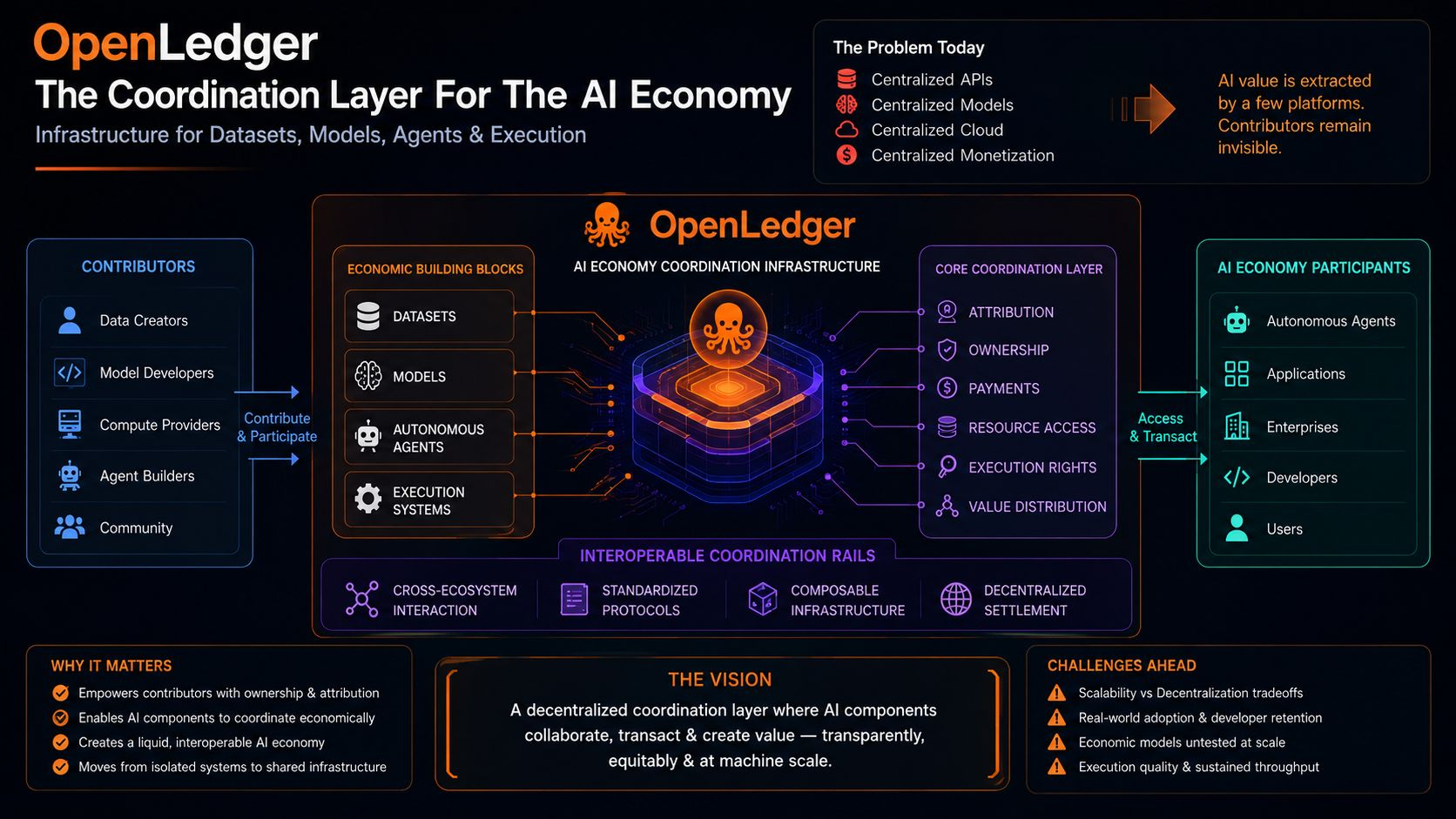
Most “decentralized AI” projects still rely heavily on:
centralized models,
centralized APIs,
centralized cloud providers,
centralized monetization,
and centralized execution environments.
So when I first came across OpenLedger, I honestly expected another polished AI narrative wrapped around old infrastructure.
But here’s the thing.
The deeper I looked into what they’re actually trying to build, the more it felt like they’re targeting a much bigger problem than most projects in this sector even acknowledge.
Not AI intelligence.
AI coordination.
And that’s where it gets interesting.
Because I don’t think the biggest issue in AI going forward is whether models become smarter. They will. Everybody already expects that.
The harder problem is figuring out how value moves between:
datasets,
models,
autonomous agents,
execution systems,
and contributors without everything collapsing back into centralized control again.
Right now the ecosystem feels fragmented everywhere you look.
Data sits in silos. Models stay locked behind corporate APIs. Contributors rarely own any meaningful upside. Agents still depend on centralized infrastructure for basic operations. And almost every economic interaction routes through some platform acting like a gatekeeper.
People don’t talk about this enough.
Everybody focuses on AI outputs. Almost nobody focuses on AI ownership structures underneath the outputs.
That’s the layer OpenLedger seems obsessed with.
And honestly, I think that’s probably the correct angle.
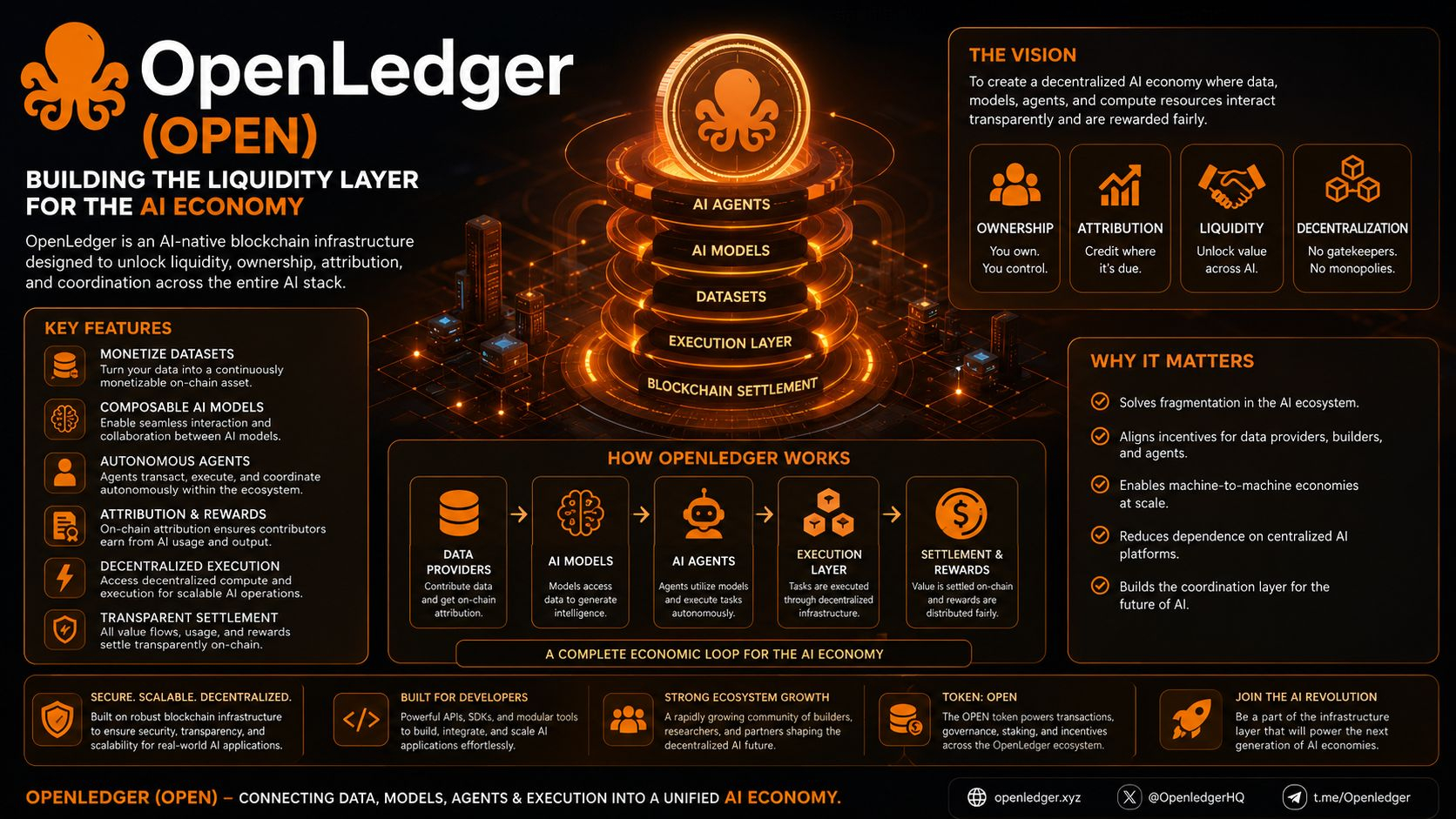
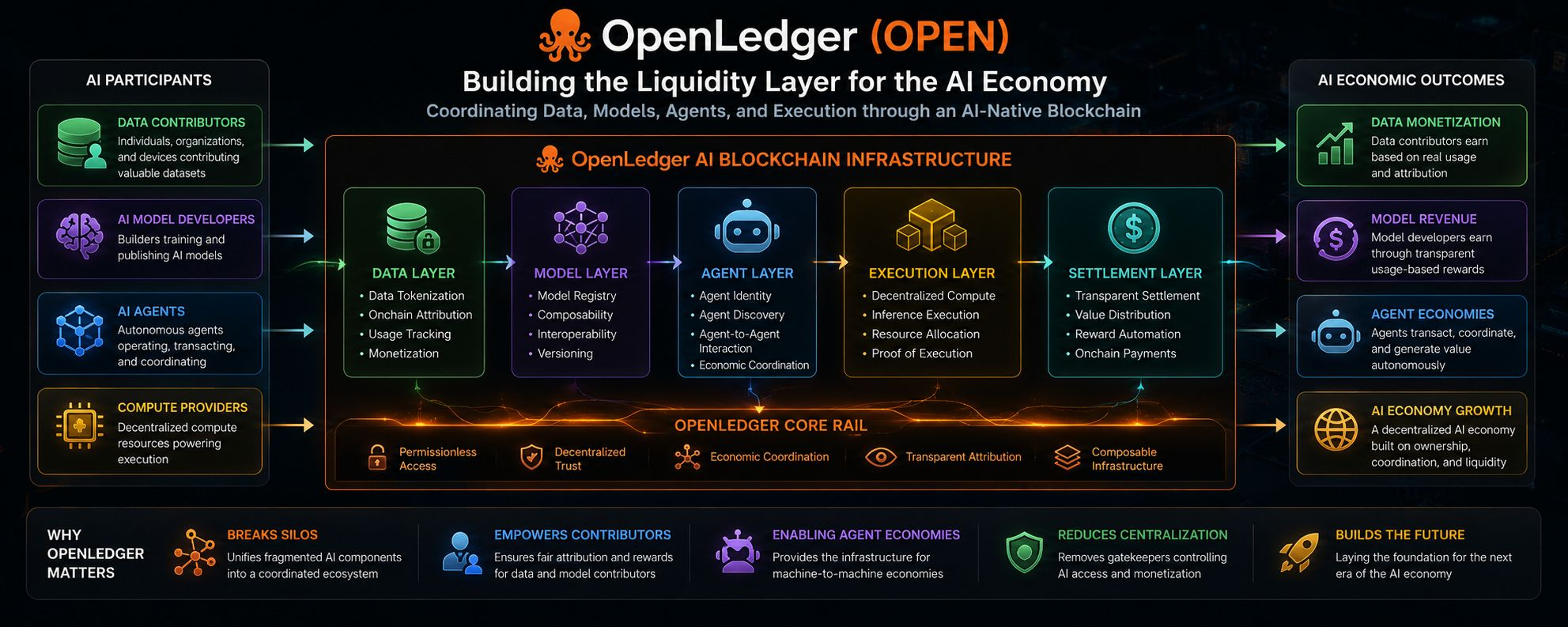
At its core, OpenLedger positions itself as an AI blockchain focused on unlocking liquidity between data, models, agents, and execution environments.
Not just AI tooling.
Not chatbot wrappers.
Actual coordination infrastructure.
Big difference.
The project basically treats AI components like economic assets capable of interacting onchain instead of functioning as isolated products trapped inside separate ecosystems.
That matters more than most people realize.
Because eventually — assuming AI keeps expanding the way everybody expects — somebody has to solve:
attribution,
value distribution,
resource coordination,
ownership,
execution rights,
and machine-to-machine payments.
AI doesn’t magically eliminate economics. If anything, it makes the economic layer way more complicated.
Take data monetization for example.
This part gets ignored constantly even though it’s one of the biggest structural problems in the entire AI industry.
Massive AI systems consume enormous amounts of user-generated and public data while contributors get almost nothing in return. Platforms absorb the value. Companies monetize the outputs. Users become unpaid infrastructure feeding the system endlessly.
Same internet model. Different branding.
OpenLedger seems to be trying to build infrastructure where contributors can actually participate economically when datasets contribute to AI outputs or agent activity.
And honestly… that’s a much more important conversation than another AI token promising “smarter automation.”
Because if data powers the system, why shouldn’t data contributors capture part of the upside?
Feels obvious once you say it out loud.
But the current AI economy absolutely doesn’t work that way.
Then you move into interoperability — which honestly might become an even bigger issue later.
Every AI ecosystem today feels disconnected from every other ecosystem. Different APIs. Different tooling frameworks. Different access rules. Different monetization structures.
Everybody builds their own isolated kingdom and hopes developers never leave.
It’s messy.
OpenLedger’s architecture tries to create shared coordination rails between:
datasets,
models,
execution layers,
and autonomous agents.
Meaning these systems can theoretically interact through blockchain infrastructure instead of staying trapped inside disconnected silos.
Now look, I’ll be honest.
Crypto projects love talking about interoperability because it sounds sophisticated. Half the time the actual adoption never materializes.
So I’m not blindly assuming OpenLedger automatically solves this problem.
But at least they’re targeting something real.
That already separates them from a huge amount of AI noise floating around the market right now.
And then there’s the autonomous agent side of things.
Honestly, the phrase “AI agents” got abused so badly that people almost tune it out automatically now. Fair enough.
But underneath the hype, there’s still a legitimate infrastructure question sitting there: how do autonomous systems coordinate economically without depending on centralized rails for everything important?
Because most current agents still rely heavily on:
centralized cloud execution,
centralized APIs,
centralized authentication systems,
centralized payment processors,
and centralized hosting infrastructure.
That’s not autonomy.
That’s dependency wearing futuristic branding.
OpenLedger seems much more focused on agents functioning as native economic participants inside blockchain environments themselves.
Meaning agents could theoretically:
access resources,
coordinate with other agents,
trigger execution,
transact value,
and distribute rewards autonomously.
And honestly, if machine-to-machine economies ever scale meaningfully — which I think they probably will eventually — infrastructure like this becomes necessary.
Traditional financial systems weren’t designed for autonomous digital participants operating continuously across decentralized networks.
People underestimate how weird that future gets.
Also, timing matters here. Probably more than people admit.
The market already started shifting away from pure AI meme speculation toward infrastructure discussions:
decentralized compute,
AI ownership,
coordination layers,
attribution systems,
execution infrastructure,
and agent economies.
That shift changes everything.
Speculative narratives fade fast. Infrastructure conversations usually stick around longer because eventually builders need actual rails underneath the hype.
And OpenLedger positioned itself directly inside that transition.
Still… this is where things get tricky.
The decentralized AI sector remains extremely early.
Like genuinely early.
Most systems in this category haven’t faced serious real-world scale yet. Economic coordination between autonomous agents still feels experimental across huge parts of the industry. Scalability challenges still exist everywhere.
People act like attaching blockchain to AI magically fixes structural problems.
It doesn’t.
Infrastructure only matters if people actually use it consistently.
That means OpenLedger still needs to prove:
developer adoption,
ecosystem retention,
tooling quality,
execution consistency,
agent activity,
and real economic throughput.
That’s the hard part. Always is.
Not the branding. Not the narratives. Not the engagement farming on social media.
Actual infrastructure adoption.
And honestly, there’s another issue sitting underneath all this that people rarely discuss openly.
AI systems demand speed. Decentralized systems often sacrifice speed for coordination and security.
That tension doesn’t disappear just because AI narratives get popular.
Eventually every infrastructure project in this sector has to make difficult tradeoffs between:
decentralization,
scalability,
performance,
and coordination efficiency.
I’m genuinely curious how OpenLedger handles that balance long term because that challenge destroys a lot of ambitious infrastructure projects eventually.
Still, I respect the fact they seem more focused on building underneath the AI economy rather than just selling another futuristic story.
That matters.
Because honestly? I think the real battle in AI eventually shifts away from “who has the smartest model” and moves toward: who controls the coordination layer underneath the entire ecosystem.
Ownership. Liquidity. Attribution. Execution. Economic settlement.
That’s the real game.
And whether OpenLedger ultimately wins or not, at least they appear focused on the right problem instead of chasing surface-level hype cycles like everybody else.