
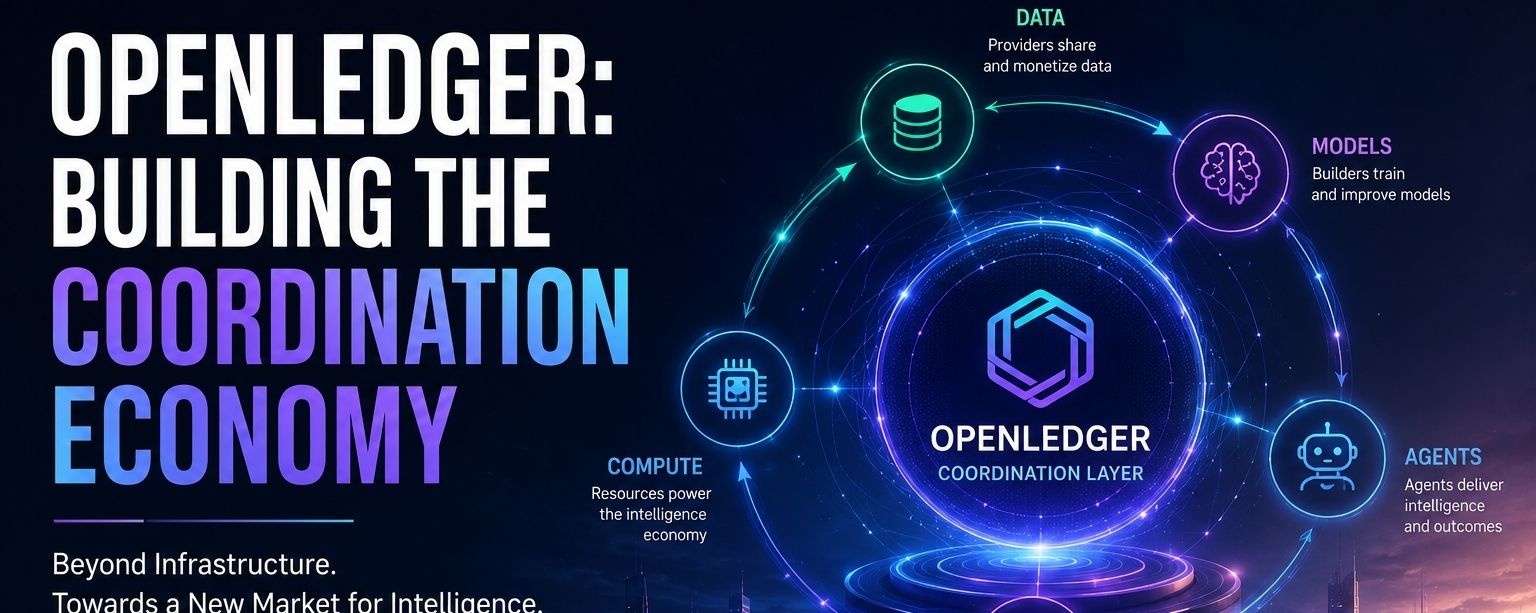
Markets have a habit of flattening complexity into something tradable. When a new technology appears, it rarely gets understood on its own terms. Instead, it gets compressed into familiar metrics throughput, scale, speed, or narrative adjacency. AI becomes about compute. Blockchains become about transactions per second. And anything that sits between the two is quickly labeled as “infrastructure,” as if infrastructure were a solved problem rather than an evolving bottleneck.
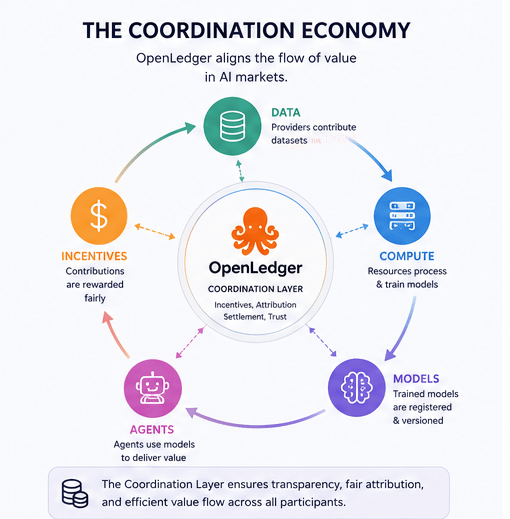
But the history of markets suggests that the real friction rarely lives where people are looking. It hides in the layers that determine how value actually moves, not how fast it can move. One of the least discussed and most stubborn of these layers is coordination. Not just technical coordination, but economic coordination: who gets paid, when, and why.
That’s where the current wave of AI begins to show its cracks. Models can be trained, agents can be deployed, and data can be processed at scale. But the moment multiple actors are involved data providers, model builders, inference layers, agent operators the system starts to resemble less of a pipeline and more of a fragmented marketplace. Each participant contributes something, but there is no native mechanism to coordinate incentives across them. Payments are delayed, attribution is fuzzy, and trust is often externalized.
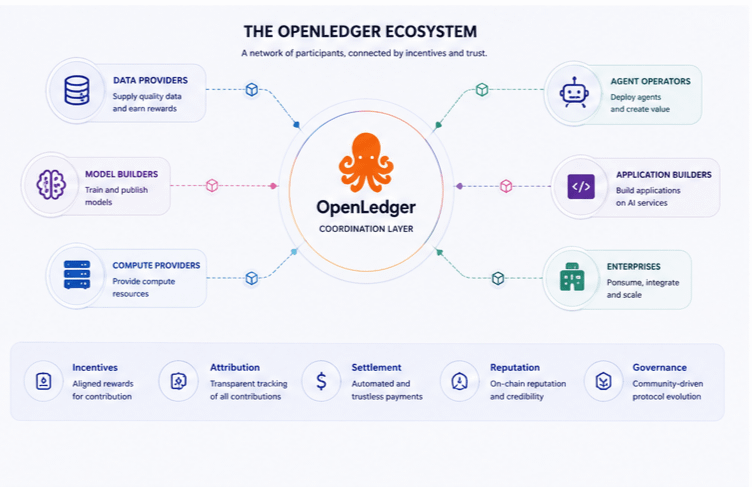
The market tends to describe projects like OpenLedger as “AI blockchains,” a phrase that sounds compelling but says very little. It suggests a fusion of two narratives AI and crypto without addressing the underlying economic tension. What if the point isn’t to make AI faster or cheaper, but to make it economically coherent?
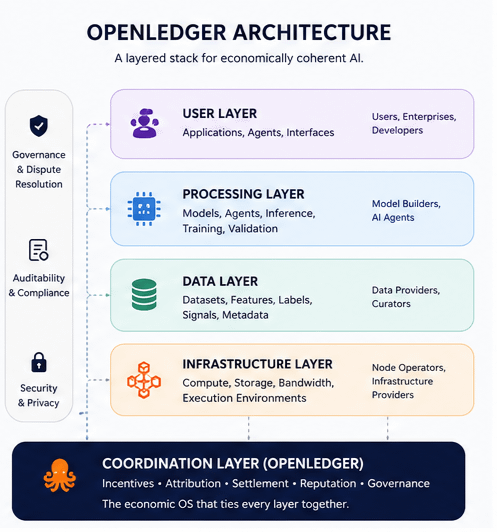
Seen through that lens, OpenLedger starts to look less like infrastructure and more like a coordination layer for fragmented intelligence markets. Not a place where models run, but where relationships between participants are formalized and settled. In traditional markets, this role is often played by clearinghouses or exchanges entities that don’t produce value themselves but make value transferable between others. Without them, liquidity doesn’t scale, no matter how advanced the underlying assets are.
The analogy is closer to advertising than cloud computing. In digital advertising, the real innovation wasn’t just targeting or delivery it was the coordination of multiple stakeholders: advertisers, publishers, exchanges, and data brokers. The system worked not because each piece was efficient, but because the incentives between them were aligned well enough to create continuous flow.
If OpenLedger is attempting something similar for AI, then the token is not simply a utility mechanism for paying fees or accessing services. It may be pricing something more abstract: the legitimacy of coordination itself. A token, in this context, becomes a shared agreement about how value is distributed across participants who don’t fully trust each other. It represents a neutral layer where contributions can be measured, disputes can be resolved, and incentives can be enforced.
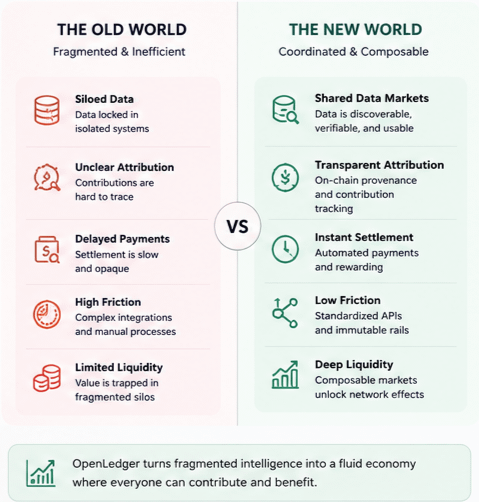
This framing shifts the question from “what can the token do?” to “what economic relationships does the token make possible?” That’s a more difficult question, and one that doesn’t resolve neatly into standard valuation models. If the network fails to attract meaningful coordination real data providers, credible model builders, and agents that generate actual demand then the token risks becoming a placeholder for activity that never materializes.
From an enterprise perspective, the challenge becomes even sharper. Coordination is not just a technical problem; it’s a governance and compliance problem. Enterprises care about auditability, accountability, and predictable incentives. They need to know not just that a model works, but that its outputs can be traced, its inputs verified, and its contributors compensated in a way that aligns with legal and operational constraints. Building a system that satisfies both decentralized participants and institutional requirements is not trivial it’s a balancing act that most networks underestimate.
There’s also the question of behavior. Developers tend to gravitate toward ecosystems where friction is low and rewards are immediate. Coordination layers, by definition, introduce structure, and structure can feel restrictive. If participation requires adherence to complex incentive mechanisms or governance rules, adoption may lag behind more permissive environments, even if those environments are less economically sound in the long run.
This creates a paradox. The very thing OpenLedger might be trying to solve coordinated value flow in AI requires a level of discipline that early-stage ecosystems often resist. And yet, without that discipline, the problem remains unsolved.
So the market may continue to view OpenLedger as just another AI blockchain, another attempt to merge two dominant narratives. But at a deeper level, it may be probing a more uncomfortable question: what does it take to make intelligence itself economically composable?
If that’s the real direction, then success won’t be measured in transactions or throughput, but in whether independent actors begin to trust a shared system to coordinate their incentives without central authority.
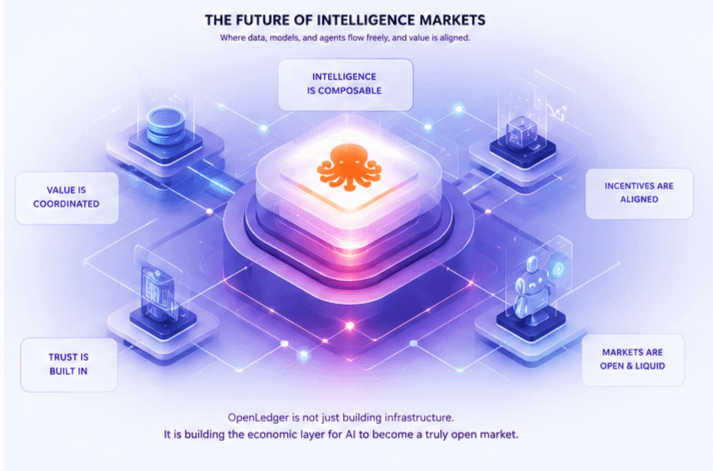
And if that happens, it may not look like infrastructure at all but something closer to a new kind of market.
Sometimes the hardest thing to price is not the asset, but the agreement around it.