
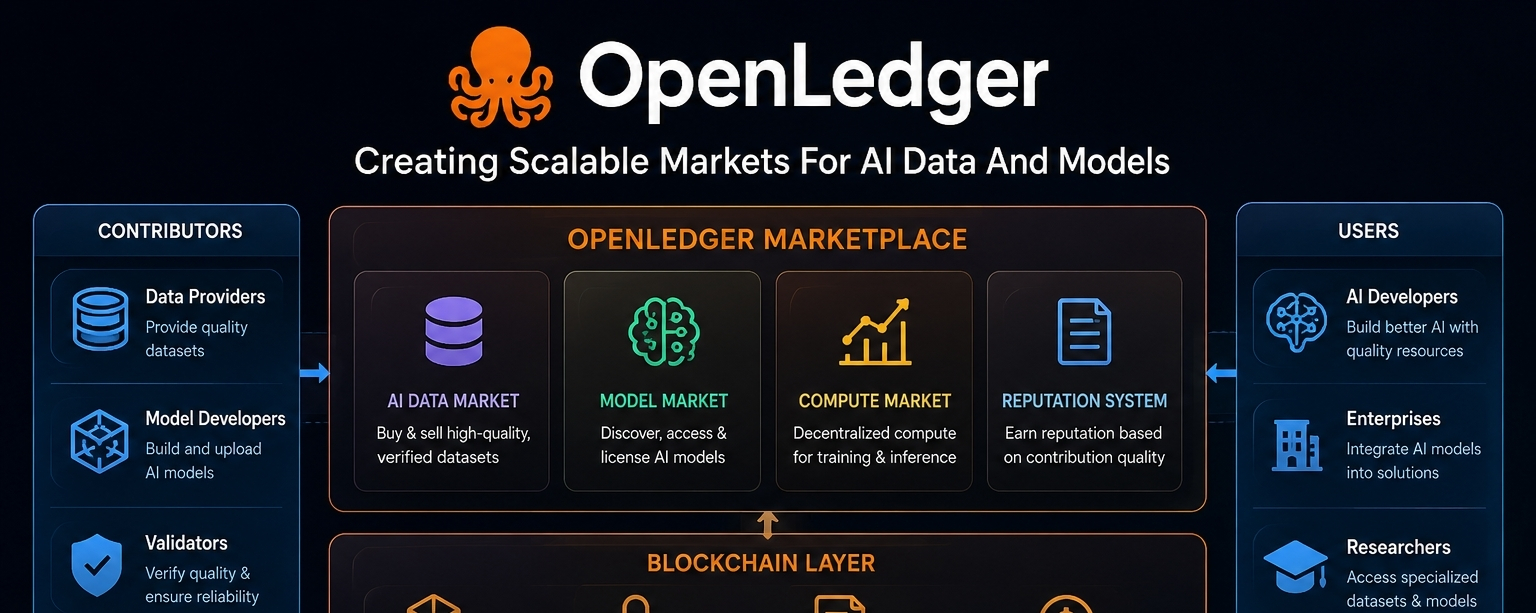

The race to dominate artificial intelligence is no longer only about building smarter models. The real competition is shifting toward access to high quality data decentralized infrastructure and fair economic systems that reward contributors instead of concentrating power in a few corporations. In this evolving landscape OpenLedger is positioning it self as one of the most interesting projects connecting blockchain technology with the future of AI economies.
Most AI systems today depend on centralized companies that control massive datasets computing resources and proprietary models. While these firms have accelerated innovation they have also created a closed environment where smaller developers independent researchers and ordinary users struggle to participate meaningfully. The value generated by AI often flows upward to large corporations while the individuals contributing data feedback and knowledge rarely receive fair compensation. OpenLedger is attempting to challenge this imbalance by creating scalable markets where AI data and models can become tradable verifiable and economically rewarding digital assets.
The idea behind OpenLedger is built around a simple but powerful observation. Artificial intelligence cannot improve without continuous streams of fresh specialized and reliable data. At the same time the world is producing enormous amounts of information every second through businesses creators communities and digital interactions. Yet much of this valuable information remains fragmented inaccessible or monetized unfairly. OpenLedger aims to bridge this gap by creating an ecosystem where contributors can provide AI ready data sets and receive rewards directly through decentralized infrastructure.
This approach introduces a new economic model for artificial intelligence. Instead of relying solely on giant tech firms to own and manage the AI pipeline OpenLedger opens participation to a global network of contributors. Data providers model developers validators and users can all become active participants in the ecosystem. This structure transforms AI from a closed corporate system into a collaborative market place powered by blockchain transparency.
One of the biggest problems in the AI industry today is data quality. Many machine learning models suffer because the information used to train them is out dated biased duplicated or poorly labeled. OpenLedger addresses this issue by emphasizing verifiable and incentive driven data contributions. Contributors are encouraged to provide higher quality datasets because rewards are linked to use fulness and reliability. This creates a feedback loop where better data leads to better models and better models generate stronger demand inside the market place.
Another major advantage of OpenLedger is scalability. Traditional AI infrastructure often struggles with growing computational demands and centralized bottlenecks. OpenLedger introduces decentralized coordination mechanisms that can distribute work loads across a wider network. By doing this the project aims to support a more scalable ecosystem capable of handling increasing AI demand without depending entirely on centralized cloud providers.
The importance of scalable AI markets becomes even clearer when considering the future of AI specialization. General purpose models are powerful but industries increasingly need domain specific intelligence trained on niche data sets. Healthcare finance cyber security gaming education, and logistics all require tailored AI systems with unique knowledge bases. OpenLedger market place model allows specialized data providers to monetize highly targeted information while enabling developers to access the precise resources needed to build advanced sector specific models.
This creates opportunities that extend beyond technology companies. Independent experts researchers and even small communities could eventually participate in AI economies without needing billion dollar infrastructure. A medical research group for example could contribute anonymized datasets for specialized diagnostics models. A gaming community could help train advanced NPC behavior systems. Financial analysts could provide structured market intelligence for predictive models. OpenLedger's frame work turns these contributions into economically valuable assets rather than invisible labor.
The decentralized nature of the ecosystem also introduces stronger transparency. One of the biggest criticisms surrounding modern AI systems is the lack of accountability regarding training data origins and model development processes. OpenLedger blockchain based structure can potentially improve traceability by recording contributions validations and usage history on chain. This could help establish greater trust in AI systems at a time when concerns around misinformation bias and data misuse continue to grow globally.
Another reason OpenLedger is attracting attention is the timing of its vision. Artificial intelligence and blockchain are increasingly converging into a new technological narrative. Investors developers and institutions are actively searching for projects that combine decentralized infrastructure with AI utility rather than relying purely on speculation. OpenLedger fits into this emerging category by focusing on infrastructure and real economic coordination instead of short term hype cycles.
The project also aligns with the broader movement toward ownership in the digital economy. In the early internet era users generated enormous value for platforms without direct compensation. Social media transformed attention into profits but creators often received only a fraction of the value they helped produce. AI risks repeating the same pattern if centralized companies remain the sole beneficiaries of data driven intelligence systems. OpenLedger attempts to create a more balanced model where contributors retain economic participation in the value chain.
However the path forward is not without challenges. Building scalable decentralized AI infrastructure requires solving difficult technical and economic problems simultaneously. Data verification privacy protection storage efficiency and incentive alignment are all critical issues that must function smoothly for the ecosystem to succeed. Competition is also increasing rapidly as multiple blockchain AI projects enter the market with similar ambitions. OpenLedger will need strong execution active community participation and meaningful adoption to establish long term relevance.
Regulation may also play an important role in shaping the future of decentralized AI markets. Governments worldwide are beginning to introduce policies around data ownership AI accountability and digital asset frame works. Projects operating at the intersection of these sectors must adapt carefully to changing regulatory environments while maintaining decentralization principles. OpenLedger’s ability to navigate this evolving landscape could significantly influence its growth trajectory.
Despite these uncertainties the project reflects a much larger shift happening across the technology industry. Artificial intelligence is evolving from isolated software into a global economic infrastructure layer. Data is becoming one of the most valuable resources in the digital world and systems that can coordinate verify and monetize this resource efficiently may become foundational to the next generation of internet economies.
OpenLedger vision is ultimately about creating an open market place where intelligence itself becomes collaborative and economically accessible. Rather than allowing AI development to remain concentrated in the hands of a few dominant players the project proposes a decentralized alternative where contributors across the world can participate in building and benefiting from intelligent systems.
As AI adoption accelerates globally the demand for scalable data markets and decentralized model ecosystems is likely to grow significantly. Projects capable of connecting blockchain incentives with real AI utility may define the next phase of digital innovation. OpenLedger is positioning itself at the center of this transformation aiming to build an ecosystem where data models and intelligence can move freely across decentralized networks while rewarding the people who help power the future of artificial intelligence.
@OpenLedger #OpenLedger #openledger $OPEN