I kept getting distracted today. Had a tab open for something else entirely, and somehow ended up deep inside OpenLedger's technical documentation for two hours. Happens.
What caught me wasn't the project overview — I'd skimmed that already. It was a small line in the attribution engine update from late January. The team had pushed a technical change ensuring data-to-output links stay intact even as models get fine-tuned and updated over time. On the surface that sounds like routine maintenance. But I stopped and actually thought about what that's describing.
Because here's what I think most people reading about OpenLedger are getting subtly wrong.
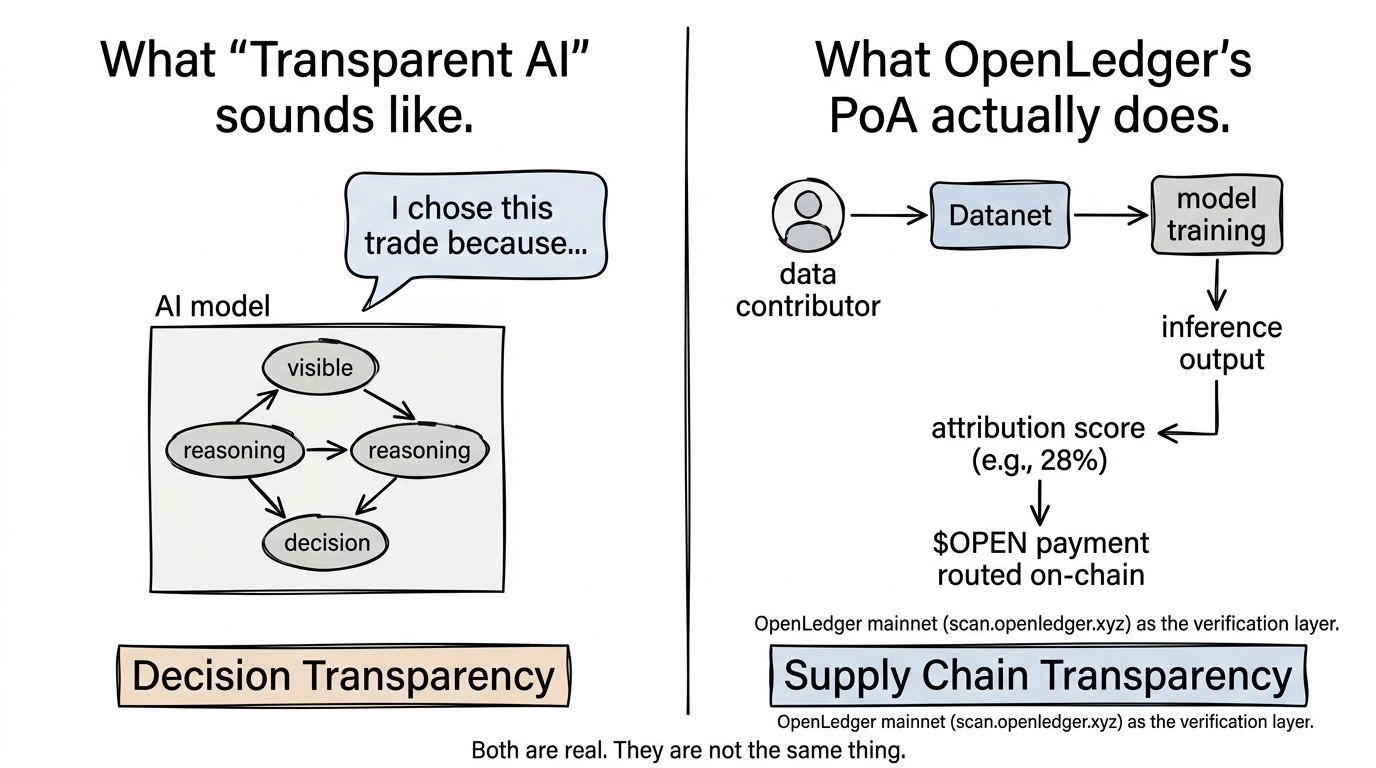
When they say "transparent AI ecosystem" — and they do say it constantly — the market hears: I can see why the model made that decision. You can audit the reasoning. You can inspect the logic. AI becomes legible.
That's not what OpenLedger is building.
What Proof of Attribution actually does is trace which training data influenced a model's output — and by how much. The January update made that trace durable across fine-tuning cycles. So when a model trained on a writer's dataset generates content, PoA computes an influence score, records it on-chain, and routes $OPEN rewards accordingly. Automatic, immutable, proportional. Contributor gets paid. Chain records the lineage. Done.
That's supply chain transparency. It's about who owned what data and whether they got compensated for it. It answers the question: whose work trained this model?
What it doesn't answer is: why did the model say that, or choose that trade, or reject that signal.
Those are completely different things. One is about money. The other is about understanding. And the entire "transparent AI" framing collapses the two into a single pitch that sounds unified but actually isn't.
I thought about this more than I expected to. Because it matters for what happens next.
The Theoriq integration in January — trading agents executing on-chain with every step recorded — is being framed as making AI agents accountable. And technically it is. You can verify a trade occurred at a specific block. You can trace which agent wallet signed it. But the decision tree that led to the trade, the weighting of inputs, the reasoning — that still lives off-chain inside Theoriq's logic. OpenLedger catches the output and stamps it. The thinking happened somewhere else.
So you get a permanent, tamper-proof receipt. You don't get a window.
Now — here's what bothers me. The PoA scoring methodology uses influence function approximations for smaller models, and suffix-array token matching for larger ones. Both are sophisticated mathematical proxies for data influence. They're not direct causal proofs. When a contributor sees "28% attribution" on their dataset, that figure is a model's estimate of statistical contribution — not a clean measurement of cause and effect. The chain records it as fact. The underlying calculation is an approximation.
I'm not saying this breaks anything. The system is still more honest than anything that exists off-chain right now. But "transparent" is doing real work in this pitch, and it's worth being specific about what transparent actually means in each layer.
Here's the honest summary: OpenLedger is building accountability infrastructure for the AI supply chain. Data contributors, model builders, validators — they get verifiable records and automatic payments. That's genuinely useful, and genuinely underbuilt in the broader ecosystem. The OpenFin layer teased in March could push this toward live DeFi agent execution in ways that make $OPEN more than a gas token.
But the version of transparency people tend to imagine — the one where AI reasoning becomes inspectable and legible to ordinary participants — that's a harder problem, and this protocol doesn't claim to solve it. It claims to solve the compensation problem. Which is real. Just narrower than the category name suggests.
Who benefits immediately from this design: data contributors who upload into Datanets and now get a verifiable, on-chain record of how their work propagates through model outputs. That's concrete. That's already working on mainnet.
Who's being promised something bigger: everyone who hears "transparent AI ecosystem" and pictures AI that explains itself. That gap might not matter much if the supply chain use case generates real volume. Or it might matter a lot if the DeFAI trading agent story starts requiring genuine decision-layer transparency to attract institutional capital.
I don't know yet. The team unlock schedule starts in September. Until then, the chain keeps writing receipts.