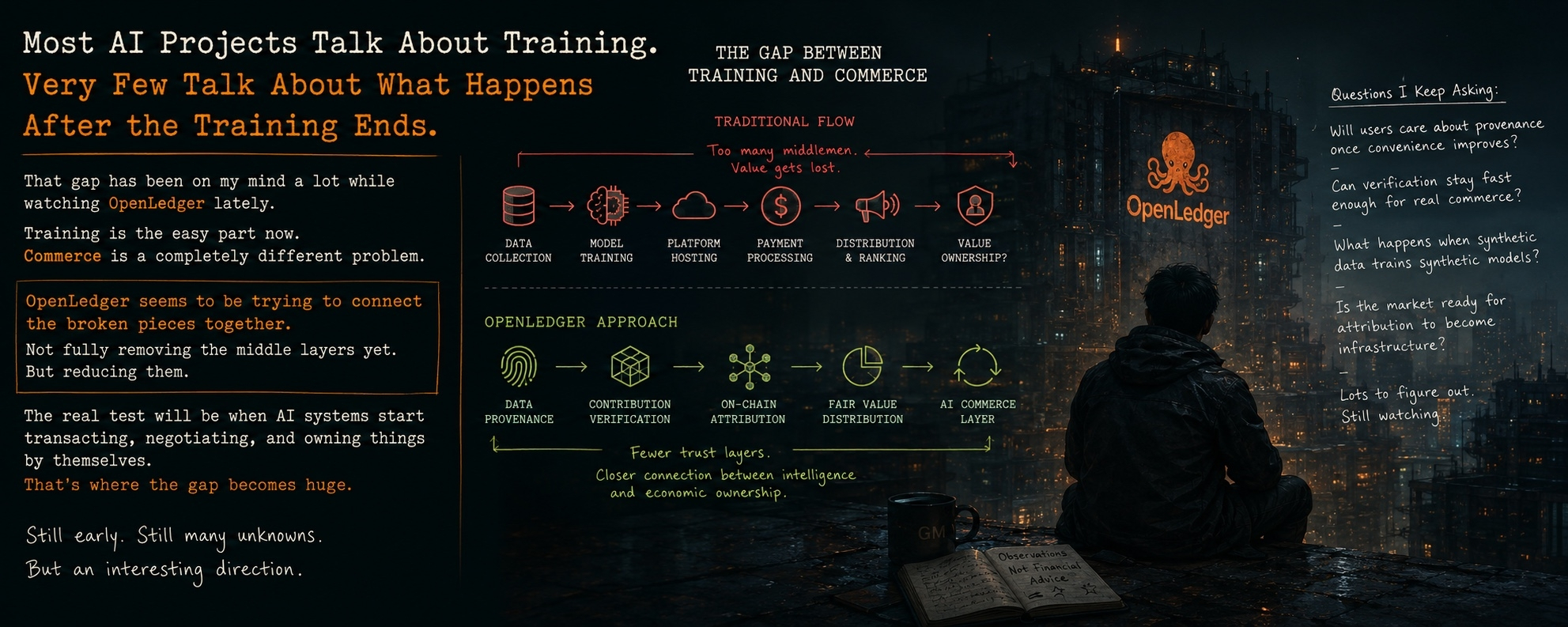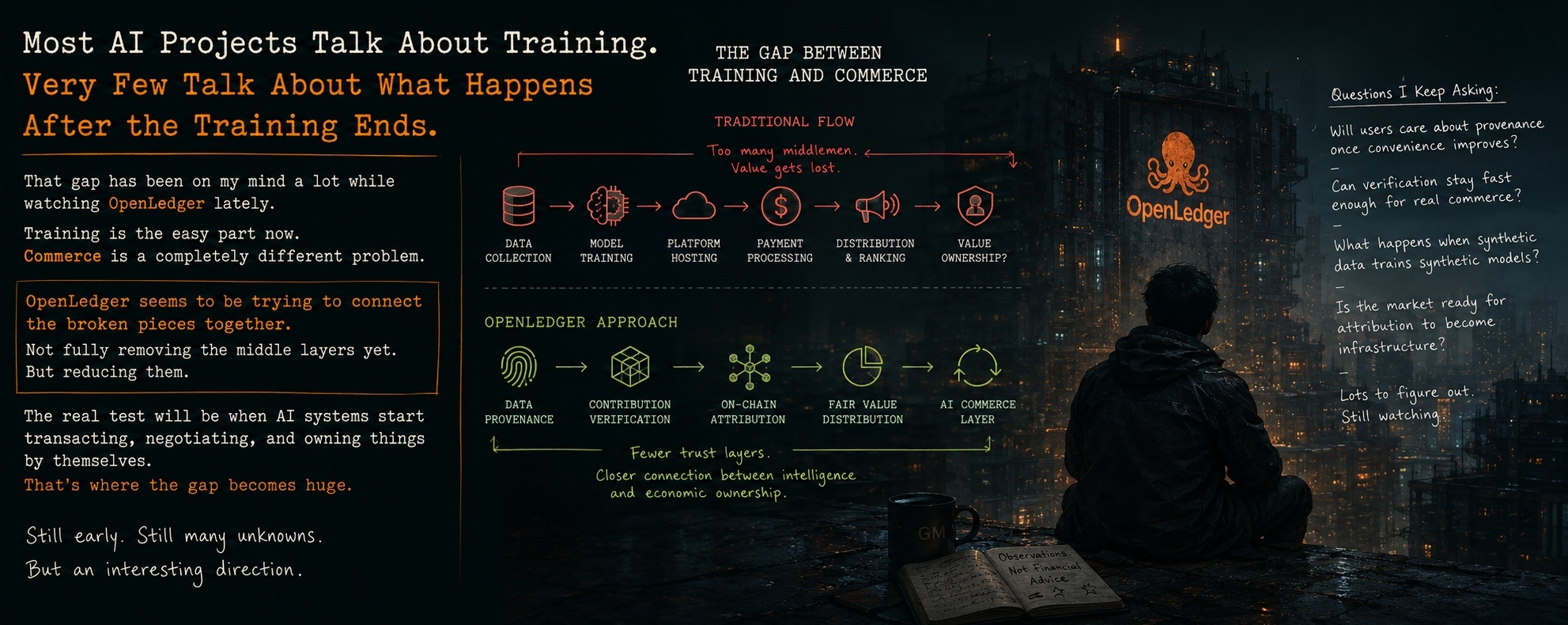
Ai Projects Talk About Training.
Few Talk About What Happens After Training Ends.
That gap has been on my mind while watching OpenLedger.
Honestly training is the part now.
* Data gets collected everywhere.
* Models get trained everywhere.
* People rent GPUs and fine-tune models.
Everyone says they are building "AI infrastructure”.
Commerce is a different problem.
OpenLedger understands better than most projects.
I notice OpenLedger does not focus on the model itself.
It focuses on proving where outputs came from.
It looks at who contributed value.
It checks how rewards move across the system after AI starts operating.
That sounds simple.
In reality it gets fast.
Most AI systems rely on trust hidden somewhere.
* Someone owns the data pipeline.
* Someone controls verification.
* Someone decides what is useful.
OpenLedger tries to reduce that dependency.
It does not remove it fully.
It reduces it.
That difference matters.
If AI commerce becomes machine-to-machine.
I think about how AI systems work.
An AI model generates something.
Another platform hosts it.
Another company processes payments.
Another system ranks visibility.
Another group verifies quality.
Nobody knows who created value.
The commercial layer is disconnected from the training layer.
That creates incentives.
* Data contributors feel underpaid.
* Model builders chase scale, not accuracy.
OpenLedger tries to connect those broken pieces.
It tests whether attribution can become infrastructure.
That is a problem.
Attribution sounds easy until AI systems remix outputs.
Then questions become uncomfortable.
* Who deserves value if a model learned from contributions?
* Who verifies whether data was useful or noise?
OpenLedger seems designed around this problem.
I question some things.
Do users care about where systems come from?
History shows people choose speed and cheap products.
Most people do not inspect systems unless something breaks.
So I wonder if OpenLedger is building for a market.
That risk feels real.
Verification costs are another thing.
Adding attribution layers makes systems heavier.
AI commerce wants speed.
Trust systems slow things down.
Balancing those pressures is difficult.
Many decentralized systems fail here.
Not because the vision is wrong.
Operational friction becomes unbearable.
OpenLedger still feels early.
You see experimentation, not maturity.
Parts of the network discover what users want.
I prefer that.
It reminds me of infrastructure projects.
The unfinished feeling tells you more than branding.
What I watch is whether systems like OpenLedger connect intelligence production with ownership.
If AI becomes autonomous.
Then the gap between training and commerce becomes an infrastructure problem.
Most people talk like AI ends at chatbots.
I do not think it does.
The industry may not be prepared for what happens after.