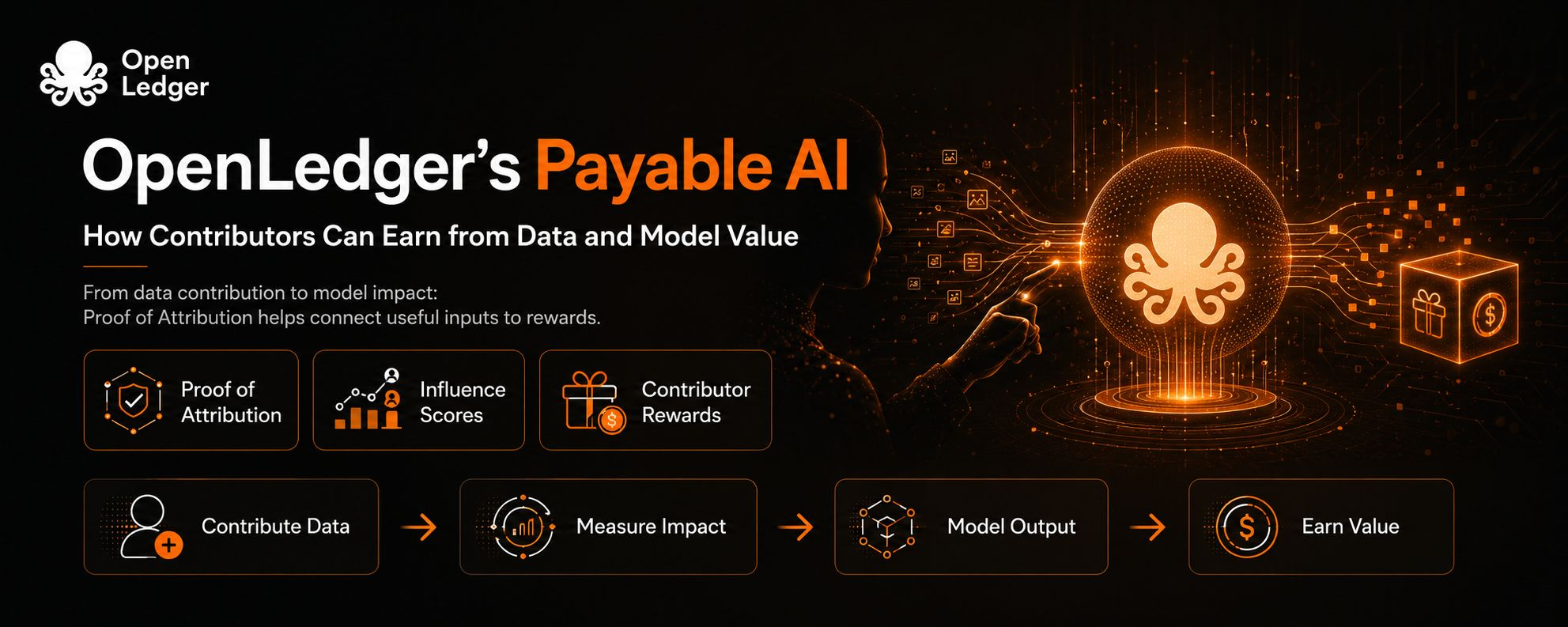

been thinking about OpenLedger’s “Payable AI” idea from the contributor’s side.
not the model founder.
not the app builder.
not the token trader.
the contributor.
because AI has a strange habit of making value look clean after the messy work is already hidden. Someone collects niche data. Someone labels it. Someone improves it. Someone trains or fine-tunes around it. Then the model gives a useful answer, and suddenly all that background labor disappears behind one polished output.
OpenLedger is trying to make that disappearance harder.
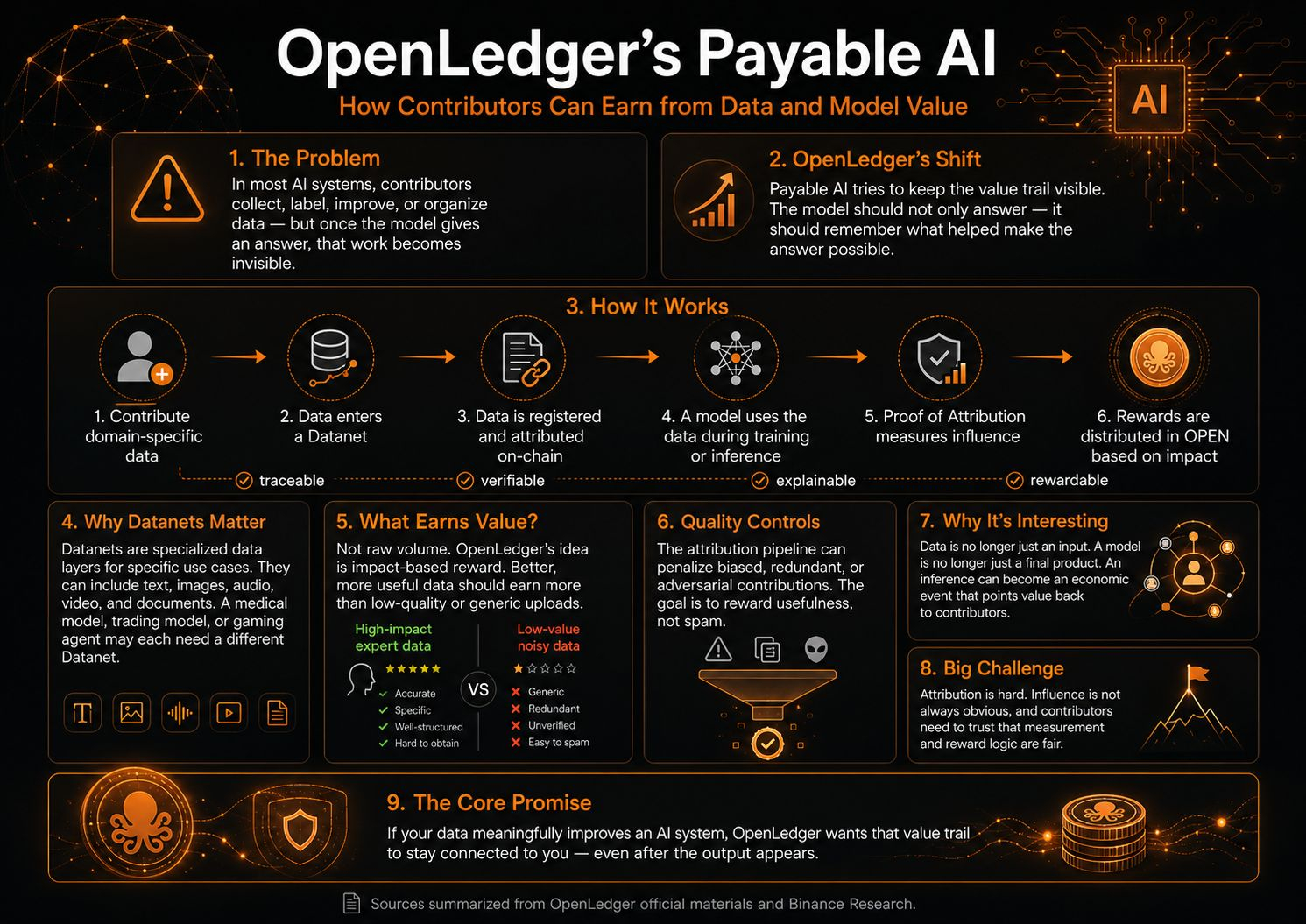
Its own Payable AI explanation says OpenLedger wants AI models that can actually pay contributors, using Proof of Attribution to identify data influence and connect that influence to rewards, price discovery, and explainability. In simple terms, the model should not just produce an answer. It should remember what helped make the answer possible.
that is the important shift.
Most AI systems treat data like a one-way donation. You contribute it, the system absorbs it, and maybe the final model becomes more valuable. But your connection to that value usually ends there. OpenLedger’s version is more active: if your data helps shape model behavior or inference, the system should be able to trace that influence and reward you for it.
The official Proof of Attribution docs describe it as a cryptographic mechanism that links data contributions to AI model outputs, keeps an immutable record, and gives contributors credit and rewards based on the impact of their data.
that sounds small until you think about what it changes.
Data is no longer just an input.
A model is no longer just a final product.
An inference is no longer just an answer.
Each AI output can become an economic event.
That is where Payable AI gets interesting. Binance Research says OpenLedger’s Proof of Attribution identifies the data points shaping a model’s output and rewards their contributors. It also notes that OPEN can be distributed to data contributors when their data is identified as influencing model inference.
so the earning path is not supposed to be “upload anything and get paid.”
That would become spam very quickly.
The cleaner idea is impact-based reward. OpenLedger’s data attribution pipeline says contributors submit structured, domain-specific datasets, those datasets are attributed on-chain, influence scores are calculated, and rewards are distributed based on how much the data impacts model outputs. It also mentions penalties for biased, redundant, or adversarial contributions.
that last part matters.
If Payable AI is going to work, it cannot reward volume alone. Otherwise people will flood the system with low-quality data and call it contribution. The real test is whether OpenLedger can separate useful data from noise. A small expert dataset may deserve more value than a huge generic pile of weak inputs.
This is where Datanets fit into the picture. OpenLedger describes Datanets as specialized data layers where contributors, validators, and owners help source domain-specific data across formats like text, images, audio, video, and documents.
I think that structure is important because AI value is rarely general anymore.
A medical model needs different data from a trading model. A gaming agent needs different context from a legal assistant. A DePIN intelligence model needs different signals from a creator-focused model. Payable AI only becomes meaningful when contribution is connected to a specific use case, not thrown into one giant invisible bucket.
my concern though:
attribution is hard.
AI models do not always use data in a neat, obvious way. Sometimes one data point matters directly. Sometimes influence is spread across thousands of examples. Sometimes the reward logic may be technically correct but still feel unfair to contributors. So OpenLedger’s biggest challenge is not just building the reward system. It is making contributors trust the measurement.
Still, the idea is strong.
Payable AI is not just about earning from data once. It is about keeping data economically alive after it enters the model. If your contribution improves an AI system, and that system later creates value, OpenLedger wants that value trail to point back to you.
that is the real promise.
Not passive income from random uploads.
A new kind of AI economy where data, models, and contributors stay connected after the output appears.