
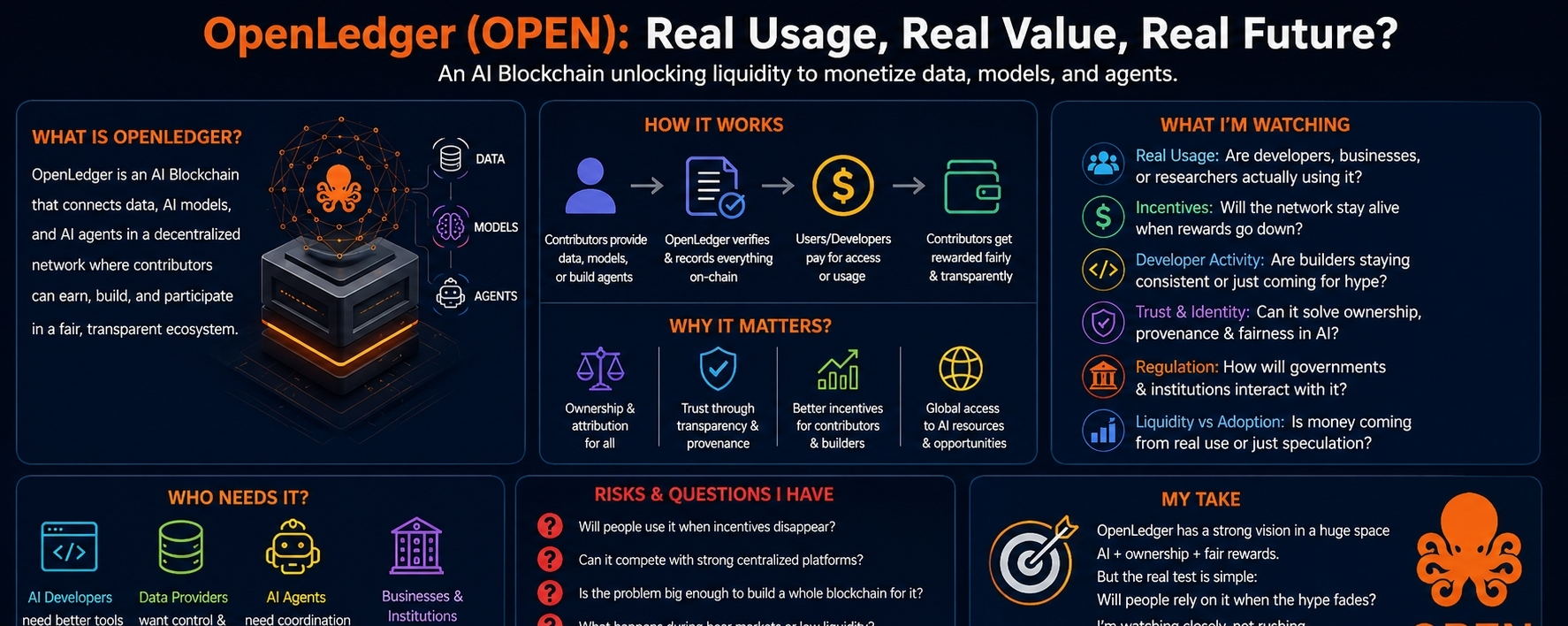
OpenLedger is one of those projects I keep coming back to because I’m trying to understand whether it is building something people will actually need or whether it is simply benefiting from the excitement around AI. I’ve noticed that anything connected to artificial intelligence gets attention quickly, and sometimes that attention moves much faster than real adoption. That is why I try to slow myself down when looking at projects like this. Instead of getting pulled into the bigger story, I prefer asking simple questions. Who is actually using this? Why would someone keep coming back to it? And what keeps the system alive when market excitement becomes quieter?
I started paying more attention to real usage because I’ve learned that good ideas alone are not enough in crypto. OpenLedger talks about creating an AI blockchain where data, models, and AI agents can be monetized, and I understand why that catches attention. Data already has value, AI models are becoming more important every year, and there is clearly a growing discussion around ownership and rewards in this space. But I still find myself wondering whether people genuinely need a blockchain layer for this or if existing systems already solve most of the problem.
I focus a lot on whether a project creates real economic activity because that usually says more than marketing ever can. If OpenLedger wants to become meaningful infrastructure, then there has to be a reason for people to stay involved beyond speculation. Developers need reasons to build. Data contributors need reasons to participate. Businesses or users need clear benefits from using the network. If everyone only shows up because rewards are attractive for a short period, that makes me cautious because crypto has a long history of temporary activity disappearing when incentives become weaker.
I’ve noticed that projects built around infrastructure usually take much longer to prove themselves. People often want instant growth, but real infrastructure becomes valuable slowly. That makes me pay attention to smaller signals. Are developers consistently building? Are tools improving? Is the network becoming easier to use? Is there actual demand forming underneath the surface? These things matter more to me than short-term price movements because prices can rise for many reasons that have nothing to do with long-term usefulness.
I remember when I used to believe decentralization automatically made a project stronger, but now I think it only matters if it solves something practical. OpenLedger is entering a space where centralized companies already dominate. Big technology firms already control powerful AI systems, huge amounts of data, and massive computing resources. Most businesses care about reliability, simplicity, cost, and legal certainty. So I naturally question why someone would choose OpenLedger over a traditional solution unless it offers something genuinely better. Maybe that advantage comes through transparency, ownership, better incentives, or fairer value distribution, but I think that still has to be proven through real usage.
Trust is another thing I keep thinking about when I look at OpenLedger because AI creates many questions around ownership and accountability. Who owns the data that trains models? Who benefits when an AI system becomes valuable? How do people know contributions are being rewarded fairly? If OpenLedger can create a system where participants feel protected and rewarded transparently, then I can understand why it might matter over time. But trust is difficult to build in crypto. It cannot come from promises alone. It comes when people continue using something because it works.
I also think about what happens when market conditions change because that usually reveals the strength of a project. During bullish periods, almost everything looks active because money flows easily and optimism is high. But difficult markets tell the real story. If incentives become smaller, do builders still stay? Do users still participate? Does activity remain steady? I think these are the questions that matter more than excitement because sustainability is usually tested when nobody is paying attention anymore.
I’ve noticed that regulation could eventually play an important role here too. AI is becoming increasingly tied to governments, institutions, and economic policy. Questions around privacy, ownership, copyrights, and accountability are becoming more serious. If OpenLedger wants to position itself around data and AI coordination, it will eventually have to exist in a world where regulations matter. That could create opportunities if institutions look for transparent systems, but it could also create challenges if legal requirements become difficult for decentralized networks to handle.
Liquidity is another thing I quietly watch because I’ve learned not to mistake market activity for real adoption. A token can have strong trading volume without the actual network being deeply useful. I always ask myself where the value is coming from. Are people paying for real services? Are developers building products users need? Or is most activity happening because traders expect future growth? These are very different situations, even when markets temporarily treat them the same.
I stopped rushing toward narratives a while ago because experience made me more patient. OpenLedger is interesting to me because the larger themes around AI, ownership, and digital coordination are becoming more important globally. There is probably real demand in the future for systems that help organize and reward contributions to intelligence and data more fairly. But I still find myself watching carefully instead of rushing to conclusions because long-term success usually comes from usefulness, not excitement.
I’m waiting more than reacting with OpenLedger because I want to see whether this becomes something people genuinely rely on or simply another project that sounded bigger than its actual adoption. I want to understand who truly needs it, what keeps participants involved over time, and whether the network still feels alive when incentives eventually become smaller. That is usually the moment when real projects quietly separate themselves from temporary stories, and I think OpenLedger still has to prove where it belongs.