I keep noticing something strange whenever markets get excited about a new technology cycle.
The first thing people chase is almost never the thing that ends up capturing the deepest value.
Crypto has done this repeatedly.
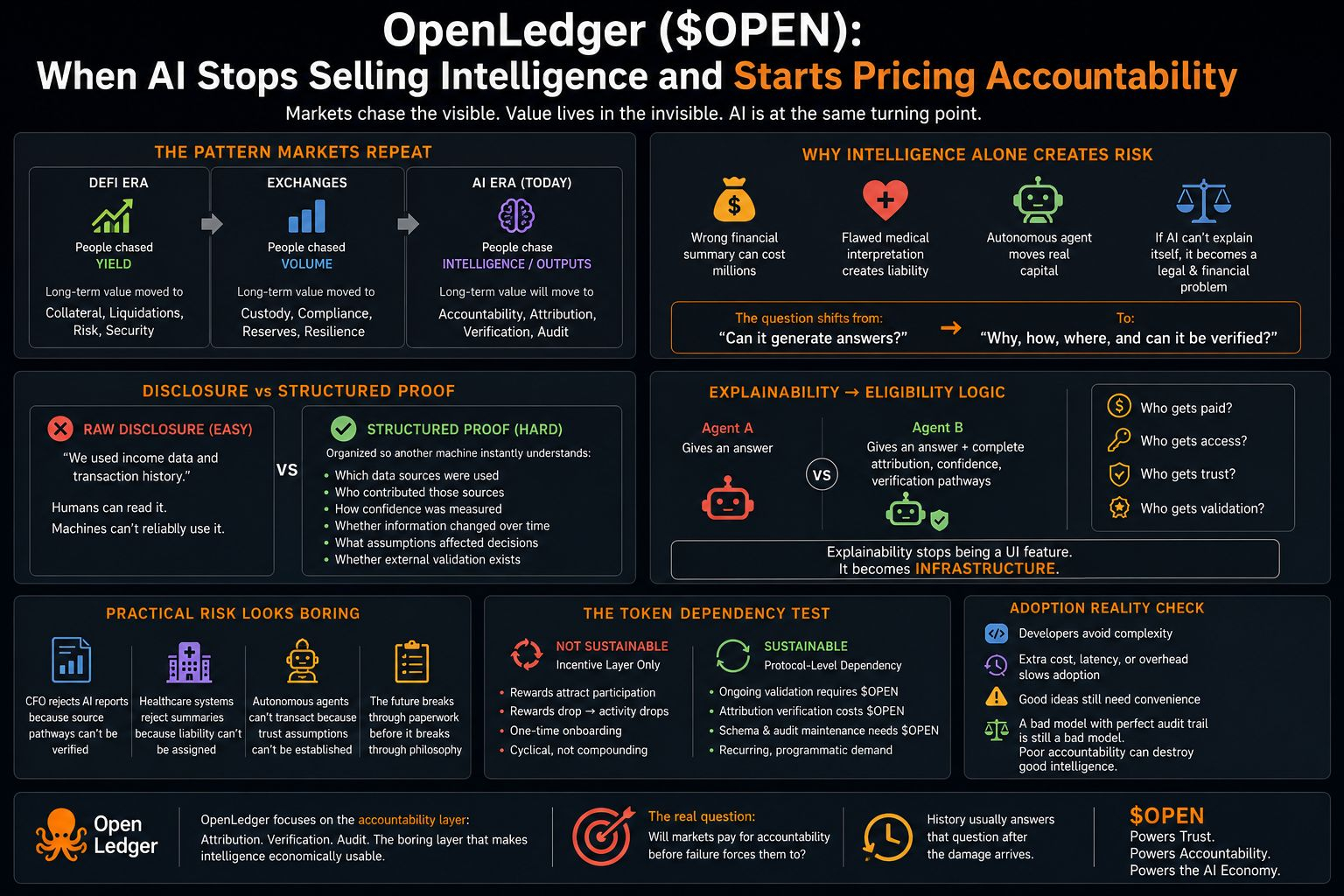
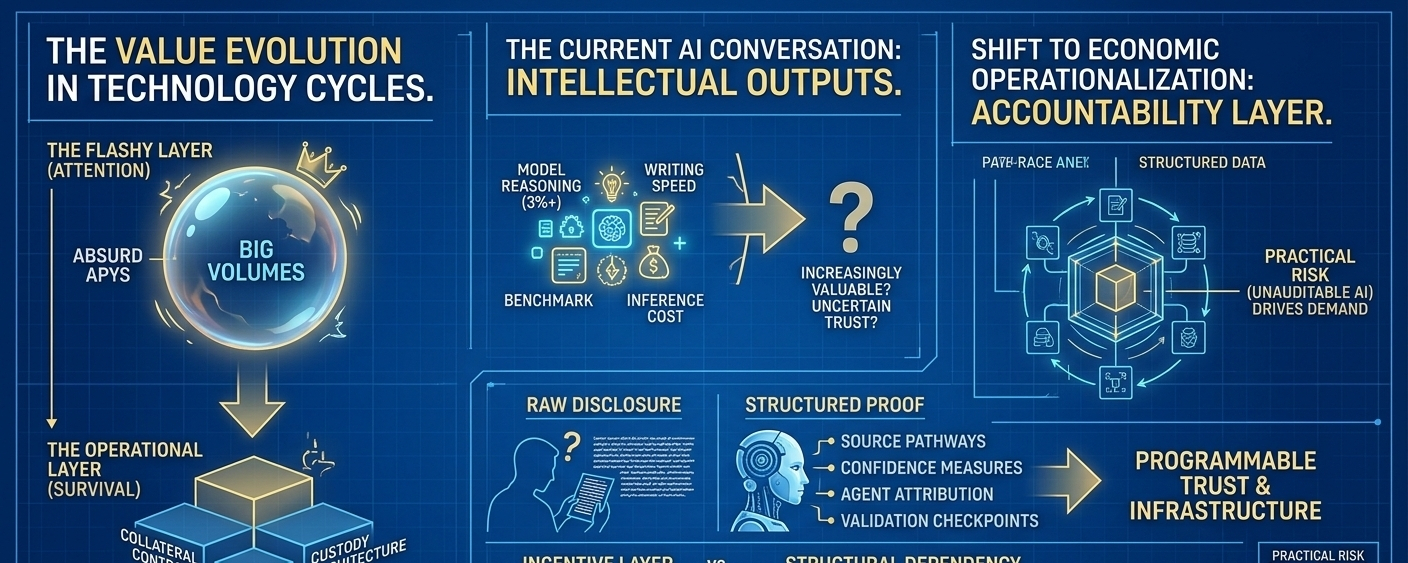
During the early DeFi era, everyone talked about yield. Screens were filled with absurd APYs, liquidity incentives, and token rewards moving faster than anyone could calculate risk. Yield became the product. Or at least people thought it was.
Then reality arrived.
Protocols that survived were not necessarily the ones with the highest returns. The long-term value slowly moved into the quieter systems sitting underneath the visible excitement: collateral controls, liquidation engines, risk management frameworks, security assumptions.
The same thing happened with exchanges.
People initially cared about volume. Bigger numbers looked exciting. More users looked exciting. But eventually markets started caring about custody architecture, compliance systems, reserve transparency, and operational resilience.
The flashy layer gets attention.
The operational layer keeps the lights on.
Now AI feels like it is entering the exact same stage.
The entire conversation today sounds almost identical.
People compare model intelligence.
Which model writes faster?
Which model reasons better?
Which model uses fewer resources?
Which model has lower inference costs?
Which model beats another benchmark by three percentage points?
Every discussion circles around outputs.
Intelligence became the visible product.
Again.
And maybe that is where the market is accidentally looking at the wrong thing.
Because intelligence by itself creates a strange problem.
Outputs become increasingly valuable while becoming increasingly difficult to trust.
That sounds contradictory until you think about where AI is heading.
Today an incorrect movie recommendation is annoying.
Tomorrow an incorrect financial summary could cost millions.
A bad product description creates inconvenience.
A flawed medical interpretation creates liability.
An AI-generated investment decision affects actual capital.
An autonomous agent paying invoices from treasury accounts affects real money.
Once AI begins entering environments where mistakes carry real-world consequences, the conversation changes completely.
Suddenly people stop asking:
"Can it generate answers?"
They begin asking:
"Why did it generate that answer?"
"Where did the information come from?"
"Who contributed the underlying data?"
"Can someone verify the decision pathway?"
"Can another system independently validate the output?"
That shift sounds small.
It is not small.
It changes the entire economic structure surrounding AI.
Because intelligence without accountability becomes difficult to operationalize.
A machine that cannot explain itself eventually becomes a legal and financial problem.
And this is where OpenLedger becomes interesting—not because it promises smarter AI, but because it focuses on a layer most people are barely discussing.
The accountability layer.
The attribution layer.
The audit layer.
The boring layer.
Crypto usually ignores boring infrastructure until the lack of it becomes expensive.
Screenshots travel faster than infrastructure diagrams.
They always have.
But infrastructure tends to capture value after the excitement slows down.
The central idea behind OpenLedger seems to revolve around turning intelligence into something measurable and traceable rather than something simply generated.
That distinction matters.
Because there is a huge difference between showing information and creating structured proof.
People often confuse these concepts.
Raw disclosure is easy.
Structured proof is harder.
Imagine an AI system approving a loan.
Raw disclosure says:
"The model used customer income data and transaction history."
Fine.
Humans can read that sentence.
But another machine cannot reliably use it.
Structured proof works differently.
Instead of merely describing the information, it organizes the information into a format where another machine can immediately understand:
Which data sources were used.
Who contributed those sources.
How confidence was measured.
Whether information changed over time.
What assumptions affected decisions.
Whether external validation exists.
That sounds less exciting than AI intelligence benchmarks.
Yet it may matter much more.
Because once machines start interacting with machines, readability becomes insufficient.
Systems require programmable trust.
A human explanation can create comfort.
A machine-readable explanation creates infrastructure.
There is an important economic difference there.
Think about payment systems.
You do not manually inspect every transaction flowing through banking infrastructure.
You rely on standardized frameworks.
AI eventually reaches the same destination.
Not because people want more documentation.
Because systems eventually become too large and too autonomous for human verification alone.
OpenLedger appears to be positioning itself around that transition.
The argument becomes less about "creating intelligence" and more about making intelligence economically usable.
Because intelligence without traceability creates friction.
And friction quietly kills adoption.
People often imagine AI risk as some dramatic science-fiction scenario.
Machines becoming uncontrollable.
Systems behaving unpredictably.
But practical risk looks much less cinematic.
Practical risk looks like a CFO refusing to approve AI-generated financial reports because nobody can verify source pathways.
Practical risk looks like healthcare systems rejecting automated summaries because liability becomes impossible to assign.
Practical risk looks like autonomous agents unable to transact because nobody can establish trust assumptions.
The future usually breaks through paperwork before it breaks through philosophy.
That is where explainability starts evolving into something larger.
Initially explainability sounds cosmetic.
People imagine dashboards and visualizations.
Something nice for users.
Something optional.
But eventually explainability becomes eligibility logic.
And eligibility logic determines who participates.
Who gets paid.
Who gains access.
Who receives trust.
Who receives validation.
Who enters economic systems.
Imagine two AI agents competing for the same task.
Agent A produces an answer.
Agent B produces an answer with complete attribution history, confidence measurements, and structured verification pathways.
Same intelligence.
Different accountability.
Who receives payment?
Who receives access?
Who receives integration priority?
Suddenly explainability stops being a user interface feature.
It becomes infrastructure.
Markets tend to assign premiums to infrastructure.
Because infrastructure reduces uncertainty.
And uncertainty creates cost.
Still, there are uncomfortable questions that cannot be ignored.
OpenLedger may have a compelling conceptual direction, but conceptual strength alone does not guarantee economic strength.
This is where the token question becomes unavoidable.
Because crypto repeatedly builds useful systems with weak value capture.
A protocol can succeed operationally while the token struggles economically.
People confuse these things constantly.
So the dependency test matters.
Does the OpenLedger network force recurring economic dependence on $OPEN?
Or does $OPEN merely function as a temporary incentive layer?
Those are very different realities.
Temporary rewards create participation.
Dependency creates demand.
Participation is easy to manufacture.
Demand is harder.
If contributors simply receive token rewards for supplying data, models, or AI resources, the mechanism risks becoming cyclical.
People arrive because incentives exist.
Rewards decrease.
Participation declines.
Markets have seen this pattern repeatedly.
Liquidity mining demonstrated it.
Play-to-earn demonstrated it.
Points campaigns demonstrated it.
Incentives can attract activity.
They do not automatically create sustainability.
The stronger question becomes whether ongoing validation, attribution verification, schema maintenance, or agent interactions require repeated token utilization at the protocol level.
Does the network create recurring programmatic demand?
Or does it create one-time onboarding activity?
Because these mechanics determine whether value compounds.
A network forcing continuous verification transactions behaves differently from a network merely distributing rewards.
The distinction matters enormously.
Repeated reliance creates structural pressure.
One-time participation creates temporary movement.
A healthy economic design ideally forces users to repeatedly touch the asset because the network itself requires it.
Not because marketing campaigns require it.
There is also another problem that deserves skepticism.
Developers are not frictionless actors.
People often assume useful infrastructure automatically gets adopted.
History suggests otherwise.
Developers avoid complexity whenever possible.
If integrating explainability frameworks introduces significant cost, additional latency, heavier architecture requirements, or operational overhead, adoption can slow dramatically.
Good ideas do not bypass human inertia.
A technically elegant system still needs practical convenience.
A bad model with a clean audit trail is still a bad model.
Accountability cannot rescue poor intelligence.
But poor accountability can absolutely undermine good intelligence.
That asymmetry matters.
And maybe that becomes the larger philosophical question sitting underneath OpenLedger.
Perhaps AI eventually becomes less about intelligence itself and more about the systems surrounding intelligence.
Because trust rarely emerges from outputs alone.
Trust usually emerges from process.
Markets often price visible products first.
Then they slowly price the hidden systems underneath.
The interesting question is whether AI accountability follows the same path.
Will markets voluntarily pay for explainability, attribution, and verification infrastructure while systems still function reasonably well?
Or will value only appear after an un-auditable AI system eventually fails in a way large enough that nobody can ignore it anymore?
History has a habit of answering those questions after the damage arrives.