
The more I spend time around AI systems, the less interested I become in the surface layer people usually focus on.
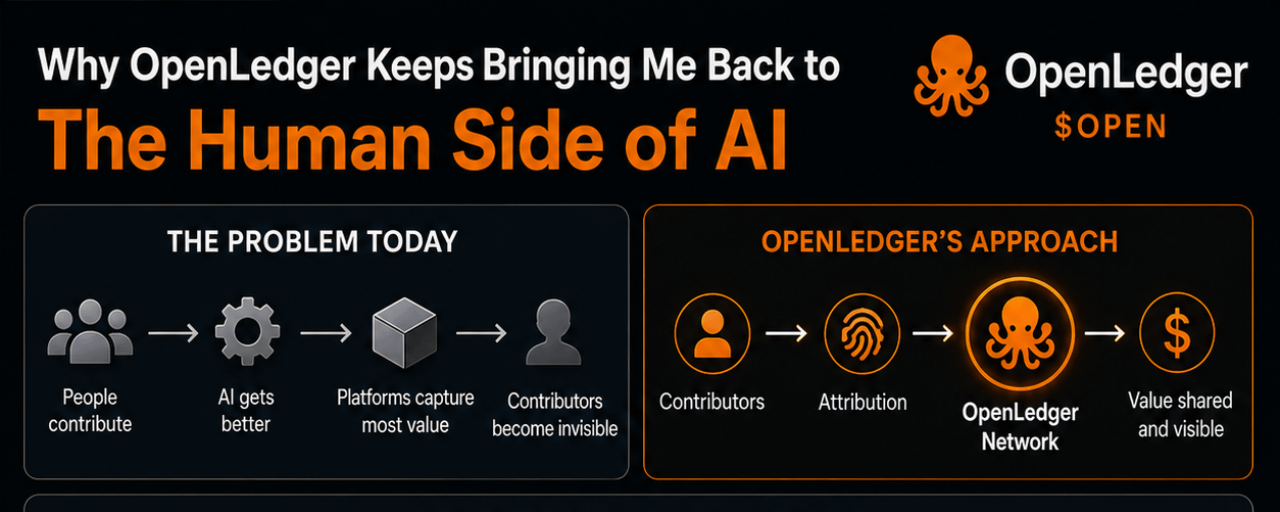
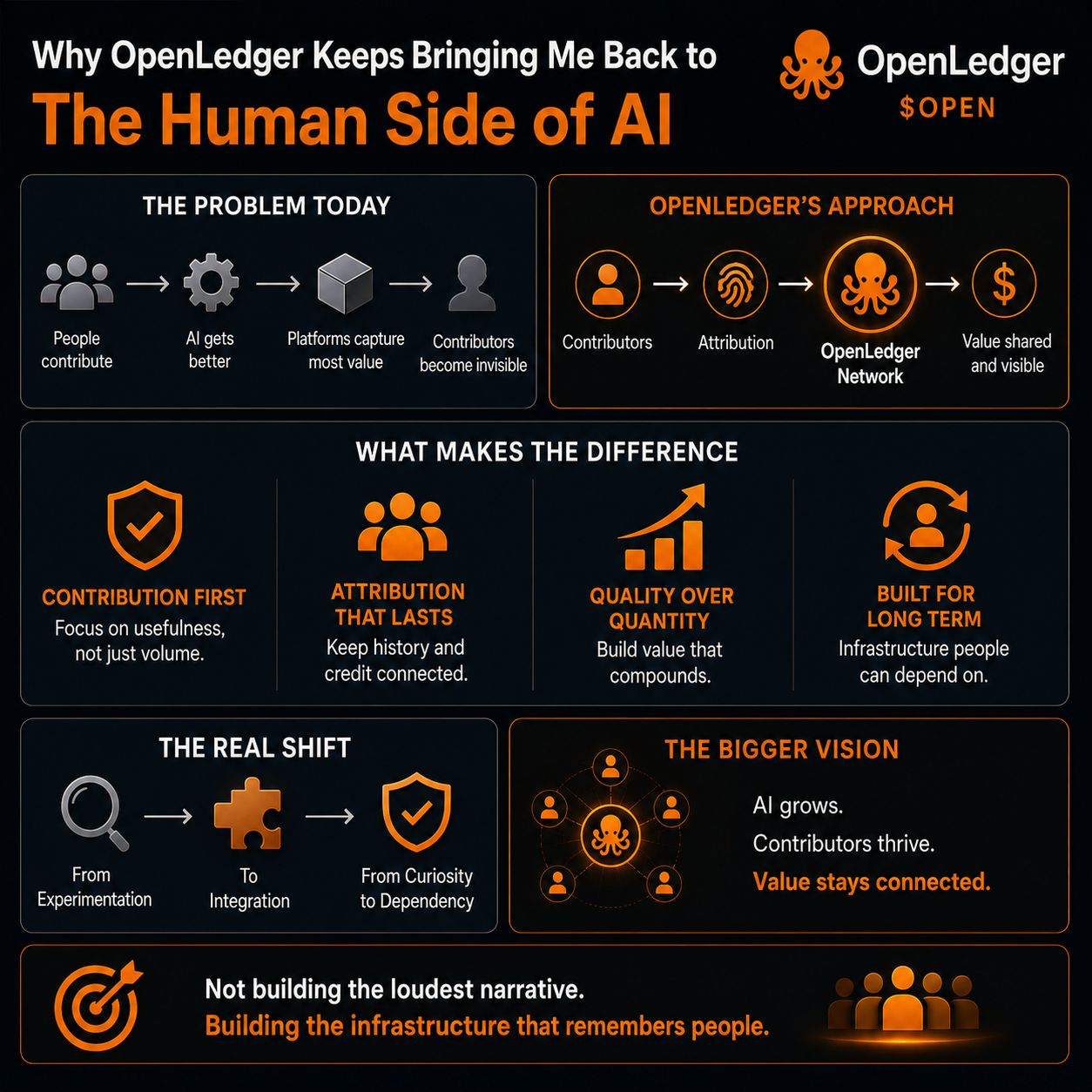
Everyone talks about model quality, automation speed, agent frameworks, or which company is winning the race. But underneath all of that, there is another layer quietly carrying the entire system: human contribution that slowly disappears once the product becomes successful.
That part feels strangely overlooked.
A dataset gets refined by hundreds of people.
Someone spends weeks cleaning noisy inputs.
Someone tests failures nobody else notices.
Someone improves outputs through constant feedback loops.
Then eventually the system becomes polished and the contribution history collapses into a single interface people consume without thinking about how it got there.
The intelligence remains visible.
The contributors do not.
That imbalance is probably why OpenLedger started feeling more interesting to me over time.
Not because the project promises bigger AI infrastructure or louder narratives, but because it seems built around the idea that contribution itself should remain economically and structurally visible inside the network.
And honestly, I think that changes the psychology of the ecosystem more than people realize.
Most digital systems reward visibility at the moment of creation, not persistence afterward. The first builder gets attention. The loudest contributor gets recognition. The platform captures the long-term value. Everyone else slowly fades into the background once the system stabilizes.
OpenLedger appears to be questioning that pattern directly.
The way I understand it, the project is trying to create coordination infrastructure where datasets, models, contributors, and agents remain connected through attribution instead of becoming detached assets floating independently from the people who shaped them.
That sounds simple conceptually.
In practice it becomes extremely difficult once real behavior enters the system.
Because incentives always reshape participation.
Early users in ecosystems like this usually behave exactly how crypto has trained them to behave. People move quickly, optimize rewards aggressively, search for loopholes, and prioritize scale over usefulness because historically those behaviors produced the strongest outcomes.
You can already see those instincts appearing in almost every participation-based network.
More uploads.
More transactions.
More visible activity.
But eventually systems reach a point where quantity stops meaning much by itself.
That’s when the ecosystem either matures or slowly degrades.
And I think OpenLedger understands that transition better than many projects in this category.
What interests me is not the immediate activity around the network, but whether the infrastructure gradually pushes contributors toward usefulness instead of pure extraction. Because over time that changes behavior in subtle but important ways.
People begin organizing data more carefully.
Builders slow down before publishing.
Maintenance becomes valuable work instead of invisible labor.
Contributors start thinking about whether outputs remain useful months later instead of only optimizing for immediate participation.
That shift is easy to miss because it does not create explosive metrics.
But honestly, durable infrastructure rarely looks dramatic while it’s forming.
The difficult part about attribution systems is that everyone agrees with them in theory while very few systems survive them in practice.
If attribution is too weak, contributors feel disconnected from outcomes.
If it becomes too complex, nobody understands how value distribution actually works.
If rewards are completely automated, manipulation expands quickly.
If governance intervenes too heavily, trust becomes inconsistent.
There’s no perfect solution there.
And I think OpenLedger’s restraint around certain areas might actually be intentional because of that tension.
Some parts of the ecosystem feel slower than they could be. Certain layers appear structured with friction instead of removing every obstacle for the sake of growth metrics. At first glance that can seem inefficient in crypto because markets are conditioned to reward speed and constant expansion.
But infrastructure systems that survive long term usually become careful about where they remove friction.
Every shortcut eventually creates downstream consequences.
Especially inside AI ecosystems where low-quality contribution can compound quietly underneath the network over time.
Once noise becomes economically rewarded, reversing the behavior becomes incredibly difficult. Systems start optimizing toward measurable activity instead of meaningful outcomes. Data quality weakens. Reputation becomes performative. Coordination becomes unstable.
You can usually feel when a network crosses into that territory because everything appears active while somehow feeling hollow underneath.
That’s why I keep thinking OpenLedger is actually wrestling with a much more human problem than a technical one.
The real challenge is not simply building AI infrastructure.
It’s designing environments where contribution remains sustainable without turning participation into pure extraction behavior.
And honestly, that’s one of the hardest coordination problems in crypto right now.
There’s another transition happening inside ecosystems like this that people often underestimate: the movement from experimentation into dependency.
At first users join because they are curious.
Later they stay because workflows begin depending on the infrastructure itself.
Those are completely different psychological states.
Curiosity tolerates instability.
Dependency does not.
Once developers start integrating systems deeply, once contributors rely on attribution histories, once models become tied to collaborative workflows, expectations change immediately. Reliability matters more than novelty. Predictability becomes more important than excitement.
That’s where real infrastructure usually begins.
Not when everyone is talking about it loudly.
When people quietly start assuming it will still work tomorrow.
I think that’s also the point where tokens become easier to understand properly.
A lot of crypto still treats tokens mainly as speculative instruments because the industry spent years optimizing around price attention. But in healthier systems, the token eventually becomes more about coordination than hype.
OPEN feels more interesting to me through that lens.
Not simply as an asset, but as a mechanism attempting to connect governance, participation, contribution, and network alignment together over time.
Whether it succeeds is still uncertain obviously.
Attribution at scale is difficult.
AI coordination becomes messy quickly.
Open participation systems naturally create edge cases nobody predicts early enough.
And governance only gets harder once ecosystems become large enough to matter.
But I also think those problems tend to appear precisely when networks begin becoming genuinely useful.
That’s why OpenLedger keeps standing out to me compared to many AI narratives floating around crypto right now.
The project feels less obsessed with creating temporary excitement and more focused on whether contribution can remain traceable long enough for trust and usefulness to compound around it.
That’s a quieter ambition than most people expect from crypto.
But honestly, quieter ambitions are often the ones that survive longer.
Because real infrastructure usually doesn’t win through noise.
It wins when people slowly stop imagining alternatives because the system became dependable enough to integrate naturally into how they already work.
And if OpenLedger keeps moving in that direction, I think the project could eventually become much more important than another short-term AI cycle narrative.
Not because it builds the loudest ecosystem.
Because it remembers that intelligence systems are still built on human contribution underneath everything else.